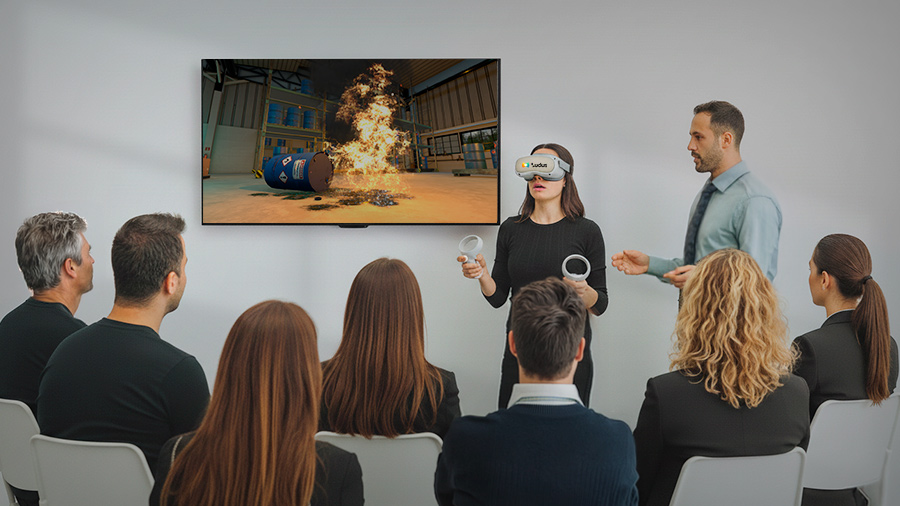
It's the question most HSE managers ask before taking the leap: if we implement virtual reality, what happens to the classroom training we already have? Does it replace it, complement it, or do the two simply coexist without touching each other? The answer matters, because it shapes how the investment is justified to senior leadership and how the change is communicated to trainers.
The real debate: it's not VR against classroom training
Framing virtual reality as an alternative to classroom training is a false premise. These are not opposing methods — they have different strengths that complement each other better than they compete. Classroom training brings relational depth, direct supervision and real-time adaptation that VR doesn't replicate. VR, in return, offers something classroom training cannot: repeatable exposure to real risk scenarios without real consequences, at any scale and at any time.
The right question is not "which is better?" but "what is each one for?"
What the data says: retention, speed and cost
Three variables carry the most weight in any training investment decision:
Knowledge retention
Passive methods — lectures, videos, presentations — generate a retention rate of between 10% and 30% of content one week after training. Virtual reality, by activating procedural memory through first-person experience, raises that figure to 75%, according to research from the University of Maryland. One year after training, learners who trained with VR retain up to 80% of what they learned.
Learning speed
A PwC study (2020) with more than 10,000 participants found that learners trained with virtual reality reach the required level of competence up to 4 times faster than with e-learning and 1.5 times faster than in classroom training. In practical terms: what requires a full day of classroom training can be completed in two hours of simulation with the same or higher retention.
Cost per trained worker
Classroom training carries high variable costs: trainer fees, venue, travel, materials, and in many cases machine or process downtime. VR converts those variable costs into a fixed platform cost. In fire extinguisher simulations alone, users of the Ludus platform avoided more than €521,000 in real extinguisher recharges in 2025 — across more than 20,000 exercises completed that year.
Truths and myths about VR in HSE training
Myth: "VR can't replace real hands-on practice"
Truth: in many cases, it's not trying to — and in some, it goes further. For training with mandatory regulated practical components, VR acts as preparation: the worker arrives at the real practice having already trained the procedure, which reduces the time needed for hands-on sessions and improves execution quality. For other content — CPR with a sensorised manikin, confined spaces, working at height — the simulation is functionally equivalent to real practice, with the added benefit of being repeatable without risk.
Myth: "Workers don't take it seriously"
Truth: the opposite happens. The PwC study found that learners trained with VR show 3.75 times greater emotional engagement with the content than those trained in a classroom. The 97% renewal rate among Ludus clients reflects that once VR is implemented, it isn't abandoned — it's maintained and expanded.
Myth: "It has no legal backing"
Truth: the regulatory landscape is moving in the opposite direction. In April 2026, Italy passed the first European law to explicitly recognise virtual reality as a valid method for the practical component of mandatory HSE training. In Spain, the UK, and across Europe, existing frameworks already establish outcome-based criteria — sufficient, adequate, practical training — that VR fully meets. The full analysis of the European regulatory context is here.
Myth: "It's expensive to implement"
Truth: the cost of not implementing it is higher. According to OSHA, the direct and indirect cost of a serious workplace accident ranges from €30,000 to €150,000. The investment in VR pays for itself with the prevention of a single serious accident. And unlike classroom training, the cost per trained worker decreases with every new user added to the platform.
So what does it replace — and what doesn't it?
The honest answer is this:
- VR does not replace mandatory hands-on practice regulated by sector-specific standards where this can be safely conducted.
- VR does replace the theoretical component delivered via lecture or video, with better retention outcomes.
- VR complements and enhances classroom practice when it acts as preparation — workers arrive better trained and the real practice session is shorter and more effective.
- VR is functionally equivalent to hands-on practice for content such as CPR, fire extinguisher use, confined spaces and working at height, where the simulation faithfully reproduces real conditions.
The question any training manager should ask is not whether VR can replace classroom training. It's which part of their training programme could be more effective, more cost-efficient and better retained if delivered through immersive simulation — and which parts would benefit from workers arriving at hands-on sessions with that groundwork already done.
---------------------------------------------------------------------------
Would you like to implement Ludus' Virtual Reality in your health and safety training?
Fill out this form to receive information about the options best suited to your company's needs.