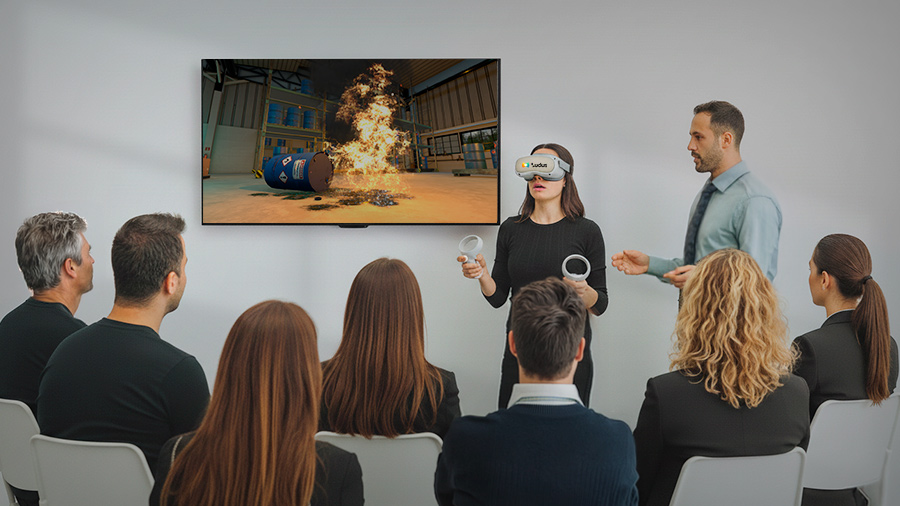
External prevention services cannot always meet the demand for HSE training due to a lack of resources. This results in losing clients and earning less money. In this article, we will explain how virtual reality can help change this by increasing product availability.
Increasing product availability is one of the paths that prevention services can take to earn more money. There are other ways, such as expanding their training offer or increasing profit margins, among others.
If you want to learn more about how prevention services earn more money using virtual reality, you can find out in the following link.
Product availability influences the ability to meet the demand for prevention services
There are some drawbacks that can limit the product availability of prevention services, preventing them from meeting the entire demand:
- Need for travel: Sometimes, trainers have to travel to different locations or countries to provide PRL training. This is common when client companies have multiple branches, for example.
These travels consume time and resources, and they must be taken into account when meeting demand and organizing training sessions. The deadlines for conducting the training increase, reducing the capacity of prevention services to meet demand.
- Urgency of the client's training needs: Sometimes, there are urgent or unforeseen training needs. Having little time to organize the training or mobilize resources can reduce the capacity to respond to these emergencies.
In this case, product availability is limited by that capacity to respond. If outsourced prevention services cannot organize training sessions with very short notice, they will not be able to meet this type of demand.
- Time required to prepare the training sessions: This aspect is closely related to the previous one. In summary, the more time required to organize PRL training, the fewer training sessions can be conducted.
- Necessary arrangements such as equipment or facility rentals: This also affects the time required and costs. Additionally, this aspect can reduce the capacity to respond if it must be done with little notice.
These and other obstacles can cause prevention services to lose money by not meeting the entire demand. That is why it is so important to increase product availability.
Virtual reality to increase the product availability of outsourced prevention services
Virtual reality (VR) recreates realistic scenarios and situations through simulations. By wearing goggles, the user immerses themselves in a virtual environment and interacts firsthand, experiencing sensations while learning.
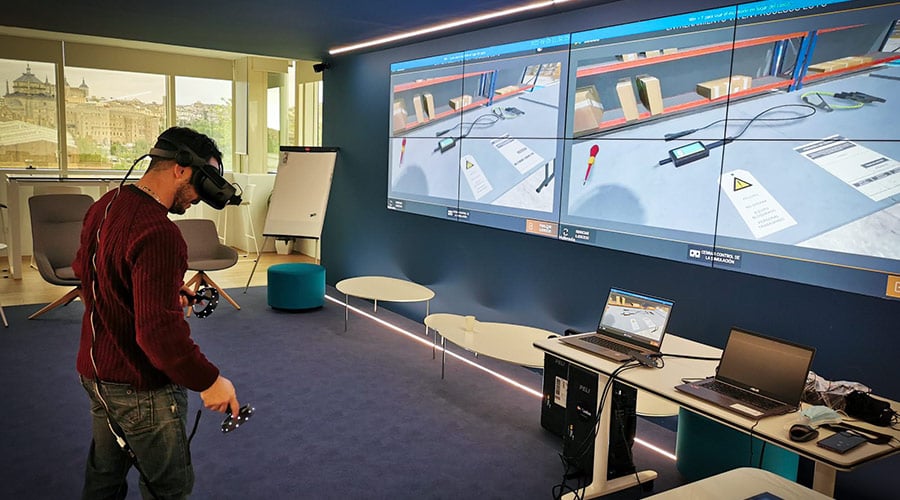
Organizing PRL training sessions with short notice
In PRL training, this technology allows employees to face the risks of their workplace. It is a tool for delivering dynamic and experiential training that enhances the assimilation and retention of knowledge.
An operator can learn about the hazards of their position by visualizing them, and even making mistakes or experiencing virtual accidents. This tool helps enhance the work of trainers and also increases the product availability of prevention services.
Many simulations have a guided mode that directs the student. This makes it easier to prepare the training sessions and allows them to be organized with short notice. The training content is present in the simulation, facilitating the trainer's task of guiding the students.
Remote training or webinars to increase product availability
The remote or webinar format of this technology also increases the product availability of outsourced prevention services. In this modality, the trainer wears the goggles and shares images and sounds through the screen. Employees follow the training remotely and can participate by making decisions for the trainer or answering questions.
The ability to deliver these training sessions remotely shortens the deadlines for training employees in different locations. The trainer (and their VR team) does not have to travel to different branches or countries, making it easier to organize the training sessions. In this way, all employees from different branches receive the same training based on regulatory standards.
All these benefits impact the ability of prevention services to respond to urgent training needs. The time and resource savings translate into an increase in product availability and the capacity to meet demand.
Savings in time and resources for renting equipment or facilities
Sometimes, prevention services or companies have to rent facilities or equipment to conduct PRL training. Virtual reality can save some of these costs when they are not essential for the training.
An example is the rental of fire extinguishers. As we know, there are different types of fires depending on the fuel. Each type of fire requires different types of extinguishers. In addition to teaching students the procedure for extinguishing fires, it is important for them to learn to choose the appropriate extinguisher.
With the fire extinguisher simulation from Ludus, it is not necessary to rent different types of extinguishers for the training. The VR simulation itself includes different types of fires and extinguishing agents to train the student's decision-making.
Furthermore, this technology provides flexibility in terms of the location where the training is conducted. This means that sometimes it is not necessary to rent specific facilities for the training sessions.
The savings in equipment or facility rentals also reduce the time required to organize a training session. It is another way to increase the product availability of prevention services.
Do you know in what other ways VR helps outsourced prevention services earn more money? Find out in this link.