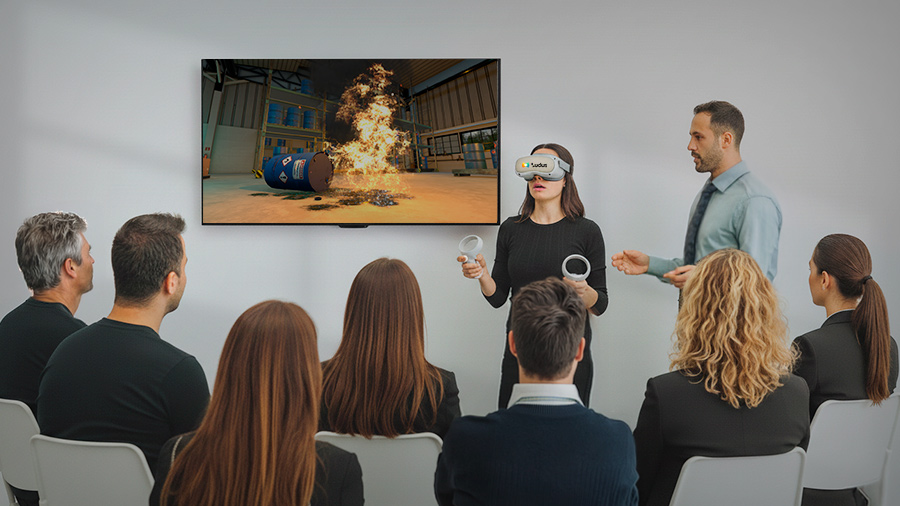
¿Te interesa dar formación de trabajos en altura con realidad virtual?

Quiero utilizar la VR de Ludus

The risk involved in work at height makes it important to use all available tools to prevent accidents. One of these tools is virtual reality, which has recently been introduced to enhance and strengthen fall protection trainings.


The accidents and falls of workers reflect the need to reinforce training for work at height with all available means.

Training for work at height to reduce accidents and falls

According to the Spanish Government, there were 26,115 work-related accidents due to falls from heights in 2022 just in Spain. Out of these falls, 775 were considered serious accidents, more than two per day.

Additionally, there were 75 fatal falls from heights. This means that 75 people lost their lives while performing their work at height. Fall protection training is crucial to try to reduce these figures.

Work-related accidents are a scourge that causes thousands of deaths worldwide every year. Incorporating resources such as virtual reality into training for jobs at heights can make a difference. 

Fall protection training with virtual reality

Virtual reality reproduces real-life environments and situations in simulations, in which the user is completely immersed. By wearing VR goggles, the immersion is complete, and the user experiences realistic sensations while interacting.

Applied to fall protection training, this technology allows living realistic experiences and practicing safety protocols in virtual environments. The trainer places the employee at a virtual work at height, such as a roof, a platform, or a crane, and the employee must protect themselves adequately.

In virtual reality training, workers train their decision-making skills. For example, they must select appropriate personal protective equipment, such as fall protection systems. If they do not use the correct PPE, they may experience an accident first-hand, such as a fall from height.
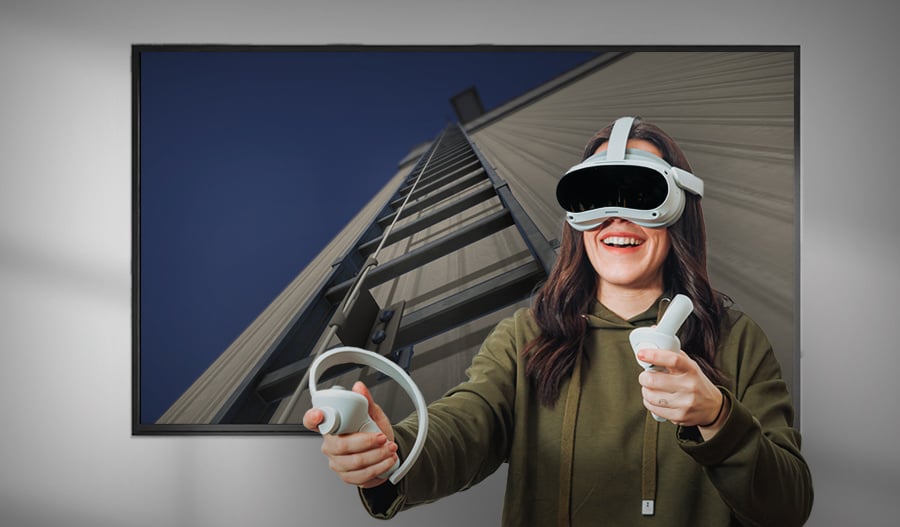
Fall protection training with virtual reality.

This realistic component of virtual reality takes the theoretical part of training for work at height to the next level. The possibility of making mistakes and experiencing virtual accidents enhances knowledge retention and awareness.

In other words, if an employee sees how choosing the wrong PPE causes a fall, they will be less likely to make the same mistake. This allows the practical part of the fall protection training to be developed effectively and raises employees' awareness of the dangers.

In addition to raising workers' awareness, the realism of the simulations helps to detect if they suffer from problems such as acrophobia or fear of heights. Detecting these types of variables before sending an employee to work at height can protect their life.

There are other benefits of using Ludus' virtual reality platform for providing training for jobs at heights. Ludus' simulation collects useful data on usage and performance to determine if employees have mastered the training content.

Are you interested in incorporating virtual reality into your training for jobs at heights or using other simulations from our catalog? Contact us for more information.


Side-by-side Ludus and Pixaera VR safety training platform dashboards compared
Ludus vs Pixaera: Which VR Safety Training Platform Wins in 2026? [Verified Comparison]
Ludus and Pixaera are both VR-native safety training platforms, but they serve different buyers. Ludus (HQ Bilbao, Spain; LATAM office
Side-by-side dashboard view of 11 safety training software platforms ranked for 2026
Best Safety Training Software 2026: 11 Platforms Compared [Verified Pricing & Features]
The best safety training software in 2026 is the platform that matches your hazard profile, workforce size and language requirements — not
How to Get Employees on Board with VR Safety Training
You have the headsets. You have the platform. You have the modules ready. In most cases, workers get on board quickly — the novelty and
VR Safety Training
VR Safety Training: What It Is, How It Works & Why It’s Replacing Classroom Training
VR safety training is the use of immersive virtual reality simulations to teach workplace safety skills in realistic, hands-on scenarios
This is how occupational health and safety trainers learn to use virtual reality
The Ludus virtual reality simulations have the mission to complement the PRL trainings, giving more options to the trainer to transmit his
How to Implement Ludus' Virtual Reality in Your Occupational Safety and Health Training
More and more companies are benefiting from using virtual reality technology in their risk prevention training. Ludus' mission is to
VR vs Classroom HSE Training: Truths and Myths
It's the question most HSE managers ask before taking the leap: if we implement virtual reality, what happens to the classroom training we
Workplace Safety Law and VR: Italy Leads a Regulatory Shift Across Europe
On 7 April 2026, Italy's Law No. 34/2026 — the Annual Law for Small and Medium Enterprises — came into force. Among its provisions, it
Mixed reality: training with virtual risks in real workplaces
Can you imagine placing a worker in front of a fire or other emergency in their workplace to train them? Thanks to technologies such as
Why UK HSE managers are shifting to immersive learning for compliance
Health, Safety and Environment (HSE) managers across the UK are under increasing pressure to ensure compliance with evolving regulations
Workplace safety diagnosis with Virtual Reality: detect accidents before they happen
According to the International Labour Organization (ILO), approximately 2.6 million deaths occur each year due to work-related causes. One
Virtual Reality for risk prevention in logistic warehouses
Working in a logistic warehouse involves potentially serious risks to the health and safety of operators. Training in health and safety,
Electrical hazards and workplace electrocutions
Electrical hazards and workplace electrocutions: how to prevent them
What is the electrical hazard? Electrical hazard refers to a workplace situation where a worker risks coming into contact with electrical
Learners forget to call emergency services in 58% of the Virtual Reality CPR Courses
Learners forget to call emergency services in 58% of the Virtual Reality CPR courses
In performing cardiopulmonary resuscitation (CPR), rhythm and depth of compressions are crucial, but so is the full protocol. One essential
Virtual Reality for Conducting Periodic and Refresher Safety Training
Occupational safety training (HSE) is essential to prevent accidents and should be conducted periodically to keep employees trained and
Virtual reality to train CPR in hospitales
Healthcare professionals must know and master emergency procedures such as cardiopulmonary resuscitation (CPR). Additionally, it's
Virtual finger amputations in 50% of Hand Injury Prevention courses with VR
What is the probability of serious accidents occurring in a company? The statistics from Ludus' virtual reality training platform provide
Errors when tackling fires in 49% of VR
One of the advantages of using virtual reality for fire extinguisher training is its ability to collect objective information. Nearly half
Ludus: The VR training tool that enables an actual culture of safety
According to OSHA, Safety culture is an environment where the attitudes, behaviors and perceptions of all workers are reflected in the
Virtual Reality in Prevention to Avoid Human Errors
Virtual Reality (VR) is already being used to enhance occupational safety and health training. The use of this technology in prevention