How to perform CPR
- Make sure the victim is in a safe environment and check for consciousness.
- Check that the victim is not breathing.
- Call 911 and follow instructions.
- Perform CPR chestcompressions at a rate of 100-120 per minute.
- Continue until emergency services arrive.
CPR is an emergency procedure that helps keep the heart beating in a victim of cardiorespiratory arrest. This can be decisive in saving his or her life by preventing irreparable damage before the arrival of emergency services.
Throughout history, resuscitation has evolved into the CPR maneuver we know today. From blowing air into the mouth with a bellows to 'tobacco enemas', the history of CPR has come a long way.
In this article we will explain how to perform CPR, step by step.
The steps prior to performing the CPR maneuver
Before starting CPR, you must be sure that you are dealing with a victim of cardiorespiratory arrest. There are a number of things to consider and steps to take before beginning CPR:
- Make sure the victim is in a safe environment, avoiding moving the victim unless he or she is not.
- Check for consciousness. A common method is to shake the person's arm, asking if he or she is okay.
- Check the victim's breathing. You will apply the forehead-chin maneuver to open his airway, and bring your ear close to his mouth. If the victim is breathing, you should be able to feel his breath or see his chest rise slightly.
- After verifying that the victim is not breathing, you should call 911 without wasting a second and prepare to perform CPR.
How to perform CPR, step by step
1. Check the victim's consciousness and respiration
As we have explained, when you see a person on the ground you must perform these checks. If you discover that the victim is unconscious and not breathing, his life is in serious danger. This is when you should start the CPR protocol.
2. Call emergency services
This is a vitally important first step. CPR will allow you to keep the victim with a chance of survival, but it is essential that emergency services arrive to assist the victim.
In addition, this call will put you in contact with healthcare professionals who know what needs to be done at any given moment. Communicating with them will help you to learn what to do during the CPR maneuver.
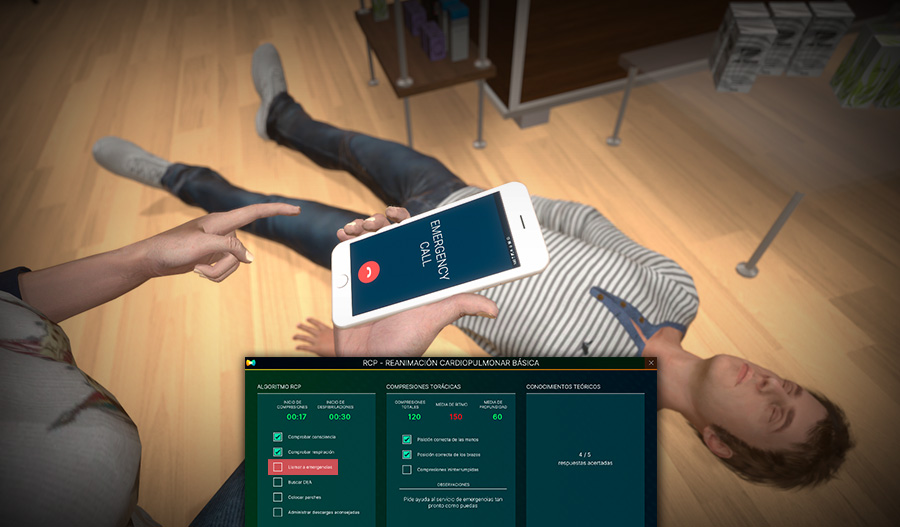
It is very important to emphasize this point in CPR maneuver courses. In training courses carried out with virtual reality technology, it has been observed that not calling the emergency services is the most common error. In approximately 70% of these courses, students fail to call the emergency services.
3. Performing CPR compressions
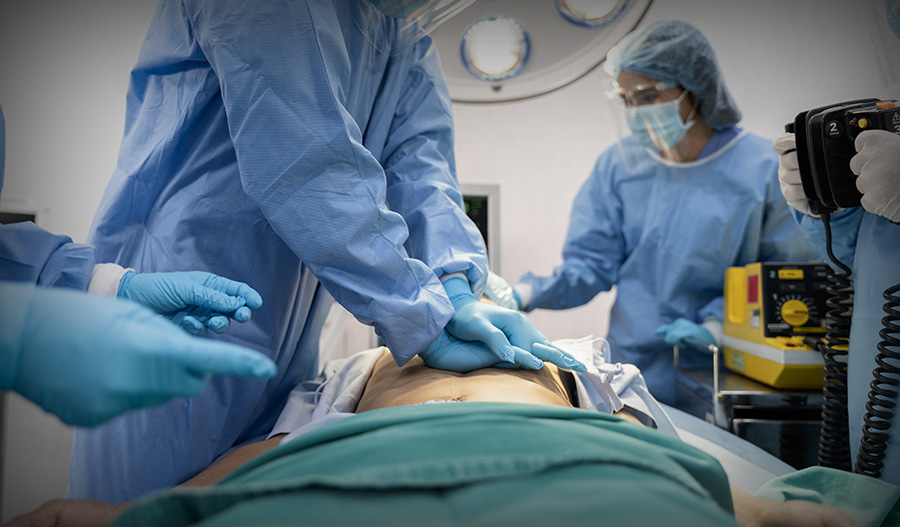
Place the victim on his or her back on a firm surface and kneel beside him or her. Place the bottom of your palm on the center of the victim's chest and place your other hand on top of the victim's chest.
Keep your arms straight and vertical, so that your shoulders are positioned vertically above your hands. This will help you use your weight to do the compressions, and less strain on your arms. Begin CPR by compressing the victim's chest to help maintain circulation.
4. Maintain compressions at a steady rate of 100-120 per minute.
The rate of compressions is a very important factor in CPR. There are several tricks to help remember and maintain a steady rhythm when performing compressions, such as music. Stayin' alive, La Macarena... Here are 5 CPR songs to help you keep the right rhythm:
New technologies make it possible to evaluate and practice this kind of aspects in CPR courses. There are now tools such as virtual reality, which offers an assessment of the rate and depth of compressions. This helps trainees train their muscle memory based on real-time feedback.
5. Continue the CPR maneuver until the arrival of the emergency services.
Emergency services have equipment to transport the victim to the hospital, where it is easier to stabilize and resuscitate the victim. Your job with CPR is to give that person a chance to be saved by keeping his or her heart moving.
The importance of mass training in CPR maneuvers
According to the Spanish Cardiopulmonary Resuscitation Council, 80% of cardiorespiratory arrests occur at home. This means that most of the time there is no health care provider nearby to attend to a victim, and immediate reaction is essential. Every second counts, which is why we should all know the CPR maneuver.
To this end, the way forward is to make CPR maneuver training widespread among the population. However, there are barriers that make it difficult for this to happen, such as the lack of confidence or the lack of realism in CPR courses.
Tools such as virtual reality (VR) can help to change this reality, overcoming the barriers to CPR training. This technology makes it possible to provide realistic and immersive training, where students learn to perform CPR maneuvers in stressful contexts.
A recent study by the Institut Català de la Salut (ICS), published in the journal BMC Medical Education, supports the use of this tool. According to this entity, the use of virtual reality in training increases the knowledge acquired in basic life support procedures, achieving "significant differences".
---------------------------------------------------------------------------
Would you like to implement Ludus' Virtual Reality in your health and safety training?
Fill out this form to receive information about the options best suited to your company's needs.