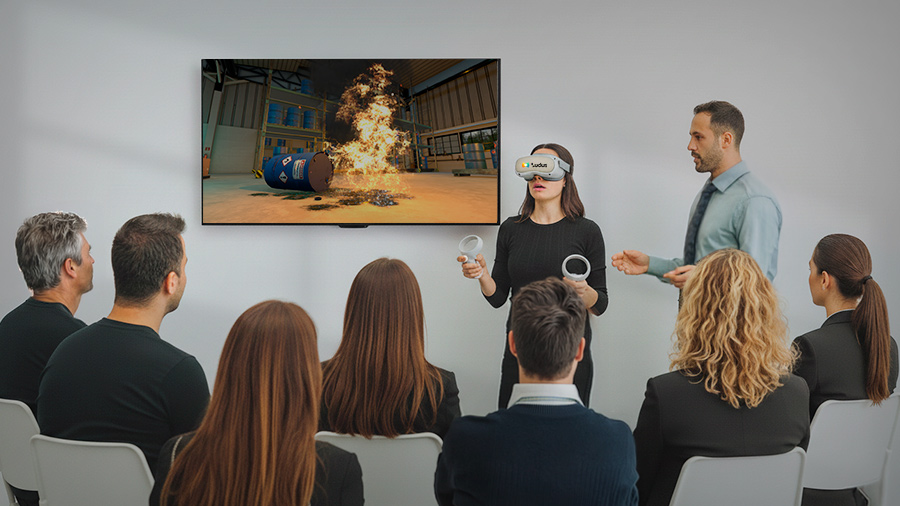
On 7 April 2026, Italy's Law No. 34/2026 — the Annual Law for Small and Medium Enterprises — came into force. Among its provisions, it amends Article 37 of Legislative Decree 81/2008, Italy's core occupational health and safety legislation, recognising, amongst other things, virtual reality and simulation technologies as valid methods for delivering the practical component of compulsory OHS training. It is the first time a European law has incorporated this equivalence directly into its occupational safety framework.
What Exactly Changes in Italy: Beyond the Headline
The reform is not generic. The new wording of Article 37.5 of Legislative Decree 81/2008 specifies that training — defined as the practical test for the correct and safe use of equipment, machinery, installations, substances and protective devices, as well as practical training applied to safe working procedures — may also be carried out using simulation technologies in a real or virtual environment.
The nuances matter:
- VR is recognized for the practical component of training: equipment and machinery use, handling of hazardous substances, PPE use, and exercises on emergency procedures including evacuation, fire suppression, working at height, and confined spaces.
- Theoretical safety training continues to be governed by the State-Regions Agreement and is not affected by this change.
- Each training intervention must be recorded in a dedicated register, also in digital format, regardless of the technology used. Traceability remains mandatory.
- The law also establishes that safety training must be delivered during temporary lay-off periods (Italy's equivalent of short-time work schemes), opening the door to VR being used precisely during those windows of reduced productive activity.
In this context, traceability is not a minor requirement. Platforms like Ludus automatically generate digital records for each session: which employee completed it, when, which exercises were performed, and what results were achieved. That information is available to the OHS manager in real time and can be exported to demonstrate regulatory compliance during inspections or audits — exactly as Italy's new law requires.
A European Movement, Not an Isolated Case
Italy isn't moving in isolation. At the European level, the European Commission published its report "Virtual Worlds: How Do They Affect Our Health and Well-Being?" in July 2025, highlighting the growing role of VR in occupational safety and operational efficiency, noting that these platforms enable employees to train for high-risk scenarios safely and effectively. This isn't a statement of intent — it's the political framework underpinning the regulatory changes now arriving across Europe.
Elsewhere on the continent, the trend is visible if less explicit:
- France: The INRS (Institut National de Recherche et de Sécurité) has published best practice guides on VR in safety training for years. OPCOs (sectoral training bodies) fund it as a valid methodology within the formation professionnelle continue framework.
- Germany: The IFA (Institut für Arbeitsschutz der Deutschen Gesetzlichen Unfallversicherung) has published studies on XR in occupational safety and backs pilot programs in construction and the chemical industry, recognizing that VR allows employees to experience hazardous situations without real-world risk.
- United Kingdom: The HSE (Health and Safety Executive), the UK's public authority for workplace health and safety, has published technical guidance on immersive technologies and acknowledges their value for training in risk environments. Regulators are actively working on adapting the existing legal framework to these technologies, which anticipates more explicit regulation in the years ahead.
The common pattern across Europe is that no country opposes VR as a training tool for OHS. What had been missing was someone putting in writing what was already working in practice in many contexts. Italy just did that.
Spain: The Right Year to Take the Next Step
In Spain, 2026 is not an ordinary year for occupational safety. The Spanish Government has declared 2026 the Year of Occupational Health and Safety, an initiative approved by the Council of Ministers linked to the 30th anniversary of Law 31/1995. The sector itself acknowledges that law needs to evolve. The Ministry of Labour has expressed its intention to advance the modification of the Occupational Risk Prevention Law through a draft bill that adapts the regulation to new productive realities, including more explicit coverage of the digital transition.
Against this backdrop, the INSST — Spain's scientific and technical reference body for OHS — published a dedicated issue of its journal in February 2026 focused specifically on digitalisation and OHS: new challenges and opportunities. It's a clear institutional signal that the debate on how to incorporate digital technologies — including VR — into Spain's preventive framework is open and active.
Current Spanish legislation (Law 31/1995 and RD 39/1997) neither mentions nor excludes virtual reality. Its validity as a training method currently depends on the interpretation of the Labour Inspectorate and sectoral agreements. The Italian precedent, combined with this year's institutional momentum, makes an explicit legal equivalence increasingly likely — and increasingly necessary.
What This Means for Companies and Prevention Services
For organizations already training with immersive platforms like Ludus — trusted by more than 250 clients across 16 countries, with nearly 95,000 training sessions completed annually by their users — these regulatory developments validate the path already taken, rather than marking a starting point.
In Italy, as of 7 April, practical training in occupational health and safety (OHS) delivered via VR has explicit legal backing for the first time. For companies with Italian operations, or prevention services active in the Italian market, the last remaining legal uncertainty around adoption has been removed.
For the rest of Europe — and especially for Spain — Italy's move reinforces what training outcomes have been demonstrating for years: the question is no longer whether VR is valid for safety training, but when each country's legislation will formally say so.
Conclusion
Italy's Law No. 34/2026 is not an anecdotal development. It is Europe's first explicit regulatory step to place immersive simulation on equal legal footing with recognized OHS training methods — arriving at a moment when the European Commission backs these technologies, several countries are incorporating them in practice, and Spain is in the midst of a serious reflection on how to modernize its preventive framework. Safety training is changing. Legislation, step by step, is following suit.
---------------------------------------------------------------------------
Would you like to implement Ludus' Virtual Reality in your health and safety training?
Fill out this form to receive information about the options best suited to your company's needs.