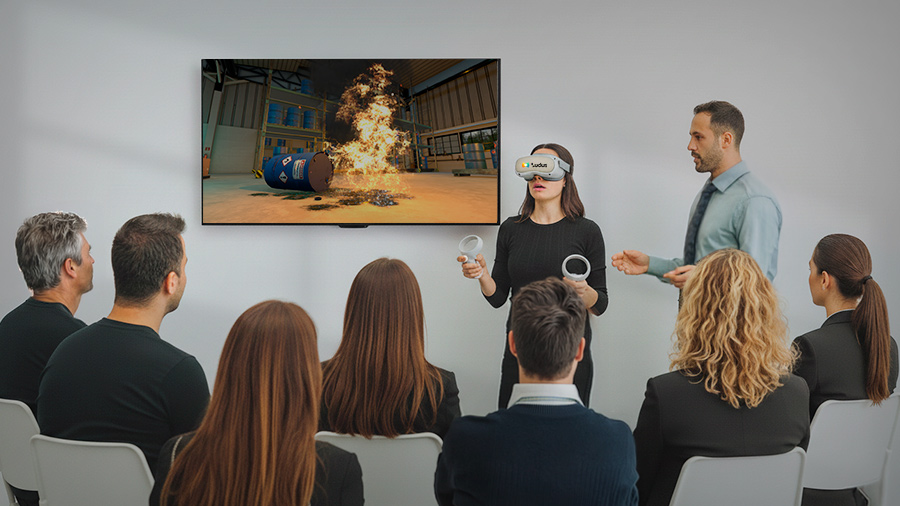
Discover the advantages of virtual reality for training in health and safety for companies

Benefits of training in health and safety for different companies

Occupational safety training (HSE) is essential to prevent accidents and should be conducted periodically to keep employees trained and aware. Technologies such as virtual reality (VR) offer a simple way to provide continuous and refresher safety training.

Why is Periodic Safety Training Necessary

The Legal Imperative of Providing Continuous and Adequate Satety Training

Safety and health training is a legal obligation for companies. This training must be provided both at the time of hiring and whenever there are changes in working conditions or equipment. In fact, without HSE training, the company will always be responsible for any workplace accident.

Official regulations, such as the Spanish Occupational Risk Prevention Law, also highlight the need to periodically repeat HSE training. Among other things, these trainings adapt to the evolution of risks and the emergence of new ones.

Periodic Training to Maintain Retention and Prevent Human Error

Various studies by health researchers indicate that knowledge retention in subjects like cardiopulmonary resuscitation (CPR) begins to decline after a few months. According to these studies, retention is reinforced through refresher training every 2-3 months.

Conducting periodic HSE refresher training helps keep employees trained and alert, avoiding human errors due to complacency. In fact, according to the Occupational Safety and Health Administration (OSHA), human error is behind 80% to 90% of workplace accidents.

The problem with conducting HSE refresher training is the cost and difficulty of organizing them periodically. Stopping processes and machines, organizing groups of employees and trainers to conduct these trainings... However, technologies like virtual reality offer a new way to conduct HSE refresher training simply.

Virtual Reality in Refresher Preventive Training

Virtual reality (VR) recreates realistic situations and scenarios in simulations, where the user engages and interacts first-hand. In a PRL training with virtual reality, the employee faces the risks of their job and learns to prevent accidents without real danger.

Firefighting, construction safety, working at heights, electrical hazards... VR allows all types of training to be conducted realistically and dynamically. It also provides an effective way to conduct periodic refresher training.

The Ludus VR platform includes multiple simulations for HSE training and features a guided individual training mode. This allows employees to conduct their refresher training autonomously and individually, practicing their prevention knowledge.

After receiving group HSE training with the platform, employees can refresh their training periodically with the individual mode. This means there is no need to stop processes or machinery to conduct refresher training. Workers pass through the simulation one by one, according to their work schedule.

The guided mode of Ludus simulations allows the worker to follow safety protocols and check their errors. It only requires a room with VR equipment installed, so employees can conduct their autonomous refresher training.

Other benefits of VR in Preventive Training 

Virtual reality helps train the worker's decision-making process, ensuring they adequately protect themselves and detect risks in simulations. They can also make mistakes, such as not wearing proper protective equipment, and experience virtual accidents like electrocutions, burns, amputations...

This ability to realistically and first-hand experience the consequences of errors enhances worker awareness. This translates into employees being more involved in prevention and more aware of dangers.

Raising worker awareness about the importance of prevention and showing them how carelessness leads to accidents helps prevent complacency. In other words, boosting motivation and awareness in HSE training helps avoid human errors.

Another advantage of VR is the ability to demonstrate that adequate and standards-based HSE training has been provided. This is possible thanks to the statistics collected by the Ludus platform, such as hours of use or exercises passed and failed.

There are other benefits for companies using Ludus virtual reality in their risk prevention training. Standardized PRL training across different locations or countries, cost savings on travel or rental of facilities and equipment... Discover these and other advantages at the following link.

VR safety training for oil and gas — IOGP 2024 key stats: offshore FAR 1.31 vs 0.56 onshore, 41% of fatalities from fire or burns, 26 of 32 deaths were contractors
VR safety training for oil and gas: what the IOGP data says you should be training
The International Association of Oil and Gas Producers recorded 32 company and contractor fatalities in 2024, across 21 separate incidents,
Ludus vs Transfr
Ludus vs Transfr: Workforce Development or Industrial HSE Compliance?
These two platforms are frequently shortlisted together and rarely compete for the same budget, because they solve problems at opposite
Ludus vs Strivr comparison cover: ready-built HSE catalogue in 17 languages vs custom build at Fortune 500 scale
Ludus vs Strivr: which VR training platform fits an industrial HSE programme?
These two platforms are not really competing for the same budget, and a buyer who understands that will reach a decision faster.
When VR safety training works (and when it doesn't) | Evidence 2026
When VR safety training works, and when it doesn’t: what the research actually shows
VR safety training works. Systematic review and meta-analysis — not just vendor case studies — confirm it outperforms traditional methods
VR medical training: 2025 trial evidence and what it means for hospital safety programmes
VR medical training: the 2025 trial evidence, and what it means for hospital safety programmes
VR medical training has the strongest evidence base of any VR training application, because medical education has a research culture that
VR training ROI: defensible inputs and the OSHA lever most business cases miss
VR training ROI: how to build the number your CFO will actually accept
The headline industry figure is 219% ROI over three years with payback in under six months. It comes from a Forrester Total Economic Impact
VR training simulator hardware guide: how to choose the device
VR training simulator: how to choose the hardware, and why the device is the last decision
A VR training simulator is three things: a headset, a software platform, and the scenarios that run on it. The headset is the part buyers
Data visualisation of VR safety training statistics showing PwC, BLS and enterprise deployment metrics
VR Training Statistics 2026: 40 Verified Numbers on Adoption, Effectiveness and ROI
Every VR training statistic in this article is traceable to a primary source. Figures without a defensible citation — including the
Composite of nine industrial VR training scenarios across sectors from oil rigs to hospital wards
Virtual Reality Training: 9 Industries Using VR for High-Risk Work
Enterprise VR safety training is not evenly distributed across the economy. It clusters in a specific set of industries where three things
Worker wearing a standalone VR headset practising a high-risk safety procedure in an immersive simulatio
What is VR safety training? A practical definition for HSE managers
VR safety training is the use of immersive virtual reality simulations to teach workplace safety procedures in realistic, hands-on
Drillship crew member wearing a VR headset during a CPR simulation, with an OPITO instructor observing
Inside the first VR CPR training on an offshore drillship: how Deepsea Networks tripled crew participation with Ludus
On an offshore drillship, the nearest hospital can be hours away by helicopter. If a crew member collapses with a suspected cardiac arrest,
Side-by-side dashboards of Ludus and Immersive Factory VR safety training platforms
Ludus vs Immersive Factory: Which EU VR Safety Training Platform Wins in 2026?
Ludus and Immersive Factory are two of the strongest EU-rooted VR safety platforms, and the right choice depends on industrial breadth,
Side-by-side dashboards of Ludus and PIXO VR safety training platforms
Ludus vs PIXO VR: Which VR Safety Training Platform Wins in 2026?
Ludus and PIXO VR are both enterprise VR safety platforms, but they're built on different models. Ludus (HQ Bilbao, Spain; LATAM office
Side-by-side Ludus and Pixaera VR safety training platform dashboards compared
Ludus vs Pixaera: Which VR Safety Training Platform Wins in 2026?
Ludus and Pixaera are both VR-native safety training platforms, but they serve different buyers. Ludus (HQ Bilbao, Spain; LATAM office
Side-by-side dashboard view of 11 safety training software platforms ranked for 2026
Best Safety Training Software 2026: 11 Platforms Compared [Verified Pricing & Features]
The best safety training software in 2026 is the platform that matches your hazard profile, workforce size and language requirements — not
How to Get Employees on Board with VR Safety Training
You have the headsets. You have the platform. You have the modules ready. In most cases, workers get on board quickly — the novelty and
VR Safety Training
VR Safety Training: What It Is, How It Works & Why It’s Replacing Classroom Training
VR safety training is the use of immersive virtual reality simulations to teach workplace safety skills in realistic, hands-on scenarios
Trainer kneeling with VR headset during a session, while two colleagues watch the simulation on a screen
This is how occupational health and safety trainers learn to use virtual reality
The Ludus virtual reality simulations have the mission to complement the PRL trainings, giving more options to the trainer to transmit his
How to Implement Ludus' Virtual Reality in Your Occupational Safety and Health Training
More and more companies are benefiting from using virtual reality technology in their risk prevention training. Ludus' mission is to
VR vs Classroom HSE Training: Truths and Myths
It's the question most HSE managers ask before taking the leap: if we implement virtual reality, what happens to the classroom training we