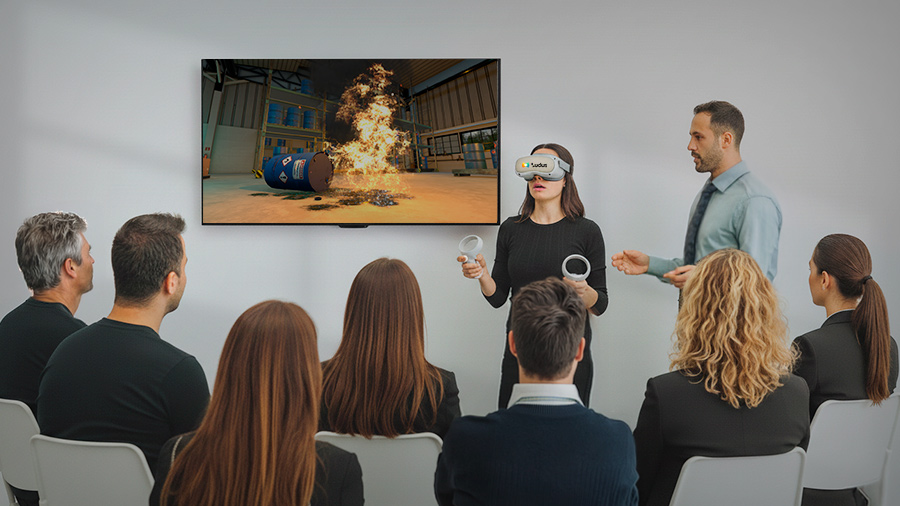
Enterprise VR safety training is not evenly distributed across the economy. It clusters in a specific set of industries where three things are simultaneously true: the work is dangerous, the traditional training is expensive, and the workforce is large enough for the economics to work. This is the 2026 map of who is actually using it, sector by sector, with verified customer references and specific use cases where they exist.
The nine sectors below account for most enterprise VR safety spend today. Fatal-injury data from the U.S. Bureau of Labor Statistics — 5,070 workplace deaths in 2024, concentrated in transportation and materials handling (1,391), construction and extraction (1,032), and 844 fatal falls — maps closely onto where VR safety training has the strongest case.
1. Oil and Gas
Offshore oil and gas has the hardest safety training problem in industry: high consequence, distant workforce, expensive access, low frequency. The OPITO BOSIET standard covers offshore workers on a four-year certification cycle. A worker's CPR practice may be 47 months old on the day it is needed.
VR closes that gap. Deepsea Networks and Ludus ran the first immersive VR CPR training delivered live on an active drillship in 2025. Crew participation was roughly three times higher than typical offshore training sessions, with zero technical setup required from the vessel team. The programme is now being expanded to additional vessels and scenarios beyond CPR — first aid, fire, and confined-space entry are next.
Ludus's oil and gas footprint also includes deployments with Moeve and Tecpetrol across LATAM. Pixaera dominates the super-major end of the market with references at Shell, BP, ADNOC, and ConocoPhillips. Both are legitimate options; the choice usually comes down to whether the buyer's framework is IOGP Life-Saving Rules or broader industrial HSE.
Common VR scenarios in oil and gas: CPR, H₂S response, hot work permits, confined-space entry, working at height, drop-object awareness, drilling floor safety.
2. Manufacturing
Manufacturing is the largest and most fragmented adopter category. The workflow argues for VR loudly: repeatable procedural training, standardisation across sites, multilingual workforces, high LOTO (lockout/tagout) risk.
Ford, Henkel, Owens Corning, Lear, and Coca-Cola use VR safety training through Ludus. Ford's deployment includes multi-country programmes; Owens Corning has publicly referenced turnkey contractor training via PIXO VR. Bosch has deployments across multiple manufacturing lines. The 2023 Springer systematic review on VR safety training effectiveness confirms manufacturing as the leading academic-research category, with the most rigorous evaluation studies to date sitting in this sector.
Common VR scenarios in manufacturing: LOTO procedures, machine guarding, PPE inspection, ergonomics, chemical handling, forklift and warehouse traffic, fire response.
3. Construction
Construction and extraction accounted for 1,032 workplace fatalities in 2024 per BLS. Fall protection is the single largest category — 844 fatal falls total across all industries, with 10.8% from over 30 feet. This is the sector where VR should be deployed more than it currently is. The friction is workforce distribution: construction crews are highly mobile, sites are temporary, and training budgets sit under different accounting than manufacturing.
Where VR is being deployed in construction, it clusters around fall protection, scaffolding, crane signalling, and confined-space work. Ludus's platform includes fall protection, safety officer at heights, working at heights in the electrical sector, and safety in construction as dedicated modules. Immersive Factory has deep references in French construction and utilities including Saint-Gobain and Vinci-adjacent contractors.
Common VR scenarios in construction: fall protection, harness inspection, scaffolding safety, crane signals, excavation safety, PPE selection, first aid on site.
4. Logistics and Warehousing
Logistics is where the most-cited VR training deployment sits. Walmart's Strivr-powered rollout covers more than 2.2 million employees across 4,700 stores using 60+ immersive modules. One outcome cited publicly: a Pickup Tower course compressed from eight hours to fifteen minutes with 70% higher post-test scores and 30% higher satisfaction than the classroom version.
Beyond Walmart, DHL is a named Ludus customer with logistics-specific programmes. Amazon has deployed VR safety training internally through multiple vendors. J.J. Keller's 2025 partnership with PIXO VR added 16 modules to the market covering active shooter, arc flash, confined space, hot work, and pre-trip vehicle inspections.
Common VR scenarios in logistics: forklift operation, dock safety, pedestrian awareness, warehouse traffic, emergency evacuation, active-shooter response, ergonomics.
5. Mining
Mining is the sector with the most operationally meaningful published outcome. An underground mining operation deploying VR safety training reported a 43% reduction in lost-time accidents post-implementation. The number is unusually clean because mining safety programmes were already highly instrumented before VR arrived, so the causal claim is defensible.
Roof control, gas detection, evacuation routes, and heavy-equipment interaction are the standard VR modules for mining. The sector's specific attraction to VR is the impossibility of practising underground emergency response any other way — live simulation of a roof fall or a methane release is not feasible.
Common VR scenarios in mining: roof control, gas detection, emergency evacuation, heavy equipment interaction, blast area management, first aid underground.
6. Utilities and Energy
Electrical utility work is a high-fatality niche within a high-fatality sector. Arc-flash incidents are catastrophic when they occur but rare enough that most workers will never see one in a full career — until they do. The training gap is exactly the pattern VR is best at closing.
The PMC 2024 study on VR for electrical worker training documents superior outcomes versus classroom on arc-flash recognition and PPE selection. Ludus's platform includes dedicated modules for working at heights in the electrical sector and electrical hazar. Immersive Factory has published references at EDF and other European utilities.
Common VR scenarios in utilities: arc-flash response, high-voltage work, working at heights on transmission structures, PPE for electrical work, substation safety.
7. Healthcare
Healthcare VR training deploys in two distinct patterns: clinical skills (CPR, code-blue response, medication administration) and workplace safety (infection control, sharps, workplace violence). Radiation safety is a specific niche where VR has produced strong published outcomes: a 2025 randomised crossover study of 39 medical professionals showed VR training significantly reduced radiation exposure compared with traditional didactic training, with higher participant satisfaction and confidence.
The economic argument for VR CPR training in healthcare is direct. Traditional instructor-led CPR training runs approximately $23,000 per learner-instructor pair over the useful life of a certification. VR delivery with a shared headset and reusable manikin collapses most of that cost while preserving OSHA and AHA-compliant technique feedback.
Common VR scenarios in healthcare: CPR and BLS, code-blue response, infection control, sharps handling, radiation safety, workplace violence de-escalation.
8. Emergency Response
Fire services, EMS, industrial first responders — this is where VR training most closely resembles simulator training in aviation. The scenarios need to be varied, high-consequence, and repeatable in ways real-world drills cannot support.
Walmart's active-shooter VR training is the most-cited emergency-response deployment. After the August 2019 El Paso attack, the company concluded that mandatory VR active-shooter training contributed materially to more than 2,000 employees escaping the incident. On the industrial side, Ludus's fire safety, first aid, and CPR simulations are used by external prevention services training industrial clients, with wireless hand-tracked delivery on standalone headsets.
Common VR scenarios in emergency response: active-shooter response, fire behaviour and extinguisher selection, CPR and BLS, mass-casualty triage, hazmat response, evacuation coordination.
9. External Prevention Services
The single largest structural use case for VR safety training is not a corporate buyer at all — it is an external prevention service that delivers HSE training to hundreds or thousands of small and mid-sized companies who cannot cost-justify their own VR deployment. This is Ludus's dominant customer segment in Spain and LATAM.
Europreven is the most fully-documented example. The Spanish prevention service, part of a group with 50,000 clients across 100 offices and 300 professionals, integrated Ludus's platform into both in-person and remote training. In 18 months they trained 7,000+ workers on-site and 2,000+ remote workers across Italy, Saudi Arabia, and the Netherlands. The most-cited operational quote from Agustín Santos, Training Manager: "The simulations provided by Ludus allow working with scenarios and risk situations that are otherwise not possible. An example of this would be exposing workers to experiencing a fall from height or a forklift accident."
The external prevention services model is why 250+ customers across 18 countries and four continents use Ludus — the customer base includes Henkel, Coca-Cola, Ford, Moeve, Lear, DHL, Owens Corning, and UNOPS (the United Nations) as direct enterprise deployments, but also the training-service intermediaries that reach thousands of small-employer end users.
Common VR scenarios in external prevention services: the full HSE catalogue delivered to many client industries under one platform license — fire, electrical, CPR, work at height, PPE, forklift, confined space, hand injury prevention.
What Ties the Nine Sectors Together
The nine industries above look different but share a structural feature: a large workforce facing a small number of high-consequence procedures that cannot be practised safely any other way. That is the case VR training exists to serve. Everything outside that structural feature — general safety awareness, code-of-conduct training, harassment prevention — is better served by simpler and cheaper formats.
If your industry is on this list and your training programme still relies on annual classroom refreshers plus one live drill, the case for adding VR is worth putting on paper.
Frequently Asked Questions
Which industries use VR training most?
Oil and gas, manufacturing, construction, logistics and warehousing, mining, utilities, healthcare, emergency response, and external prevention services. These nine sectors account for most enterprise VR safety spend in 2026.
Which industry has the strongest published outcome?
Mining, with a reported 43% reduction in lost-time accidents. Logistics is second in scale of deployment thanks to Walmart's 2.2 million-employee Strivr programme. Oil and gas has the most operationally interesting recent case study in Ludus and Deepsea Networks' drillship CPR deployment (3× crew participation).
Does VR training work for small operations?
Below 375 learners the classroom-parity argument is weaker per PwC. For smaller operations, the strongest use cases are shared external prevention services that spread the platform cost across many small-employer clients.
Which companies deploy VR training publicly?
Walmart, Bank of America, Shell, BP, Ford, Bosch, and Intel are the largest public deployments. On specialised HSE platforms, Ludus is used by Henkel, Coca-Cola, Ford, Moeve, Lear, DHL, Owens Corning, and UNOPS across 250+ customers in 18 countries. PIXO VR references Bosch, Ford, New Jersey Natural Gas, and Owens Corning. Pixaera runs at Shell, BP, ADNOC, and ConocoPhillips.
What is the highest-impact use case?
Skill-practice training for high-consequence, low-frequency events: fire response, CPR, arc-flash, confined-space entry, and active-shooter response. Live drills are dangerous or expensive; classroom training does not build muscle memory.
How is content localised across languages?
Enterprise VR safety platforms typically ship in 5 to 40 languages. Ludus's catalogue is native in 17 languages; Pixaera runs in 40+. For multilingual workforces, that number is often the disqualifying question in vendor selection.
Related Reading
- What is VR safety training?
- VR safety training complete guide 2026
- Deepsea drillship VR CPR case study
- Best Safety Training Software 2026: 11 Platforms Compared
- All Ludus training simulations
Sources
- U.S. Bureau of Labor Statistics. National Census of Fatal Occupational Injuries 2024.
- PwC. Understanding the Effectiveness of VR Soft Skills Training in the Enterprise. 2020.
- Strivr / Walmart. Walmart reduces training time by 96%.
- Ludus Global. Deepsea case study.
- Ludus Global. Europreven case study.
- OPITO. BOSIET certification standards.
- Springer. Evaluating the effectiveness of VR for safety-relevant training: a systematic review. 2023.
- PMC / NCBI. VR for occupational safety and health learning — electrical workers. 2024.
- PMC / NCBI. Comparative effectiveness of immersive VR and traditional training on radiation safety. 2025.
Editorial note: all company deployments named were verified against primary sources — customer success pages, published case studies, or press releases — in July 2026.
---------------------------------------------------------------------------
Would you like to implement Ludus' Virtual Reality in your health and safety training?
Fill out this form to receive information about the options best suited to your company's needs.