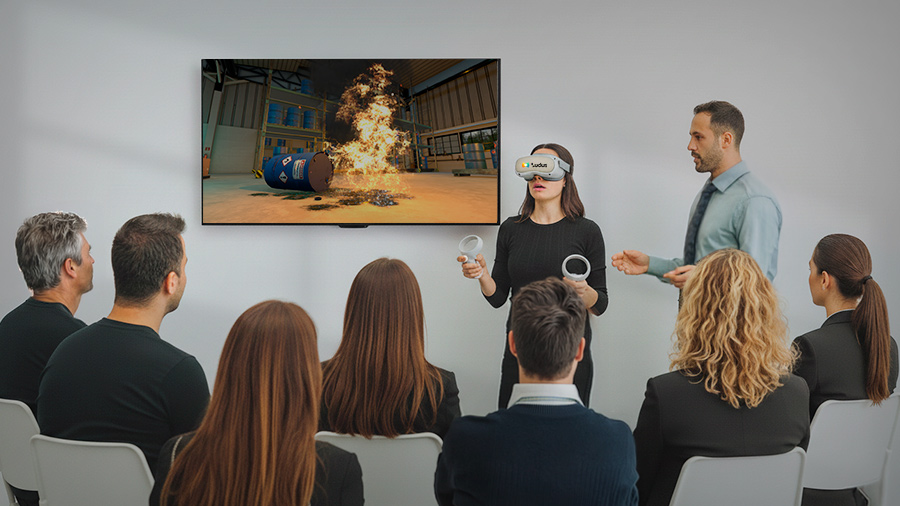
Are you interested in giving health and safety training with Virtual Reality?

I want to use Ludus' VR

The Ludus virtual reality simulations have the mission to complement the PRL trainings, giving more options to the trainer to transmit his knowledge.

To get the most out of the tool, Ludus carries out a 'train the trainer' process . The idea is to turn these PRL technicians into expert pilots of the VR technology, so that they can use it in their trainings. This is the way in which PRL trainers learn to use virtual reality.
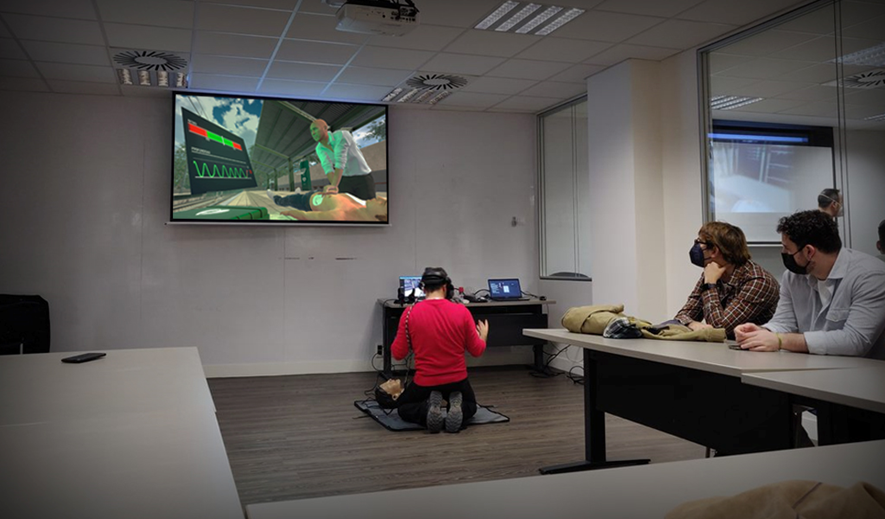
 

How do HSE trainers learn to use virtual reality from Ludus?

In the recruitment and implementation process of Ludus, the Training department is in charge of scheduling one or several trainings. The objective is to help the companies' trainers to take advantage of the tool to pass on their ORP knowledge.

The duration of these sessions varies depending on the number of people to be trained and the simulations to be used. These are the steps in the training process:

  • Introduction to the use of virtual reality: in this brief start, our trainers explain some of the virtues of VR in training. They also take the opportunity to clarify concepts, talk about how our platform works and explain the simulations we offer.
  • Set up: this is what our trainers call the phase of the training in which they explain the assembly and connection of the equipment (to reinforce the work carried out by the Ludus Support team).

In addition, two essential processes are taught at this point: virtualizing the classroom (the area in which the simulation is to be used) and adjusting the floor (matching the height of the real floor and the virtual floor). It is important that the trainers know these simple procedures, because when they want to move the equipment and use it in another place they will have to do them.

  • Use of the platform: at this point the Ludus platform is opened and the trainers are taught how to navigate it in a practical way, which is intuitive.
  • Putting on the goggles: our trainers teach, with the help of a volunteer, how to put on the virtual reality goggles correctly. In addition, customers learn the main maneuvers to perform with the controls: interacting with objects and moving around the virtual space of the simulation.
  • Entering the simulation: with this prior knowledge, the PRL trainers try out the simulations they are interested in or that best suit their needs.

In this phase, our trainers instruct on the possibilities offered by the tool, the variables that can be introduced in each simulation... This makes each exercise different. In addition, employees can learn from the consequences of their mistakes, which enriches the training.

  • Evaluation tools: after teaching how to use the simulations, our trainers explain the evaluative use of Ludus. The tool evaluates the employees' performance, and provides useful data for PRL trainers such as mistakes made, reaction time, steps completed, etc.
  • Feedback: at the end of the session, the ORP experts evaluate the training received, and make proposals for new simulations that might be of interest to them.

The work of the Ludus Training team does not end after these sessions. The accompaniment and contact to resolve any doubts is maintained over time. In addition, customers will continue to have a Support team assigned to them, and will always be accompanied by the Customer Success department.

As in any training process, the desire to learn and train with the tool is very important when it comes to becoming experts in its use. These sessions are like the training wheels on a bike: necessary to get started, but practice and training are the way to ride without help.

If you want to get information about the Ludus product or how to implement it in your PRL trainings, fill in your details in the link below and we will contact you.


How to Implement Ludus' Virtual Reality in Your Occupational Safety and Health Training
More and more companies are benefiting from using virtual reality technology in their risk prevention training. Ludus' mission is to
VR vs Classroom HSE Training: Truths and Myths
It's the question most HSE managers ask before taking the leap: if we implement virtual reality, what happens to the classroom training we
Workplace Safety Law and VR: Italy Leads a Regulatory Shift Across Europe
On 7 April 2026, Italy's Law No. 34/2026 — the Annual Law for Small and Medium Enterprises — came into force. Among its provisions, it
Mixed reality: training with virtual risks in real workplaces
Can you imagine placing a worker in front of a fire or other emergency in their workplace to train them? Thanks to technologies such as
Why UK HSE managers are shifting to immersive learning for compliance
Health, Safety and Environment (HSE) managers across the UK are under increasing pressure to ensure compliance with evolving regulations
Workplace safety diagnosis with Virtual Reality: detect accidents before they happen
According to the International Labour Organization (ILO), approximately 2.6 million deaths occur each year due to work-related causes. One
Virtual Reality for risk prevention in logistic warehouses
Working in a logistic warehouse involves potentially serious risks to the health and safety of operators. Training in health and safety,
Electrical hazards and workplace electrocutions
Electrical hazards and workplace electrocutions: how to prevent them
What is the electrical hazard? Electrical hazard refers to a workplace situation where a worker risks coming into contact with electrical
Learners forget to call emergency services in 58% of the Virtual Reality CPR Courses
Learners forget to call emergency services in 58% of the Virtual Reality CPR courses
In performing cardiopulmonary resuscitation (CPR), rhythm and depth of compressions are crucial, but so is the full protocol. One essential
Virtual Reality for Conducting Periodic and Refresher Safety Training
Occupational safety training (HSE) is essential to prevent accidents and should be conducted periodically to keep employees trained and
Virtual reality to train CPR in hospitales
Healthcare professionals must know and master emergency procedures such as cardiopulmonary resuscitation (CPR). Additionally, it's
Virtual finger amputations in 50% of Hand Injury Prevention courses with VR
What is the probability of serious accidents occurring in a company? The statistics from Ludus' virtual reality training platform provide
Errors when tackling fires in 49% of VR
One of the advantages of using virtual reality for fire extinguisher training is its ability to collect objective information. Nearly half
Ludus: The VR training tool that enables an actual culture of safety
According to OSHA, Safety culture is an environment where the attitudes, behaviors and perceptions of all workers are reflected in the
Virtual Reality in Prevention to Avoid Human Errors
Virtual Reality (VR) is already being used to enhance occupational safety and health training. The use of this technology in prevention
Prevention and VR: Standardized Training Across Different Locations or Countries
Virtual Reality (VR) offers various business advantages to external prevention services for providing risk prevention training. One of them
Benefits of fall protection training with Virtual Reality
The risk involved in work at height makes it important to use all available tools to prevent accidents. One of these tools is virtual
Virtual Reality in electrical risk prevention training.
Virtual Reality in electrical risk prevention training
Virtual reality (VR) is already being used to provide all kinds of Health and Safety (HSE) training, such as electrical risk training. This
How to increase product availability in prevention services with VR
External prevention services cannot always meet the demand for HSE training due to a lack of resources. This results in losing clients and
Benefits of training in fire extinguishing with Virtual Reality
The applicability of virtual reality (VR) in risk prevention training is reflected in exercises such as fire extinguishing. VR recreates