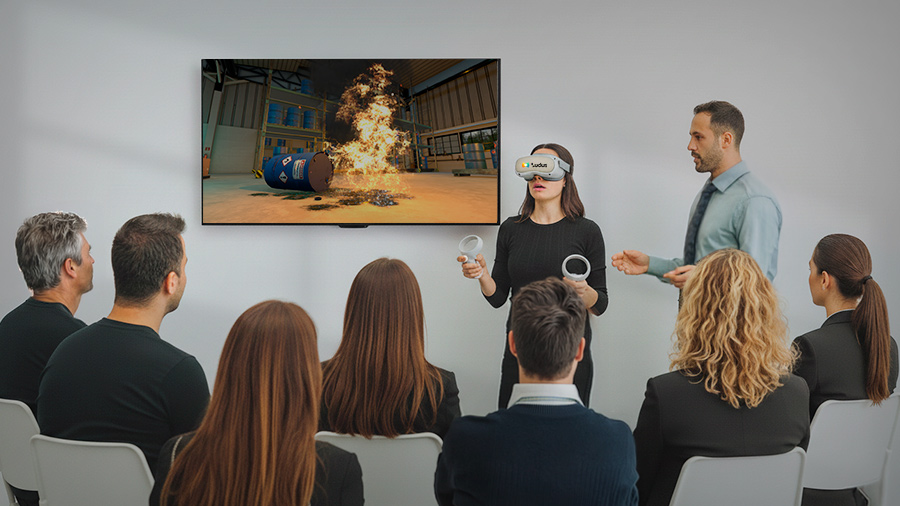
VR safety training works. Systematic review and meta-analysis — not just vendor case studies — confirm it outperforms traditional methods on knowledge acquisition and retention.
The more useful finding, and the one that should shape your vendor selection, is why it works. The mechanism is experiential: a trainee who makes a mistake and experiences the consequence inside the simulation responds emotionally in a way that a slide deck cannot reproduce. Recent physiological research measures that response directly.
That mechanism also explains the handful of studies where VR produced no measurable benefit. In those cases the trainee never experienced consequences. They watched video content while wearing a headset. The technology was present; the mechanism was absent.
So the question worth asking is not whether VR works. It is whether the VR you are evaluating is built to deliver the thing that makes it work.
Last reviewed 11 August 2026.
The Mechanism: Why Consequence Matters More Than Immersion
Most VR marketing sells immersion. Immersion is not the active ingredient. Consequence is.
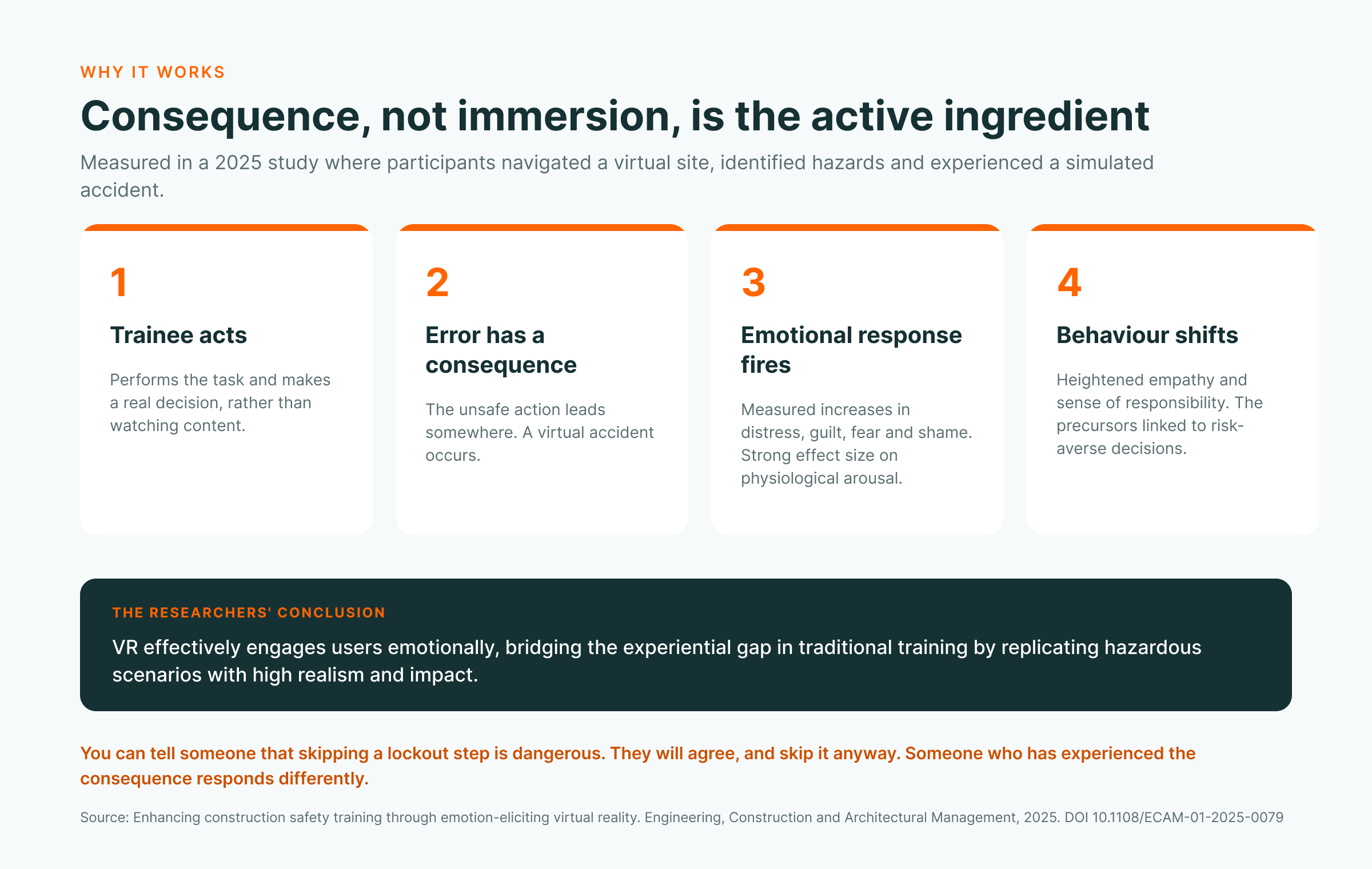
A 2025 study published in Engineering, Construction and Architectural Management (DOI 10.1108/ECAM-01-2025-0079) set out to measure this directly. Participants navigated a virtual construction site, identified hazards, and experienced a simulated accident. The researchers collected pre- and post-activity surveys, galvanic skin response data to measure physiological arousal, and structured interviews.
The findings:
- The simulation significantly increased emotional arousal, with GSR data showing a strong effect size
- Significant increases in distress, guilt, fear and shame
- Participants reported heightened empathy, guilt and responsibility in post-session interviews
- The authors concluded VR effectively engages users emotionally, bridging the experiential gap in traditional training by replicating hazardous scenarios with high realism and impact
Those emotional responses are not incidental. They are the anticipatory states theoretically linked to risk-averse decision-making. This is the experiential gap that classroom training cannot close: you can tell someone that skipping a lockout step is dangerous, and they will agree with you, and they will skip it anyway. Someone who has experienced the consequence carries a different response to the same moment.
Related work supports the same pattern from other angles. Research into VR-based risk assessment argues that evoking the sensation of physical risk triggers the visual, emotional and impulsive decision processes present in real hazardous situations, rather than the detached reasoning people apply to a questionnaire. Driving-safety research using immersive scenarios has found that consequence-based interventions prompt users to significantly reconsider their behaviour through increased risk awareness.
This is the reason Ludus's exercises are built around virtual accidents rather than around scenery. A trainee who takes an unsafe action sees where it leads.
What the Effectiveness Research Shows
Safety-specific: Safety Science systematic review and meta-analysis
The most directly relevant evidence for an HSE audience. Published in Safety Science, it reviewed the field and ran meta-analyses on pooled results.
- VR safety training outperformed traditional methods on knowledge acquisition and knowledge retention
- It identified 14 primary application domains, with construction and fire safety the most common
- The most frequent learning outcomes were hazard recognition, safety actions, and correct use of equipment and tools, usually paired with immediate feedback
- Standalone headsets have become the dominant hardware choice
The review also found that only 9.6% of studies explicitly adopted a learning theory. That number is the single most useful thing in the paper for a buyer. It says the field is full of VR built by people who understood the technology and not the learning — which is exactly where the weak results come from.
Clinical: meta-analysis of 12 randomised controlled trials
Covering 1,167 students, this analysis reported:
| Outcome | Effect size (SMD) | Result |
|---|---|---|
| Theoretical knowledge | 0.97 | Significant, p < 0.001 |
| Practical skills | 0.52 | Significant, p < 0.001 |
| Skill retention | 0.52 | Significant, p < 0.001 |
| Satisfaction | 1.14 | Significant, p < 0.001 |
An SMD of 0.5 is conventionally a moderate effect and 0.8 a large one. These are meaningful results across knowledge, skills and retention alike.
Enterprise: PwC
PwC's enterprise study compared identical training delivered in classroom, e-learning and VR formats across 12 US locations. VR learners were trained four times faster than classroom learners, were 275% more confident applying what they had learned, and were 3.75 times more emotionally connected to the content than classroom learners.
That third figure is the one that matters most here, because it measures the same mechanism the construction study measured physiologically. Emotional connection is not a soft metric in safety training. It is the difference between knowing a rule and acting on it.
Complex task performance
A 2025 study in the Journal of Management in Engineering (DOI 10.1061/JMENEA.MEENG-6834) compared VR training against traditional paper-based instruction for tendon-stressing, a complex and hazardous construction task. Trainees who actively performed the procedure in VR scored 19% higher on knowledge tests than those using a standard manual, and reported markedly greater intrinsic motivation. Workers who observed a colleague's VR session also scored above the traditional baseline — which offers a practical option where headsets are limited.
Note the wording: trainees who actively performed. That is the same variable again.
Where VR Does Not Deliver, and Why
Being straight about this is what makes the rest of the evidence trustworthy — and it points somewhere useful.
A 2025 study in the Journal of Construction Engineering and Management (DOI 10.1061/JCEMD4.COENG-15981) took 221 construction industry employees, delivered prerecorded video-based safety training, then placed them in a VR environment. It found no improvement in hazard recognition, risk perception, risk tolerance or safe behaviour, and no evidence that adding haptic feedback changed outcomes.
Read the design rather than the headline. The trainees were passive recipients of video content. They did not perform the task. They did not make decisions with consequences attached. They did not experience a virtual accident. The headset was present; the mechanism was not.
The authors' own conclusion pointed the same way: VR remains a promising platform for occupational learning, and more work is needed to understand the contexts in which it enhances adult learning. Context, not technology.
Placed alongside the finding that only 9.6% of VR safety studies used any learning theory, the picture is coherent. VR built around active performance, consequence and feedback produces results. VR built as video-in-a-headset does not. Both get called "VR safety training" in marketing material, which is why buyers need to look past the label.
The Seven Design Factors That Separate the Two
Use this when evaluating any platform, including ours.
1. Does the trainee act, or watch? Active performance beats observation, which beats passive video. If the demo is a 360-degree film, you are looking at the configuration that underperformed.
2. Do errors have consequences? The trainee should be able to get it wrong and experience where that leads. This is the mechanism the emotional-arousal research identifies.
3. Is feedback immediate? The Safety Science review found immediate feedback was a consistent feature of effective programmes.
4. Is the scenario grounded in instructional design? Ask the vendor what learning model sits behind their exercises. Fewer than one in ten studies could answer that question.
5. Can it be repeated? Skill decays. Annual training does not fix that. Unlimited retries and repeat sessions are what convert a one-off event into retained competence.
6. Does it produce exercise-level data? A completion record tells you someone attended. Exercise-level logging tells you what they actually did and where the workforce keeps going wrong.
7. Does it retain the hands-on element where required? OSHA's 2020 Standard Interpretation confirms VR can satisfy training requirements when it covers the specified content, supplemented by any required hands-on component. In CPR that means running the simulation alongside a real manikin, so compressions stay physical while the scenario, pressure and decision-making happen in the headset.
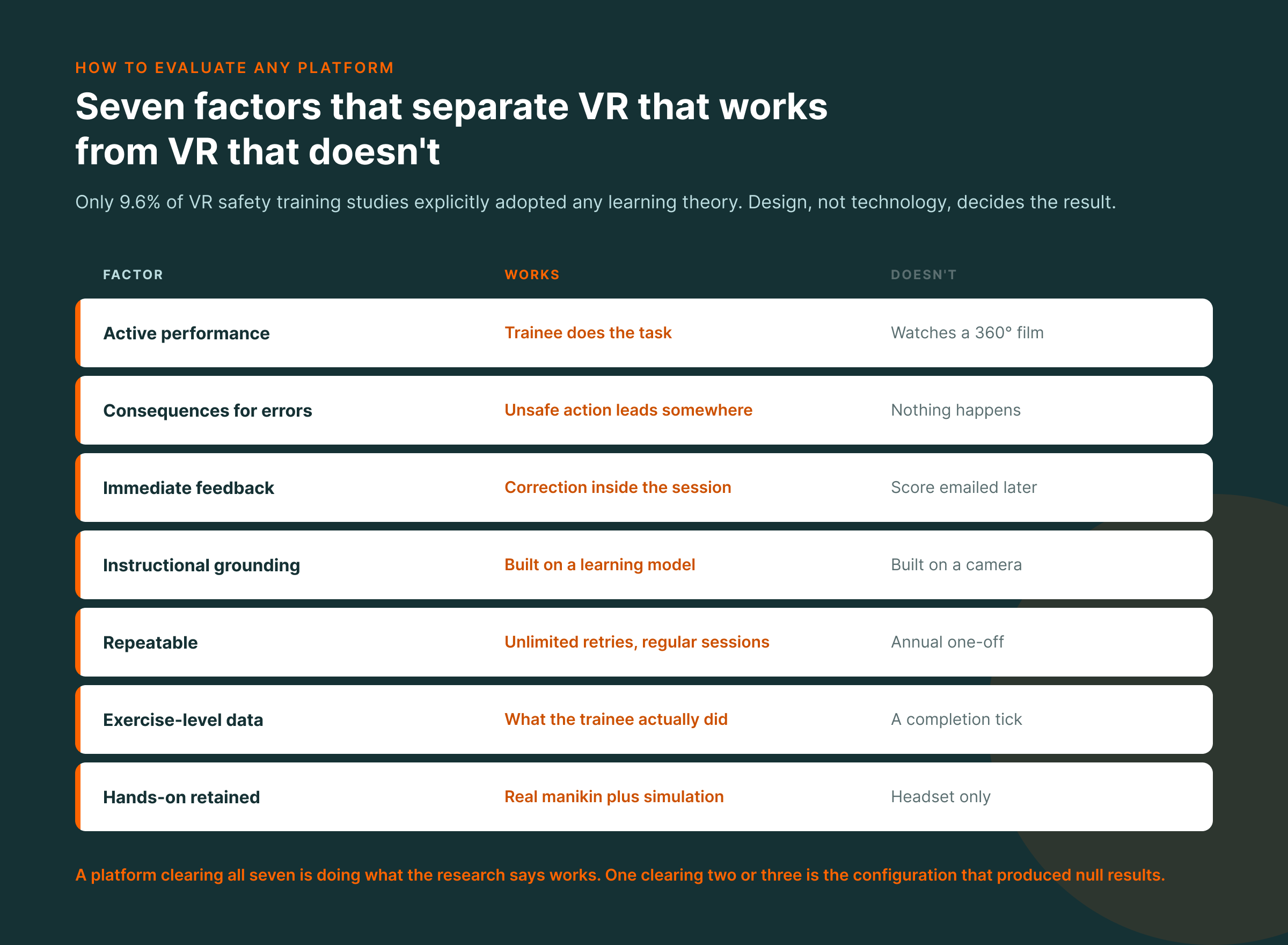
A platform that clears all seven is doing what the research says works. One that clears two or three is the configuration that produced null results.
How This Looks in Deployment
Research shows a method can work. Deployment shows it survives an operational environment.
Participation. When Deepsea Networks ran VR CPR training on an active drillship with Ludus, crew participation ran at roughly three times a standard offshore refresher session, with no technical setup required from the vessel team. Training nobody attends has an effectiveness of zero regardless of the literature.
Scale across borders. Europreven, a Spanish external prevention service, trained more than 7,000 workers on-site and over 2,000 remotely across Italy, Saudi Arabia and the Netherlands. A rail-sector multinational trained 2,700 employees across several countries within months.
Sustained commitment. Ludus reports a 97% annual subscription renewal rate across 250+ customers including Henkel, Coca-Cola, Ford, Moeve, Lear, DHL, Owens Corning and UNOPS (the United Nations). Hundreds of organisations independently deciding to continue is a meaningful signal about whether the programmes are delivering.
Scale. Walmart's programme, built to serve more than 2.2 million associates across 4,700 locations, reports that 70% of employees trained in VR performed better on evaluation exams than the control group, with test scores improving 10 to 15%.
Measurement. Ludus's predictive statistics panel logs every exercise, produces personalised reports per training programme, and surfaces workforce-level patterns: the errors that recur, the scenarios generating the most virtual accidents, the decision points where people hesitate. That converts effectiveness from something you take on trust into something you read off your own data.
How to Evaluate Any Effectiveness Claim
Five questions that separate a real finding from a marketing number.
Compared with what? A percentage without a comparator means nothing.
Measuring what? Knowledge test, simulated performance, or on-site behaviour.
Measured when? Immediately, or months later.
In what domain? Findings from one sector do not transfer automatically to another.
Who funded it? Vendor-commissioned research is not worthless, but it should be labelled. The widely-quoted 219% ROI figure comes from a Forrester Total Economic Impact study commissioned by Meta.
And one figure to reject outright: any claim tracing to the NTL Learning Pyramid, usually quoted as 75% retention for practice-by-doing against 5% for lectures. NTL cannot produce the underlying study. It still appears in competitor marketing and in comparison articles published this year.
The Practical Conclusion
The evidence supports VR safety training for knowledge, retention, engagement and emotional impact. The physiological research explains the mechanism: experiencing the consequence of an error produces a response that reading about it does not.
That mechanism is also the buying criterion. Programmes built around active performance, real consequences, immediate feedback and repetition are the ones the research supports. Programmes that put a video in a headset are the ones that produced null results.
The fastest way to tell which you are being offered is to run one of your own hazards through the simulator and watch what happens when the trainee gets it wrong.
Frequently Asked Questions
Is VR safety training effective?
Yes. Meta-analysis in Safety Science found VR outperformed traditional methods on knowledge acquisition and retention. A 12-RCT meta-analysis found significant effects across knowledge, skills and retention.
Why does experiencing a virtual accident work?
A 2025 study measured significantly increased emotional arousal with a strong effect size when participants experienced a simulated accident, alongside heightened responsibility and empathy. Those states are the precursors linked to risk-averse decision-making.
What makes some VR training ineffective?
Design. Passive video delivered through a headset, without active performance or consequences, produced no measurable benefit in a 2025 construction study. Only 9.6% of VR safety studies adopt any learning theory.
Does OSHA accept VR training?
Yes, under its 2020 Standard Interpretation, when the content elements are covered and any required hands-on component is retained. Documented training also supports a good-faith penalty reduction of up to 25%.
What effect sizes are reported?
SMDs of 0.97 for theoretical knowledge, 0.52 for practical skills, 0.52 for retention and 1.14 for satisfaction, across 12 RCTs with 1,167 students.
Do trainees need a headset each?
Not necessarily. A 2025 study found workers observing a colleague's VR session still outperformed the traditional paper-based baseline, which helps where devices are limited.
Which sectors have the strongest evidence?
Healthcare, because medical education runs randomised trials as standard. Construction has the largest body of safety-specific studies.
Methodology
On effect sizes. Standardised mean differences are conventionally read as small at 0.2, moderate at 0.5, large at 0.8.
On the PwC study. PwC measured enterprise soft-skills training rather than safety procedures. The emotional-connection and confidence findings are cited here because they measure the same mechanism the safety-specific physiological research measures directly.
On excluded figures. NTL Learning Pyramid retention percentages are excluded for lack of a traceable source, as is a claim of 300% ROI over five years attributed to Intel.
Sources
- Safety Science. Virtual reality for safety training: a systematic literature review and meta-analysis.
- Enhancing construction safety training through emotion-eliciting virtual reality. Engineering, Construction and Architectural Management, 2025.
- Effectiveness of virtual reality in nursing education: a systematic review and meta-analysis. 12 RCTs, 1,167 students.
- Effectiveness of VR training and observer-based learning for complex and high-risk construction task performance. Journal of Management in Engineering, 2025.
- Analyzing the impact of virtual reality and haptic feedback on the safety skills of construction workers. Journal of Construction Engineering and Management, 2025.
- Frontiers in Psychology. Virtual reality as a new approach for risk taking assessment. 2018.
- Virtual Reality (Springer). Assessing the impact of cinematic virtual reality simulations on young drivers. 2025.
- PwC. Understanding the effectiveness of VR soft skills training in the enterprise. 2020.
- OSHA. 2026 annual adjustments to civil penalties. Effective 15 January 2026.
- OSHA. Standard Interpretation on training delivery methods. 2020.
- Ludus Global. Deepsea Networks and Europreven case studies. ludusglobal.com/en
Related Reading
- VR training statistics 2026: 40 verified numbers
- VR medical training: the 2025 trial evidence
- What is VR safety training?
- VR safety training: 9 industries using it for high-risk work
- VR training ROI: how to build the number your CFO will accept
- All Ludus training simulations
---------------------------------------------------------------------------