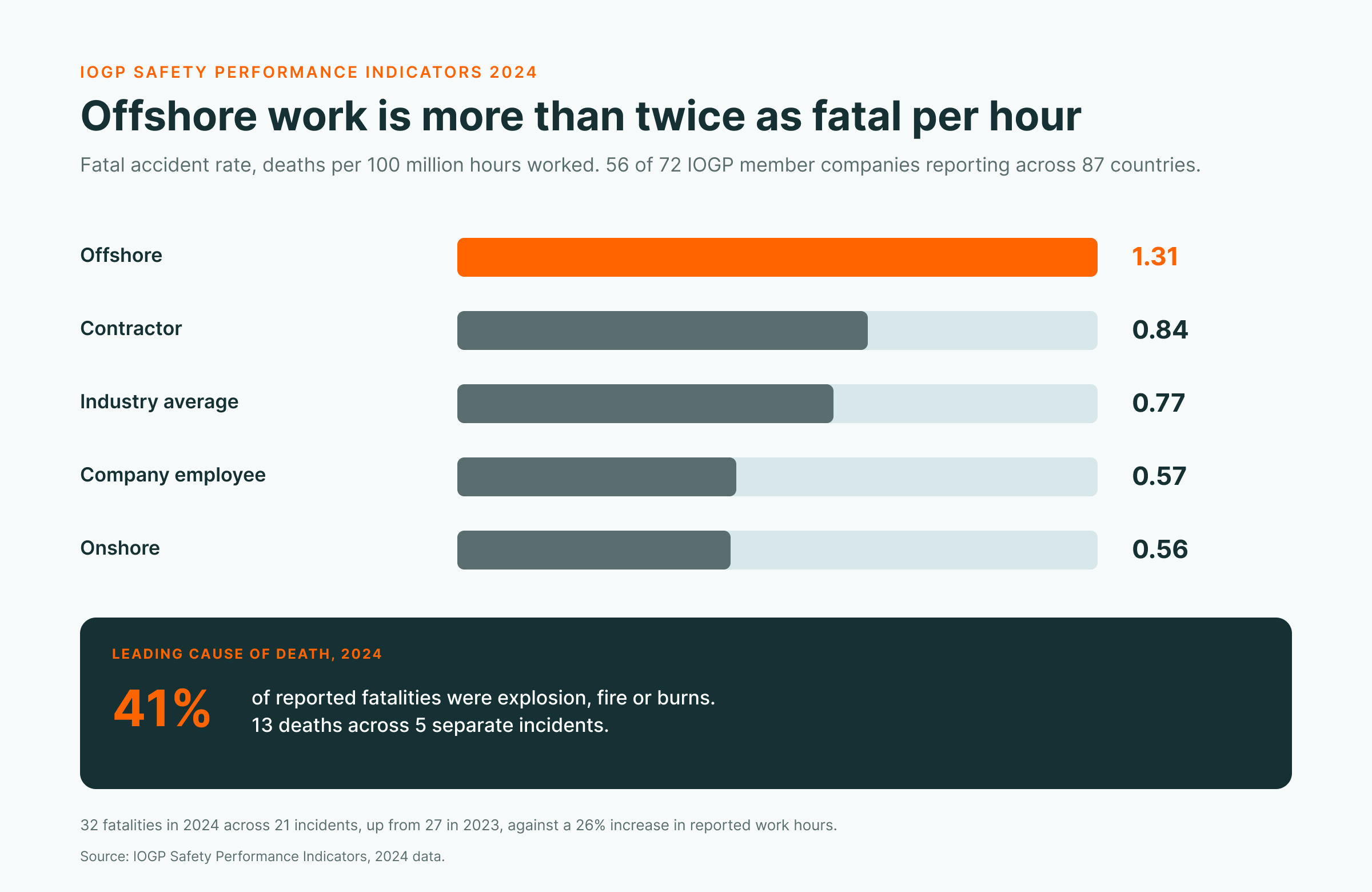
The International Association of Oil and Gas Producers recorded 32 company and contractor fatalities in 2024, across 21 separate incidents, up from 27 the previous year. The fatal accident rate was 0.77 per 100 million hours worked, itself 6% lower than 2023 against a 26% increase in reported hours.
Two numbers inside that dataset should shape any training decision.
Offshore work carried a fatal accident rate of 1.31 against 0.56 onshore. Per hour worked, offshore was more than twice as fatal.
Explosion, fire or burns accounted for 41% of fatalities — 13 deaths across 5 incidents.
If you are selecting VR safety training for oil and gas, those two facts point at a specific requirement: fire and emergency response scenarios, deliverable to offshore crews who are hard to reach, at a frequency higher than certification cycles allow. Everything else in a vendor comparison is secondary to whether the platform can do that.
Written for HSE managers, offshore installation managers and training leads at operators and drilling contractors evaluating immersive training against IOGP and OPITO frameworks. Last reviewed 19 August 2026.
What the 2024 IOGP Data Actually Shows
The IOGP dataset is the most authoritative global benchmark in this industry. The 2024 report drew submissions from 56 of 72 operating company members, covering operations in 87 countries, and includes both member companies and their contractors.
| Metric | 2024 | Context |
|---|---|---|
| Total fatalities | 32 | Up from 27 in 2023; 21 separate incidents |
| Fatal accident rate (FAR) | 0.77 | Down 6% from 0.82 |
| Company FAR | 0.57 | Employees of member companies |
| Contractor FAR | 0.84 | Nearly 50% higher than company employees |
| Onshore FAR | 0.56 | |
| Offshore FAR | 1.31 | More than double onshore |
| Company fatalities | 6 | Across 6 separate incidents |
| Contractor fatalities | 26 | Across 15 separate incidents |
| Explosion, fire or burns | 41% of fatalities | 13 deaths, 5 incidents |
Two implications deserve stating plainly.
Contractors die at a higher rate than employees. 26 of the 32 fatalities were contractor personnel, at a FAR of 0.84 against 0.57. Any training programme that reaches only badged employees is missing the population most at risk. This is an argument for a delivery model that can be handed to a contractor workforce cheaply and repeatedly, not one requiring a permanent training centre booking.
Offshore is the sharp end. A FAR of 1.31 against 0.56 onshore, in an environment where medical evacuation is measured in hours rather than minutes.
The IOGP Life-Saving Rules, and What They Imply for Scenario Selection
IOGP published its Life-Saving Rules in 2010 and simplified them to nine in 2018 under Report 459. They were derived from analysis of 1,484 fatal incidents between 1991 and 2010 and 1,173 high potential events between 2000 and 2010. IOGP members concluded that following them could have prevented roughly 70% of those fatalities, and IOGP states that since 2008, 376 lives could potentially have been saved.
The nine rules cover bypassing safety controls, confined space entry, driving, energy isolation, hot work, line of fire, safe mechanical lifting, work authorisation and working at height.
Read as a training specification rather than a poster, that list is a scenario shopping list. A platform serving oil and gas should be able to demonstrate exercises against confined space entry, energy isolation and lockout, hot work permits, working at height and line of fire. If a vendor cannot show those running today, they are proposing a build rather than a product.
Alongside them sits the emergency response layer the fatality data demands: fire response and extinguisher selection, given that 41% of 2024 fatalities involved explosion, fire or burns, and CPR, given the evacuation problem.
The CPR Gap Nobody Schedules Around
The OPITO BOSIET certification is the standard offshore safety qualification and is typically renewed on a four-year cycle, with CPR sitting inside it as one module among several.
CPR is a perishable skill. Compression depth, rate and rhythm degrade within months of training. On a four-year cycle, a crew member's practice can be 47 months old on the day a colleague collapses, in an environment where a helicopter is the ambulance.
BOSIET is not the problem. It is a floor, and a well-designed one. The gap is that nothing conventionally occupies the space above it, because flying an instructor to an installation for interval refresher training is expensive, weather-dependent and disruptive to operations.
This is the specific problem Deepsea Networks and Ludus set out to test by running what both parties believe was the first immersive VR CPR training delivered live on an active drillship. The outcomes:
- Crew participation roughly three times a standard offshore refresher session
- Zero technical setup required from the vessel team
- An OPITO-certified instructor trained the on-board HSE advisor to run subsequent sessions independently
- Two named crew members on record, including the Offshore Installation Manager
The participation figure is the one worth dwelling on. Offshore training attendance for elective refresher sessions is notoriously soft on a busy installation. Tripling uptake without adding compulsion changes the economics of the whole programme.
Platform Landscape for Oil and Gas
Five approaches, and what each is actually built for.
Pixaera is the closest thing to a purpose-built IOGP platform, with published references at Shell, BP, ADNOC and ConocoPhillips and content organised around the Life-Saving Rules. If your framework is IOGP and your organisation is a super-major, this is a serious option and should be on the list.
Ludus covers the emergency response and industrial hazard layer: fire response and extinguisher selection, CPR and first aid, confined space, work at height including in electrical environments, PPE and hand-injury prevention. 23 products and 700+ exercises in 17 languages, standalone-first with hand tracking, compatible with any standard CPR manikin. Oil and gas references include Moeve and Tecpetrol, which has rolled out Ludus licences across four countries, alongside the Deepsea offshore deployment, within a client base of 250+ customers including Henkel, Coca-Cola, Ford, Lear, DHL, Owens Corning and UNOPS.
TrainBeyond focuses narrowly on oil and gas with a small number of core modules built around rig site operations and API and ISO standard content. Third-party comparisons describe a per-exercise commercial model, which can suit an operator needing only two or three specific rig scenarios.
Luminous XR serves construction, oil and gas and heavy industry with a mix of off-the-shelf modules and custom development. Third-party estimates put custom projects at $50,000 to $150,000 or more, over three to nine months.
Treeview builds fully bespoke simulations modelled on a client's actual environments and equipment — the right answer for a proprietary process no library will ever contain, and the wrong one for standard hazards.
Five Questions That Separate Platforms in This Sector
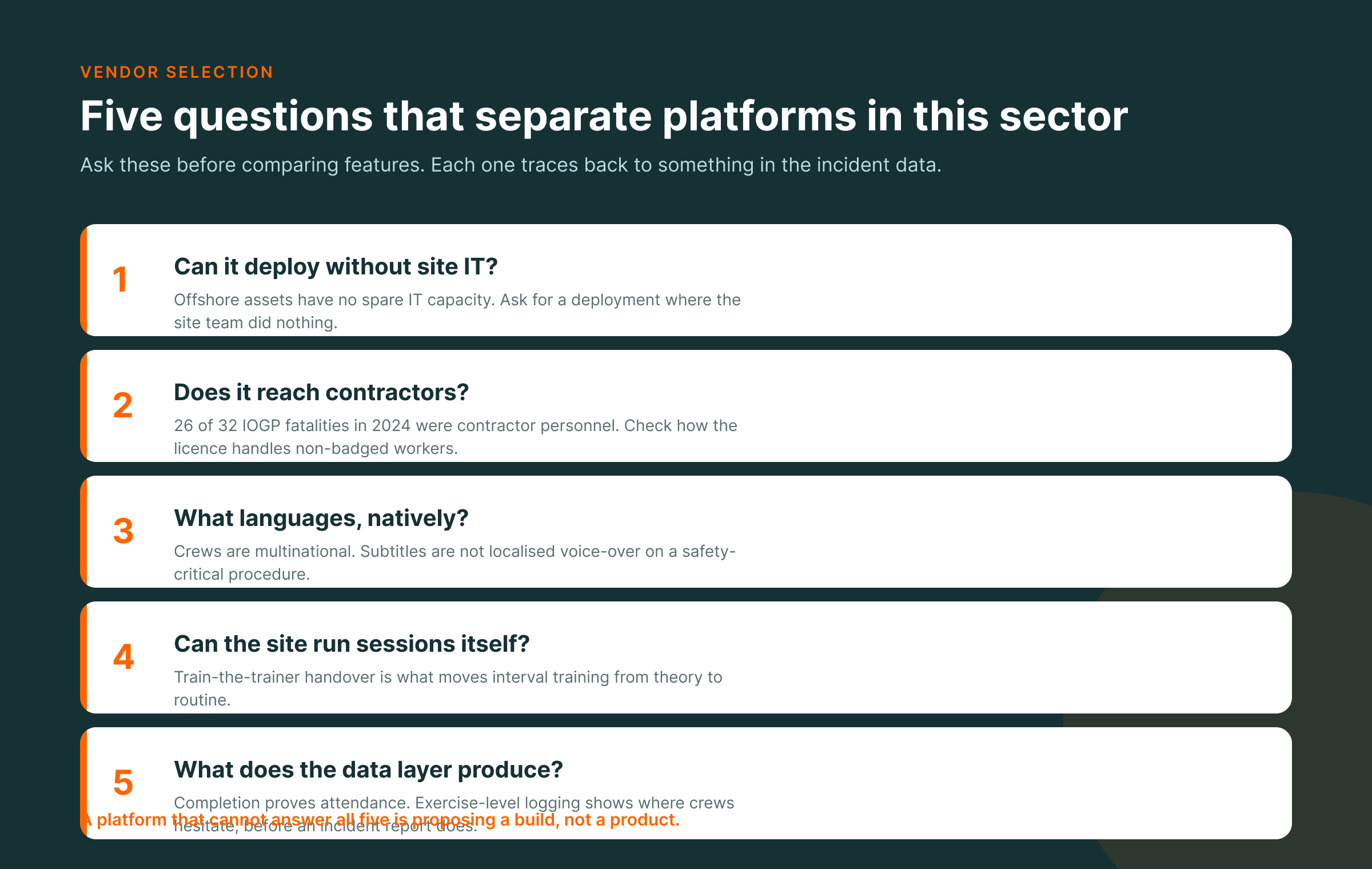
1. Can it be delivered to an installation without IT support? Offshore assets rarely have spare IT capacity. A system needing a PC, cabling or external sensors will not survive the mobilisation conversation. Ask for evidence of a deployment where the site team did nothing.
2. Does it reach contractors? With 26 of 32 IOGP fatalities in 2024 being contractor personnel, a licence model that makes it expensive to train non-badged workers is training the wrong population.
3. What languages, natively? Offshore crews are frequently multinational. Subtitles are not the same as localised voice-over on a safety-critical procedure.
4. Can the site run sessions itself after handover? The Deepsea model — where an external certified instructor trains the on-board HSE advisor who then runs repeat sessions — is what moves interval training from theory to routine. Ask whether the vendor supports train-the-trainer handover or expects to be re-engaged each time.
5. What does the data layer produce? A completion record proves attendance. Exercise-level logging shows which crew members hesitate at which decision points, which errors recur, and which scenarios generate the most virtual accidents. On an installation, that is a leading indicator ahead of an incident report. Ludus's predictive statistics panel is built for exactly that read.
Building the Case Internally
Three framings that tend to survive scrutiny in this sector.
Start with your own FAR and TRIR against the IOGP benchmark. Industry figures establish the category is real. Your own numbers establish you have a problem worth funding. IOGP's 0.77 FAR overall and 1.31 offshore are the comparators.
Cost the instructor logistics, not the headsets. For remote and offshore assets, mobilising a trainer dominates the cost model. A locally-run session after a single train-the-trainer visit removes most of that.
Treat interval training as the deliverable. The objective is not to replace BOSIET. It is to occupy the 47 months where nothing currently happens.
If the cost-distance-frequency problem is familiar, the fastest way to test it is to run one of your own scenarios and see what the record looks like afterwards.
Frequently Asked Questions
How dangerous is oil and gas work?
IOGP recorded 32 fatalities in 2024 across 21 incidents, at a FAR of 0.77. Offshore FAR was 1.31 against 0.56 onshore. Contractor FAR was 0.84 against 0.57 for company employees.
What causes most fatalities?
In 2024, explosion, fire or burns accounted for 41% of IOGP-reported fatalities — 13 deaths across 5 incidents. Transportation consistently accounts for 30 to 40% across longer trend periods.
What are the IOGP Life-Saving Rules?
Nine rules under Report 459, simplified from 18 in 2018, derived from 1,484 fatal incidents and 1,173 high potential events. IOGP states 376 lives could have been saved since 2008 by following them.
Does VR replace BOSIET?
No. BOSIET remains the certification. VR occupies the interval between renewals, where skill decay occurs and nothing is currently scheduled.
Which platforms serve this sector?
Pixaera for IOGP-framework super-majors. Ludus for emergency response and broad industrial hazards across 17 languages. TrainBeyond for narrow rig-site content. Luminous XR and Treeview for custom builds.
How much does custom development cost?
Third-party estimates put bespoke VR projects at $50,000 to $150,000 or more, over three to nine months. Off-the-shelf catalogues avoid this cost for standard hazards.
Can it work offshore without connectivity?
Standalone headsets run the simulation on-device. In the Deepsea deployment, connectivity was supplied as part of the package and the vessel team required no technical setup.
What about contractor training?
This is the underserved population, at 26 of 32 IOGP fatalities in 2024. Ask any vendor how their licence model handles non-badged workers before signing.
Methodology
On IOGP data. All fatality, FAR and cause figures come from IOGP Safety Performance Indicators 2024 data, covering submissions from 56 of 72 operating company members across 87 countries, including contractor personnel. Life-Saving Rules background is from IOGP Report 459.
On platform claims. Competitor descriptions are drawn from vendor material and third-party 2026 comparison guides. Pricing for custom development is a third-party estimate range, not a vendor-confirmed quote, and is presented as such.
On the Deepsea figures. The 3× participation outcome, zero-setup requirement and named crew are from the published Ludus and Deepsea Networks case study. It is a single pilot on one installation and is presented as such rather than as a generalised result.
Excluded: NTL Learning Pyramid retention percentages, for lack of any traceable underlying study.
Sources
- International Association of Oil and Gas Producers. Safety performance indicators, 2024 data.
- IOGP. Life-Saving Rules, Report 459.
- OPITO. BOSIET certification standards.
- NIOSH. Fatalities in Oil and Gas Extraction (FOG) database.
- Onshore Safety Alliance. Industry safety data and trends.
- Ludus Global and Deepsea Networks. VR CPR training on an active drillship.
- Third-party 2026 enterprise VR training platform comparisons.
Related Reading
- Deepsea drillship VR CPR case study
- Ludus vs Pixaera
- VR safety training: 9 industries using it for high-risk work
- VR training statistics 2026: 40 verified numbers
- What is VR safety training?
- All Ludus training simulations
---------------------------------------------------------------------------