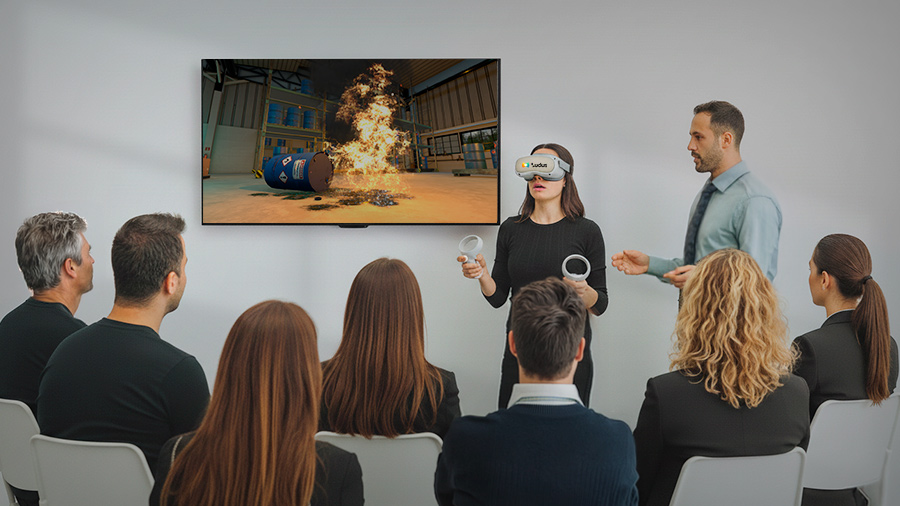
VR medical training has the strongest evidence base of any VR training application, because medical education has a research culture that runs trials. Multiple randomised controlled trials published across 2024 and 2025 tested VR against traditional simulation for CPR, emergency response, radiation safety and intensive care procedures. The consistent finding is that VR performs at least as well as traditional simulation on knowledge and skill acquisition, and better on engagement, confidence and self-directed learning.
What the evidence does not support is replacement. VR increases how often people practise and how engaged they are while practising. It does not remove the need for hands-on manikin work or accredited certification.
Last reviewed 27 July 2026.
The Problem Healthcare Is Actually Solving
Two problems, and most hospitals are only counting one of them.
Clinical skill decay between certifications. CPR competence degrades within months. Certification cycles run in years. Every hospital knows this and very few have a practical way to close the gap, because instructor-led refresher sessions require scheduling clinical staff away from patients — the scarcest resource in the building.
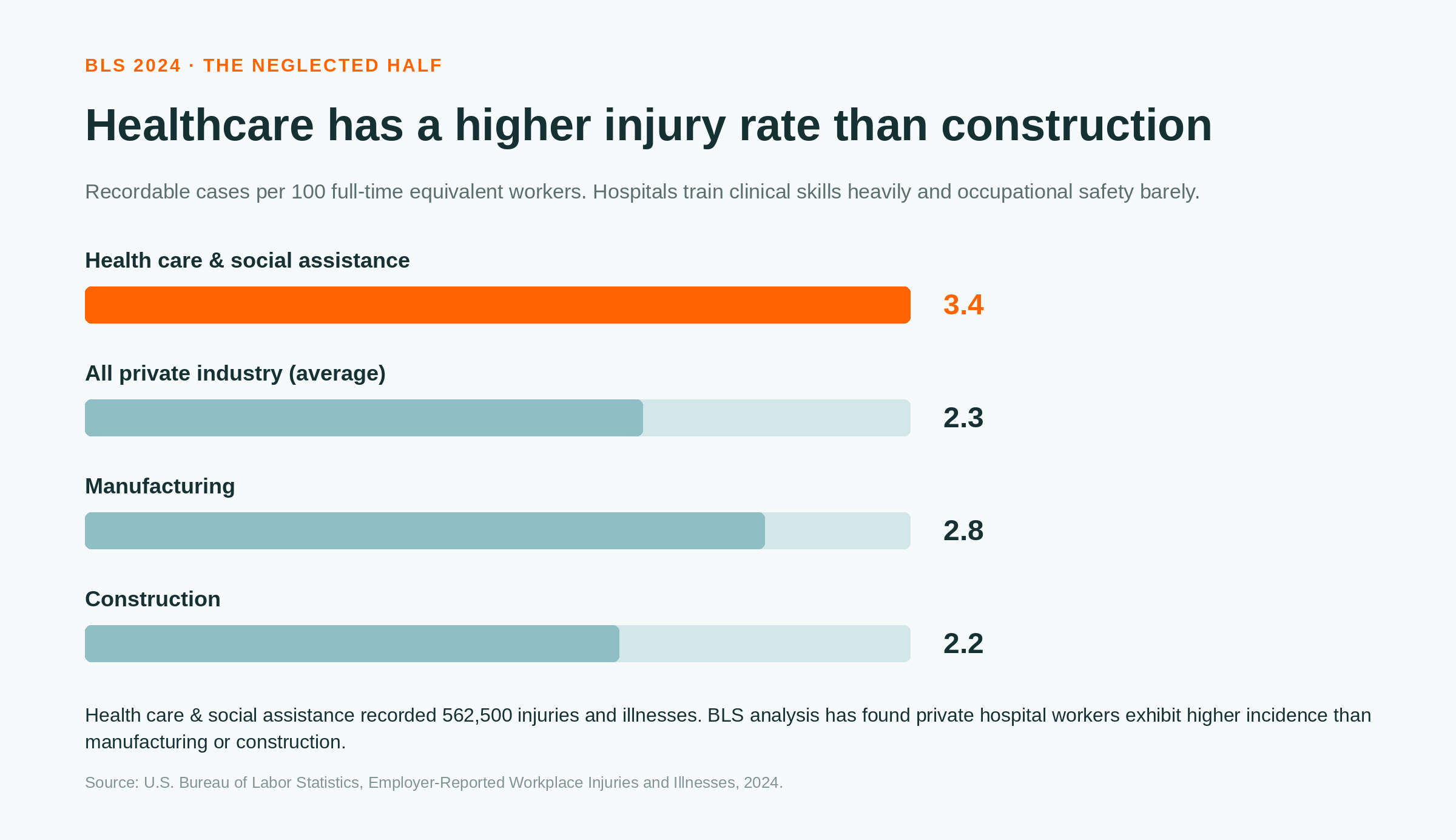
Occupational injury among healthcare workers themselves. This is the one that gets under-resourced. The health care and social assistance sector recorded a total recordable case rate of 3.4 per 100 full-time equivalent workers in 2024, against an all-industry private sector average of 2.3. BLS analysis of hospital workers has found private industry hospital workers exhibit a higher incidence of injury and illness than employees in manufacturing or construction. Health care and social assistance recorded 562,500 injuries and illnesses in a single year.
Patient handling and repositioning drive overexertion injuries. Workplace violence from patients and visitors is a persistent hazard at rates well above most industries. Needlestick and sharps exposure remains a leading incident category, alongside slips, trips and falls.
There is also an ageing-workforce compounding effect: where healthcare workers over 40 are injured, claims are substantially more likely to become expensive lost-time claims, with older workers' claim costs running materially higher than younger workers' due to slower recovery.
The honest framing for a hospital is that VR has two separate business cases — and the occupational safety one is usually the neglected half.
What the 2025 Trials Actually Found
Each study below is a randomised controlled trial published in a peer-reviewed venue.
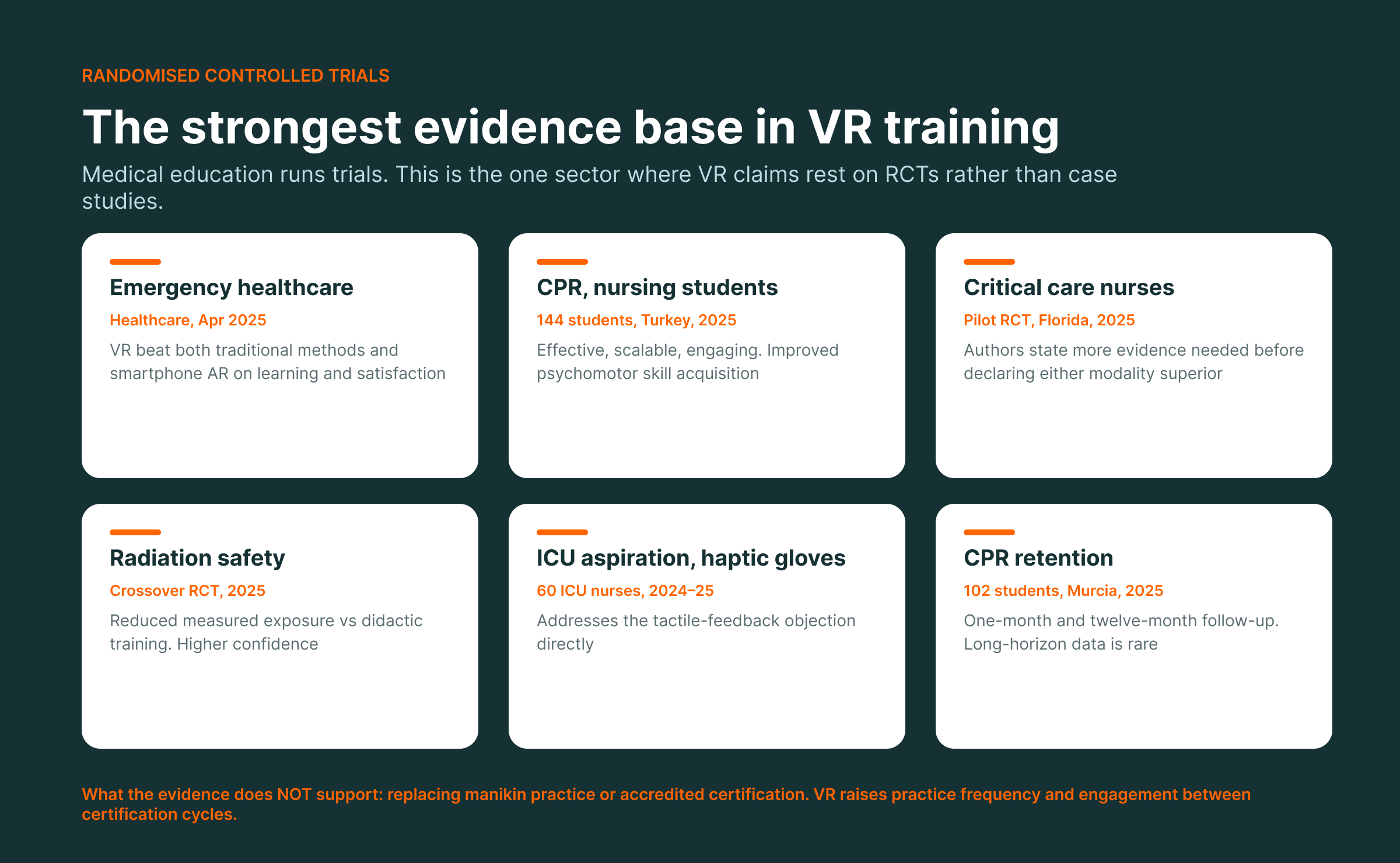
Emergency healthcare training — Healthcare, April 2025. A randomised controlled trial with two intervention groups compared VR and smartphone-based augmented reality against traditional methods for CPR and emergency care training. VR-based learning produced significantly better results in both learning outcomes and user satisfaction than traditional methods and than the AR comparator. Notable because it tested VR against a second technology arm rather than only against classroom.
CPR training for nursing students, 2025. A randomised controlled trial with 144 second-year nursing students at a state university in Turkey compared VR-based training on Oculus Quest 2 headsets against traditional simulation. Both groups received the same theoretical instruction first. Assessment used a CPR knowledge test, a self-directed learning skills scale, the Kolb Learning Style Inventory, a simulation design scale, and an OSCE for CPR skills. The conclusion was that VR-based CPR training is effective, scalable and engaging, enhancing psychomotor skill acquisition and promoting cognitive engagement.
Critical care nurse resuscitation training, 2025. A randomised controlled pilot at a not-for-profit hospital in Central Florida examined VR simulation against traditional manikin-based simulation for cardiopulmonary arrest management, measuring knowledge and confidence. The authors are explicit that more evidence is required before either modality can be declared superior — which is the appropriately cautious reading of the current literature.
Radiation safety, 2025. A randomised crossover study of medical professionals found immersive VR training reduced measured radiation exposure compared with traditional didactic training, with higher confidence and satisfaction.
Intensive care aspiration skills with haptic gloves, 2024–2025. A randomised controlled trial of 60 intensive care nurses across adult, coronary and neonatal ICUs tested haptic-glove-based VR training on aspiration skills and caregiving behaviours. Relevant because it addresses the most common objection to VR for clinical procedures: the absence of tactile feedback.
Long-term retention — Spain, 2025. A randomised trial of 102 secondary school students in the Region of Murcia compared immersive VR CPR training against traditional theoretical training and a no-intervention control, with follow-up at one month and twelve months. Trials with twelve-month follow-up are rare and disproportionately valuable, because retention over time is the actual question in CPR training.
What the body of evidence supports: VR performs at least as well as traditional simulation on knowledge and psychomotor skill, and better on engagement, confidence and self-directed learning. Portability and cost advantages are consistently noted, since traditional manikin-based simulation is constrained by cost, space and scheduling.
What it does not support: replacing manikin practice or accredited certification. The Florida authors say directly that more evidence is needed before declaring either modality superior. Anyone selling VR as a wholesale replacement for hands-on CPR training is ahead of the literature.
The Deployment Model the Evidence Points To
The strongest configuration is not VR instead of a manikin. It is VR with a manikin.
The headset delivers the scenario: the patient, the setting, the bystanders, the time pressure, the decision points. The manikin delivers the physical compression practice. The worker gets realistic conditions and real tactile feedback in the same exercise.
This is how the Ludus CPR simulation is built. It runs wireless on a standalone headset, uses hand tracking so clinicians work with their own hands rather than controllers, and is compatible with any standard CPR manikin rather than requiring a proprietary sensorised unit. The practical consequence is that a hospital already holding manikins keeps using them.
The Deepsea Networks deployment is the clearest demonstration of what this unlocks operationally. VR CPR training was delivered on an active offshore drillship with no technical setup required from the vessel team, and crew participation ran at roughly three times a standard session. An OPITO-certified instructor trained the on-board HSE Advisor to run subsequent sessions independently. That model — where an external expert trains an internal person who then runs repeat sessions — translates directly to a hospital ward.
The Occupational Safety Half
Everything above concerns clinical skills. The second business case covers the hospital as a workplace, and it maps onto the same catalogue any industrial employer uses.
Patient handling and ergonomics. Sharps and needlestick prevention. Fire response and evacuation in a setting where evacuation means moving non-ambulatory patients. Electrical safety in clinical environments. Confined space and plant rooms. Workplace violence de-escalation, which healthcare needs more than almost any other sector.
This is where a general HSE platform has an advantage over a purely clinical simulation product. Ludus runs 23 products and more than 700 exercises across VR and Mixed Reality under one licence, in 17 languages, covering both clinical scenarios and occupational ones. The client base spans Henkel, Coca-Cola, Ford, Moeve, Lear, DHL, Owens Corning and UNOPS (the United Nations), with 250+ customers and a 97% annual renewal rate. For a hospital group, the relevant point is that the occupational safety catalogue is the same one industrial employers already rely on, rather than a thin add-on to a clinical product.
Every exercise feeds the predictive statistics panel, which for a healthcare training lead means seeing which errors recur across which wards and which scenarios generate the most virtual incidents — rather than a completion percentage.
Costs, Stated Carefully
The figure circulating in healthcare VR discussions is up to $23,000 saved per trainee-trainer pair. It is specific to aseptic technique training, where the saving comes from reduced lab time and instructor presence. It gets repurposed as a CPR figure regularly and it should not be.
For CPR and emergency response, the honest economics are about scheduling rather than a headline saving: removing the instructor bottleneck, enabling short repeat sessions between certification cycles, and cutting the clinical hours lost to travelling to a simulation centre. Those are measurable from a hospital's own rostering data, which makes them more defensible than any external figure.
Hardware costs are the same as any sector: $349.99 for a Meta Quest 3S, $599.99 for a Quest 3, $699 for a PICO 4 Ultra Enterprise. Quest 3 pricing rose in April 2026, so check any budget built earlier. Ludus offers the headset on a hire basis alongside its VR training platform.
What to Do Next
If you are evaluating for a hospital or healthcare group, the useful pilot is narrow: one clinical scenario, one occupational safety scenario, one ward, one quarter. That produces participation data, competency data and staff feedback across both halves of the business case at once.
Running one of your own scenarios through the simulator is the fastest way to establish whether the content depth supports it.
Frequently Asked Questions
Is there real trial evidence for VR medical training?
Yes. Multiple randomised controlled trials published in 2024 and 2025 across CPR, emergency care, radiation safety and ICU procedures. This is the strongest evidence base of any VR training application.
Does VR replace manikin-based CPR training?
No. Evidence supports VR as a supplement that raises practice frequency and engagement between certification cycles. Trial authors are explicit that neither modality has been shown superior overall.
Are hospitals more dangerous than construction sites?
By non-fatal injury rate, yes. Health care and social assistance recorded 3.4 recordable cases per 100 FTE in 2024 against 2.3 across private industry.
What is the strongest single study?
The April 2025 randomised controlled trial in Healthcare, because it tested VR against both traditional methods and a smartphone AR arm and found VR better on learning and satisfaction.
What about long-term retention?
The Murcia trial with twelve-month follow-up is the most useful reference. Trials that follow up a year later are rare and matter more than immediate post-test results.
Does VR CPR work without haptic feedback?
The evidence supports pairing VR with a standard manikin so physical compression practice is retained. A 2024–2025 RCT also tested haptic gloves for ICU aspiration skills, which is a developing area.
What does it cost?
Hardware from $349.99 per headset. The $23,000 per trainee-trainer pair figure belongs to aseptic technique training specifically and should not be applied to CPR.
What is the most neglected use case in healthcare?
Occupational safety for staff. Patient handling, sharps, violence de-escalation and evacuation are under-trained because clinical education absorbs the budget, despite healthcare's injury rate exceeding construction and manufacturing.
Methodology
On the evidence base. Healthcare is the one sector where VR training claims can be supported by randomised controlled trials rather than vendor case studies. This article cites RCTs published 2024–2025 in peer-reviewed venues. Where trial authors qualify their own findings, those qualifications are reproduced rather than removed.
On the $23,000 figure. Specific to aseptic technique training. It appears in earlier Ludus content attributed to CPR, which is incorrect and is being fixed.
On hardware pricing. Earlier Ludus articles quote approximately $499 for a Meta Quest 3. Superseded following the April 2026 increase to $599.99.
Sources
- U.S. Bureau of Labor Statistics. Employer-Reported Workplace Injuries and Illnesses, 2023–2024.
- U.S. Bureau of Labor Statistics. Hospital workers: an assessment of occupational injuries and illnesses. Monthly Labor Review.
- Effectiveness of Virtual and Augmented Reality for Emergency Healthcare Training: A Randomized Controlled Trial. Healthcare, April 2025.
- Evaluating the effectiveness of virtual reality simulation in CPR training for nursing students: A randomized controlled trial. 2025.
- Exploring the role of virtual reality simulation in critical care nurses' training: A randomized controlled pilot study. 2025.
- Virtual reality versus theoretical training in CPR among adolescents: a randomized trial with a one-year longitudinal follow-up. 2025.
- Randomised controlled trial of haptic-glove VR training on ICU nurses' aspiration skills, 2024–2025.
- Comparative effectiveness of immersive VR and traditional training on radiation safety, 2025.
- Ludus Global. Deepsea Networks case study and platform pages. ludusglobal.com/en
Related Reading
- Ludus CPR simulation — hand tracking, real-time feedback, any manikin
- VR training statistics 2026: 40 verified numbers
- VR safety training: 9 industries using it for high-risk work
- What is VR safety training?
- Deepsea drillship VR CPR case study
- All Ludus training simulations
---------------------------------------------------------------------------