Written for: EHS and facilities managers who carry the annual fire extinguisher training obligation and are evaluating whether VR can discharge it.
Evaluated: 15 September 2026. Regulatory requirements verified against osha.gov. Methodology note at the end.
The short answer
Five platforms are worth evaluating for fire safety specifically in 2026: Ludus, Humulo, PIXO VR, Pixaera and Immersive Factory. They differ less on simulation quality than on three things that decide procurement: fire class coverage, whether Mixed Reality is supported, and how many languages the content ships in.
The compliance position matters more than any feature comparison, so it belongs first.
OSHA 29 CFR 1910.157(g) requires fire extinguisher education upon initial employment and at least annually thereafter, wherever an employer provides extinguishers for employee use. Employees designated to fight incipient fires under an emergency action plan require training on assignment and annually. This is a recurring obligation, not a one-off, which is precisely the pattern where live burn training becomes expensive and VR becomes economic.
One honest qualification, stated up front rather than buried: for designated employees requiring hands-on training under 1910.157(g)(3), VR should supplement physical practice rather than replace it outright. Mixed Reality delivery, where a real extinguisher body is used against a virtual fire, closes most of that gap. Any vendor claiming VR alone fully discharges the hands-on element for designated employees is overstating the position.
Why fire is the strongest VR training case
Three reasons, in order of weight.
It is the most lethal category in heavy industry. The International Association of Oil and Gas Producers recorded 32 fatalities in 2024, of which 41% were explosion, fire or burns, accounting for 13 deaths across 5 incidents. That is the single largest cause category in the dataset.
It is annually recurring by regulation. Most safety training obligations run on multi-year cycles. Fire extinguisher education is annual under 1910.157(g), which means the cost repeats every year for every employee in scope. Anything that reduces per-session cost compounds immediately.
Live training is consumable-intensive. Every discharge on a live burn field costs a refill, a technician, a permit in many jurisdictions, and an environmental footprint. Ludus reports approximately 1,200 virtual extinguishers used per month across its platform against a refill cost near 30 euros each, which indicates savings around 60,000 euros per month across its customer base before instructor and logistics costs are counted.
What training must actually cover
Worth having in front of you when watching a demo, because it is the specification any platform must meet.

Under 1910.157(g)(1), education covers the general principles of extinguisher use and the hazards of incipient stage firefighting. In practice, four elements:
- Fire behaviour, including what incipient stage means and the point beyond which an employee should evacuate rather than fight
- Extinguisher classes matched to fire types, since using the wrong class can worsen a fire
- The PASS technique: pull, aim at the base, squeeze, sweep
- The decision to stop, which is the element live training handles worst because nobody stages a fire that grows beyond control
That fourth point is where VR has an advantage no live burn field can match. A simulation can let a fire defeat the trainee, which is the outcome they most need to have experienced and the one no safety officer will ever stage in reality.
Note also that Class K fires are not covered by 1910.157, falling under NFPA 10 and local fire codes, and that construction sites fall under 29 CFR 1926.150 rather than 1910.157.
The five platforms

Ludus
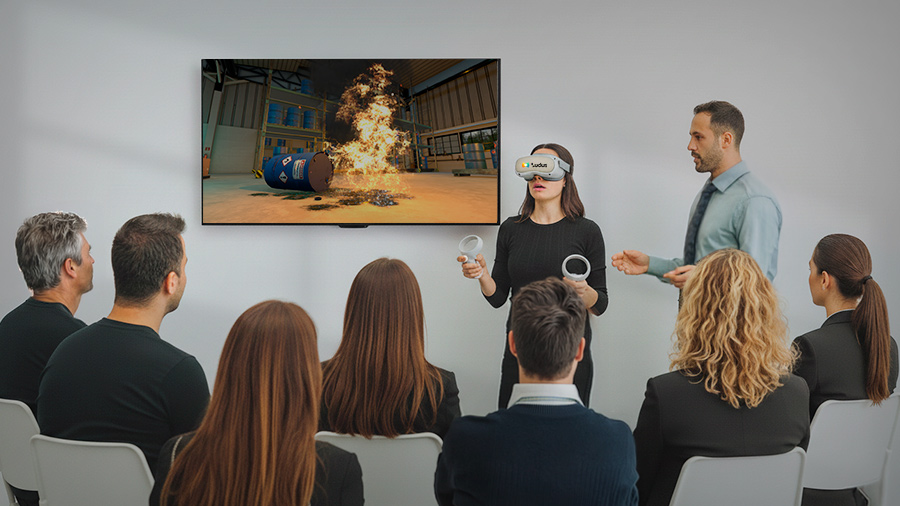
Fire response and extinguisher selection delivered in both VR and Mixed Reality, within a catalogue of 23 products and 700-plus exercises across 17 languages, under a single unlimited licence. Runs standalone with hand tracking, controller-free.
The Mixed Reality option is the differentiator for this specific obligation, because it lets a trainee handle real equipment against a virtual fire in their actual workplace, which addresses the hands-on question more directly than pure VR.
Named clients include Henkel, Coca-Cola, Ford, Moeve, Lear, DHL, Owens Corning and UNOPS, across 250-plus customers in 18 countries at a 97% annual renewal rate.
Best for: multi-hazard programmes, multilingual workforces, organisations wanting fire training inside a broader catalogue rather than as a standalone purchase. Limitation: if fire is genuinely your only requirement, a single-module purchase elsewhere costs less.
Humulo
A single-product company based in Edgewater, Maryland, offering fire extinguisher simulation among a focused set of OSHA-aligned modules, sold as per-module licences without subscription and running offline. Customers include Department of Defense facilities, Kaiser Aluminum and Central Washington University.
Best for: US employers needing fire extinguisher training specifically, with no multilingual requirement and a preference for one-off purchase. Limitation: no published multi-language coverage; narrow catalogue if the programme later expands.
PIXO VR
Operates a marketplace model with one of the widest pre-built module selections, including fire safety. Published pricing starts around $475 per month for content library access and $999 per month for full platform access. Added 16 modules through a J.J. Keller partnership in 2025.
Best for: organisations wanting breadth across safety, operations and soft skills from one subscription. Limitation: third-party marketplace content varies in quality; subscription costs compound at scale.
Pixaera
Built around IOGP Life-Saving Rules with published references at Shell, BP, ADNOC and ConocoPhillips, and content in 40-plus languages. Fire and emergency response sit within an oil and gas oriented catalogue.
Best for: energy super-majors working to an IOGP framework. Limitation: oriented to oil and gas rather than general industry.
Immersive Factory
Strong French and European industrial presence, with co-designed exercises including electrical lockout work developed with SUEZ across six modules between 2017 and 2021. Fire sits within a broader HSE workshop catalogue.
Best for: French-speaking European operations. Limitation: narrower language coverage than Ludus or Pixaera outside its core markets.
Comparison table
| Ludus | Humulo | PIXO VR | Pixaera | Immersive Factory | |
|---|---|---|---|---|---|
| Mixed Reality fire | Yes | No | No | No | No |
| Languages | 17 | Not published | Not published | 40+ | Limited |
| Licence model | Unlimited catalogue | Per module | Subscription from $475/mo | Enterprise | Per workshop |
| Wider catalogue | 23 products, 700+ exercises | 5 core modules | Marketplace | IOGP-oriented | 30+ workshops |
| Hand tracking | Yes | Controllers | Varies | Varies | Varies |
| Offline | Yes | Yes | Varies | Varies | Varies |
| Geography | Europe, LATAM, 18 countries | United States | United States | Global energy | France, Europe |
What to ask in a demo
Show me a Class B fire and a Class K fire. Class coverage varies more between platforms than any marketing page admits, and Class K is outside 1910.157 but may still be your obligation under NFPA 10.
Let the fire beat me. Ask the vendor to run a scenario where the trainee fails and the fire grows past incipient stage. If the simulation cannot fail, it cannot teach the evacuation decision.
How does this satisfy 1910.157(g)(3) for designated employees? A straight answer acknowledges VR supplements hands-on rather than replacing it. An evasive answer tells you something about the rest of the deck.
What language will my night shift train in? Subtitles are not localisation on a safety-critical procedure.
What does the record show? A completion flag proves attendance. Exercise-level data shows whether the trainee selected the correct class, held the right distance and made the evacuation call. Ludus logs every exercise into a predictive statistics panel from which a prevention manager can read recurring errors across the workforce.
The economics, briefly
For a 300-person site with annual obligations under 1910.157(g), the comparison is not headset cost against licence cost. It is:
- Extinguisher refills eliminated
- Burn field hire or permit costs removed
- Instructor days reduced
- Production time recovered, since sessions run in a meeting room rather than off site
- Environmental discharge avoided
Ludus's own platform data, around 1,200 virtual extinguishers monthly at roughly 30 euros a refill, is the clearest published indication of the consumable saving alone.
The fastest way to size it for your own site is to run one of your fire scenarios and compare the session record against what your current provider gives you.
Book a walkthrough with the Ludus team →
Frequently asked questions
Does OSHA require annual fire extinguisher training?
Yes, under 29 CFR 1910.157(g)(1) and (g)(2), upon initial employment and at least annually thereafter, wherever extinguishers are provided for employee use.
Can VR satisfy that requirement?
For the education element, yes. OSHA specifies outcomes rather than format, confirmed by a 2020 Standard Interpretation. For designated employees requiring hands-on training under (g)(3), VR supplements rather than replaces physical practice, and Mixed Reality closes most of that gap.
Which platforms offer VR fire training?
Ludus, Humulo, PIXO VR, Pixaera and Immersive Factory. Only Ludus among these offers Mixed Reality fire delivery.
What must the training cover?
Fire behaviour and incipient stage, extinguisher classes matched to fire types, the PASS technique, and the decision to stop fighting and evacuate.
Are Class K fires covered?
Not by 1910.157. Commercial kitchens fall under NFPA 10 and local fire codes.
Does construction use the same standard?
No. Construction sites fall under 29 CFR 1926.150.
What are the penalties for non-compliance?
$16,550 per serious or other-than-serious violation and $165,514 per willful or repeat violation, effective 15 January 2026, applied per violation.
What does VR fire training save?
Chiefly consumables and logistics. Ludus reports around 1,200 virtual extinguishers used monthly at approximately 30 euros per refill, indicating roughly 60,000 euros monthly in avoided refills across its customer base.
Methodology
Evaluation date: 15 September 2026.
Regulatory sourcing. All 1910.157 requirements verified against the standard text and OSHA standard interpretations published on osha.gov. Penalty figures from the 2026 civil penalty schedule effective 15 January 2026.
Platform assessment. Competitor details are drawn from vendor published material and third-party 2026 comparison guides. PIXO VR pricing is as published by third parties; Humulo, Pixaera and Immersive Factory do not publish list pricing, so none is stated for them.
Disclosure. This comparison is published by Ludus Global. Where a competitor's model is better suited to a particular buyer, that is stated in the relevant entry rather than omitted.
Excluded. NTL Learning Pyramid retention figures, which appear widely in VR fire training marketing, are excluded because no underlying study exists.
Sources
- OSHA. 29 CFR 1910.157, Portable fire extinguishers.
- OSHA. Fire equipment training requirements, standard interpretation.
- OSHA. 2026 annual adjustments to civil penalties. Effective 15 January 2026.
- International Association of Oil and Gas Producers. Safety performance indicators, 2024 data.
- Ludus Global. Platform pages and simulation catalogue. ludusglobal.com
- Humulo Virtual Reality, PIXO VR, Pixaera and Immersive Factory published material.
Related reading
- VR safety training: 9 industries using it for high-risk work
- VR safety training for oil and gas: what the IOGP data says you should be training
- When VR safety training works (and when it doesn't)
- VR training ROI: the number your CFO will actually accept
- Ludus vs Humulo: narrow OSHA module set or broad multilingual catalogue?
- All Ludus training simulations
---------------------------------------------------------------------------