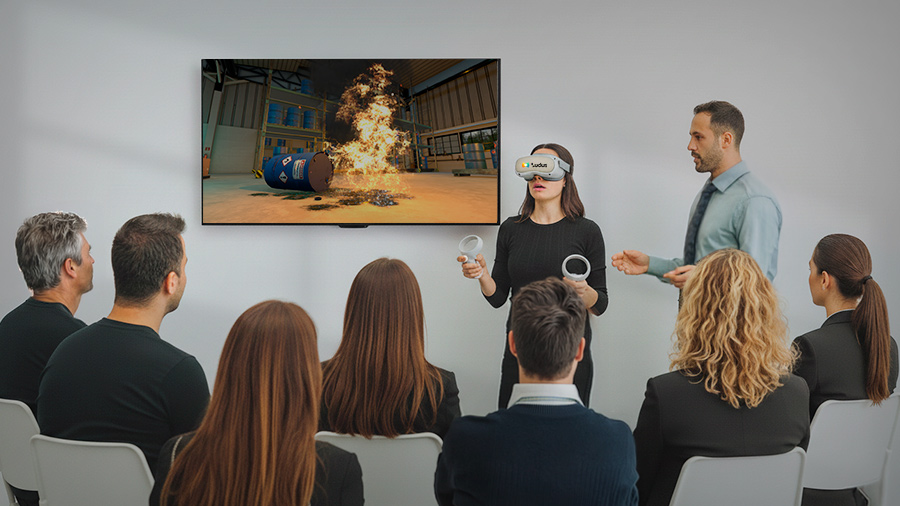
You have the headsets. You have the platform. You have the modules ready. In most cases, workers get on board quickly — the novelty and impact of the first session do most of the work. But in some teams, an initial challenge may arise: how do we get everyone to take that first step? It's not a technology problem. It's change management. And it has a solution.
Why initial resistance disappears on its own
Most workers who arrive with doubts about a VR training session change their attitude after trying it for the first time. Initial resistance isn't a rejection of technology — it's the natural response to any novelty that interrupts routine. The trainer's challenge isn't to convince, it's to get the worker to put on the headset for the first time.
The data backs this up: the 97% renewal rate among Ludus clients reflects that once a company incorporates virtual reality into its training programme, it doesn't turn back. And the reason is that workers themselves start asking for more. As Iñaki Etxeguren, Director of Hotel Ercilla, puts it: "Employees get hooked, and the training sessions become enjoyable."
5 strategies for introducing VR training successfully
1. Start with a demonstration, not a training session
The first contact with virtual reality shouldn't be a mandatory training session. It should be a voluntary demonstration, preferably in a low-pressure moment — a shift change, a team meeting, a safety day. The goal is for the worker to try the technology without the pressure of "having to learn something". Curiosity does the rest.
High emotional-impact simulations, like the Risk Awareness at Height one — which reproduces the real vertigo of standing at the top of a tower crane — work especially well in this context. They generate conversation, generate impact, and eliminate the "this is just a game" barrier.
2. Involve the most sceptical workers in the pilot phase
In any team, some workers carry more informal influence than others — the ones everyone looks to when something new comes along. If those workers are the first to try the platform and the first to share their opinion, their positive assessment carries more weight than any top-down communication.
The trick is to choose them deliberately: identify the most sceptical or most influential workers and give them a prominent role in the testing phase. Ask for their feedback. Make them part of the process. When they're the ones recommending the training to their colleagues, the persuasion work is done.
3. Use gamification as motivation, not as distraction
The Ludus platform generates outcome statistics at the end of each session: reaction time, mistakes made, protocol completed correctly or not. These data points can be used as positive motivation — not to penalise, but to let the worker see their progress in a tangible way.
Some companies run group sessions where workers compare results, encourage each other to improve, or compete in a friendly way on certain exercises. Gamification doesn't trivialise training — it makes it more memorable and more effective. According to the PwC study, learners trained with VR show 3.75 times greater emotional engagement with the content than those trained in a classroom. That connection is what drives retention.
4. Connect training to real situations in the role
A logistics worker who trains the Forklift Risks simulation in a scenario that visually replicates their own warehouse has a completely different experience from someone watching a generic video about warehouse safety. The feeling of "this is happening to me, in my workplace" is what turns a training session into a memory.
This means choosing modules carefully. Don't launch all available simulations at once — start with the ones most relevant to each worker's specific role. Personalising the training is one of the factors that most influences acceptance.
5. Collect and share internal testimonials
Nothing convinces a worker more than another worker's opinion. Collect spontaneous comments after the first sessions — especially from those who arrived with the most doubts — and share them internally. A phrase like "I thought it was going to be a gimmick and it surprised me" carries more weight than any rational argument.
Ana Blasco Prieto, from Mutua Montañesa, describes her experience after trying the Hand Injury Prevention simulation: "The new simulation was fantastic — the change of being able to use real hands was spectacular. It adds a level of realism that exceeds expectations. It's exactly what I'm looking for: that impact that makes workers react and see what could happen to them."
What trainers who have already done it say
The experience of trainers who have been using the Ludus platform for some time consistently points in the same direction: the initial challenge disappears quickly, and what remains is a demand for more.
Francisco Javier Cejudo, Head of Training at Prosegur, sums it up precisely: "As a trainer, this technology allows you to step out of the standard classroom format. We manage to give a more realistic value to the situations the learner faces, and the sessions are much more dynamic and participative."
Agustín Santos, Training Manager at Europreven — who has trained more than 7,000 workers in person using the platform — adds: "Ludus simulations allow you to work with risk scenarios and situations that would otherwise not be possible. An example would be exposing workers to experiencing a fall from height or a forklift collision."
And Antonio Fariña, from Training Coordination at Grupo Preving (now Vitaly), frames it as part of a broader trend: "At Grupo Preving we have always kept pace with new technologies applied to occupational health and safety, and we saw that virtual reality is a great complement to incorporate into our training."
The trainer's changing role
Introducing virtual reality into a training programme doesn't just change the worker's experience — it changes the trainer's role. The platform handles the procedural execution: the learner interacts with the simulation autonomously. The trainer shifts to designing the programme, selecting modules, reading outcome data and deciding what needs reinforcement.
Víctor Antonio Pérez Lizama, from Moeve's Internal Training team, describes this shift from the inside: "We bet on virtual reality because it enables innovative, dynamic and more effective training. Above all, it adds value to the team's work: there are nine of us driving this transformation and adapting together to this new way of teaching."
Getting employees on board with VR training rarely requires a major persuasion effort. It requires designing the first experience well — making it relevant, impactful and voluntary. The technology takes care of the rest.
---------------------------------------------------------------------------
Would you like to implement Ludus' Virtual Reality in your health and safety training?
Fill out this form to receive information about the options best suited to your company's needs.