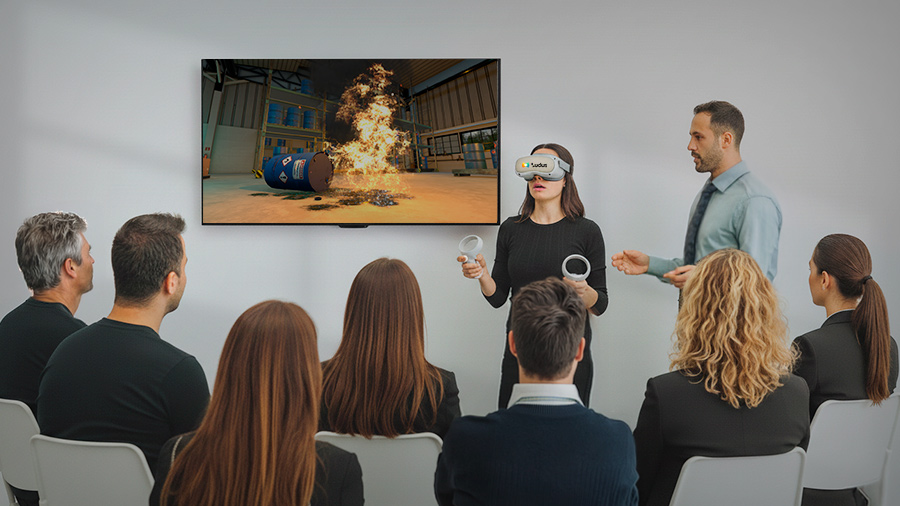
VR safety training is the use of immersive virtual reality simulations to teach workplace safety procedures in realistic, hands-on scenarios without real-world risk. A worker puts on a standalone VR headset, steps into a 3D reconstruction of their own site or an equivalent one, and completes a branching scenario — a fire response, a confined-space entry, a chemical spill, a CPR emergency — where every decision and physical action is tracked, scored and logged for compliance.
That is the plain definition. The rest of this article covers what actually happens in a session, what VR replaces, what it does not, and where the evidence stands after roughly a decade of enterprise deployment.
How a Session Works
A typical VR safety training session breaks into four phases.
Briefing (2–3 min). The trainer explains what the worker is about to do, which OSHA standard or internal procedure they are training against, and how the exercise will be scored.
Simulation (8–25 min). The worker puts on a headset — most commonly a Meta Quest 3 at around $499 or a Pico 4 Ultra Enterprise at around €549 — and enters a 3D environment. In a fire-extinguisher scenario they identify the fire class (A, B, C, D or K), pick the correct extinguisher, apply the PASS technique, hold a safe distance, and call for help if the fire is beyond control. In a CPR scenario they position the casualty, check for response, and deliver compressions at the correct depth and rate. Every action is logged.
Feedback (3–5 min). The worker sees their score, the decisions they made, and where they deviated from the procedure. Unlimited retries are standard.
Documentation (automatic). The platform writes a completion record — timestamp, score, scenario version, learner ID — to the LMS or compliance dashboard. That record is the audit evidence an inspector will ask for.
On platforms like Ludus, every completed exercise also feeds a predictive statistics dashboard. Prevention managers extract personalised reports per training programme, watch trends across the workforce (most common errors, most frequent virtual accidents), and act on early signals — a crew section repeatedly failing a lockout step, for example — before those signals turn into real incidents.
What VR Safety Training Replaces
The traditional stack for high-risk procedure training is three things: classroom instruction, tabletop or paper drills, and periodic live drills. VR does not replace all three cleanly — it replaces what each one is bad at.
Against the classroom. Classroom training struggles with skill practice. Watching a slideshow about fire triangles is not the same as extinguishing a fire. In PwC's 2020 enterprise study, 1,600+ managers were split across classroom, e-learning, and VR delivery of the same content. VR learners were trained roughly four times faster, felt 275% more confident applying what they had learned, and reported four times greater focus during training.
Against tabletop drills. Tabletop exercises talk through what a worker would do. VR has them do it. The difference matters most for procedures where hesitation is the failure mode — arc-flash response, confined-space rescue, active-shooter movement. Walmart credits VR active-shooter training with helping more than 2,000 employees escape the August 2019 El Paso attack.
Against live drills. Live drills give real-body practice but are expensive, dangerous, and low-frequency. Walmart compressed an 8-hour Pickup Tower course into a 15-minute VR session — a 96% reduction — and has since delivered more than 2.2 million VR-based training sessions across 4,700 stores through its Strivr partnership. Bank of America has run more than 50,000 employees through the same delivery model.
What VR does not replace: the annual live fire evacuation drill in most jurisdictions, hands-on equipment familiarisation for site-specific machinery, and the trainer relationship. Any vendor telling you otherwise is overselling.
Why It Works: the Evidence
Two studies anchor the effectiveness case.
PwC (2020) — 1,600+ enterprise managers, 12 US locations, same content across classroom, e-learn and VR arms:
- Trained roughly four times faster than classroom
- 275% more confident applying what they had learned
- 3.75 times greater emotional connection to the content
- Four times more focused during the session
- 78% preferred VR
PwC also modelled cost parity with classroom at 375 learners, becoming 52% cheaper at 3,000.
University of Maryland (2018) — Krokos, Plaisant and Varshney, published in Virtual Reality journal (DOI 10.1007/s10055-018-0346-3). Recall study across 40 participants. Median VR recall was 90.48% versus 78.57% for desktop delivery — an 8.8% absolute improvement, with 40% of participants scoring at least 10% higher in VR.
A widely-quoted "75% VR retention vs 5% classroom lecture" claim, credited to the NTL Learning Pyramid, is not sourced — the NTL Institute itself cannot produce the original study. Serious VR effectiveness claims trace back to PwC, UMD, or specific customer deployments, not the pyramid.
Operational evidence is thinner but growing. A mining operation reported a 43% reduction in lost-time accidents after VR implementation. Intel claimed 300% ROI over five years on its VR programme. Ludus's own case study with Deepsea Networks on an offshore drillship recorded three times higher crew participation in VR CPR sessions versus traditional offshore refresher training. Europreven, a Spanish prevention service, used the platform to train 7,000+ workers on-site and 2,000+ remote workers across Italy, Saudi Arabia, and the Netherlands inside 18 months.
Compliance: What OSHA and Equivalents Actually Require
OSHA specifies training outcomes, not format. Sections 29 CFR 1910 (General Industry) and 29 CFR 1926 (Construction) require training that covers site-specific hazards, is delivered in a language the worker understands, includes practice or demonstration of competency, is documented (identity, date, topics covered), and is repeated periodically. Spain's Ley 31/1995 on prevention of occupational risks and Royal Decree 39/1997 impose functionally identical requirements: theoretical and practical training appropriate to the role, documented competency assessment, records on file.
VR training satisfies all of these. The audit trail is richer than a paper sign-in sheet.
For 2026, OSHA's maximum civil penalties (effective 15 January 2026) are:
| Violation type | 2026 maximum |
|---|---|
| Serious | $16,550 per violation |
| Other-than-serious | $16,550 per violation |
| Failure to abate | $16,550 per day past deadline |
| Willful or repeat | $165,514 per violation |
| Minimum willful penalty | $11,524 |
Those are per-violation figures. A serious inspection finding across multiple sites compounds fast.
Which Companies Use It
Enterprise deployment of VR safety training now spans most industrial sectors. Public deployments include Walmart, Bank of America, Shell, BP, Intel, and Ford. On the specialised HSE platform side, Ludus is used by Henkel, Coca-Cola, Ford, Moeve, Lear, DHL, Owens Corning, and UNOPS (the United Nations) — among 250+ customers across 18 countries and four continents, with a 97% subscription-renewal rate. That client mix — European industrial majors, US Fortune 500, and a UN agency — matters more than any single case study. Serial procurement decisions are what validate a category.
Ludus operates from Bilbao, with a LATAM office in Mexico City. The first UK client is live and expansion into Italy is under way, supported by an ambassador and partner network across LATAM, Spain, Europe, and the Middle East.
Where to Start if You Are Evaluating VR Safety Training
Three practical questions to answer before running a pilot.
What are your top three risk categories? Not "we do lots of safety training." Which specific procedures cause the most incidents, near-misses, or audit findings? Those are your VR candidates. Everything else can wait.
How many learners do you have at each site? PwC's cost curve puts VR at parity with classroom around 375 learners and cheaper beyond that. Below that number, VR still wins on quality but the economic argument is weaker. Above 1,000 learners the cost case gets hard to argue with.
What languages do you need? This is the question that quietly disqualifies most VR vendors. Bilingual is easy. Seventeen languages, all with native voice-over and localised scenarios, is a much smaller vendor list.
If those three answers point to a serious rollout, the next step is a live scenario walkthrough with one of your actual hazards in the simulator. Ludus runs 20-minute walkthroughs using a scenario the buyer supplies — fire, electrical, CPR, whatever fits — so you can benchmark against any platform on your shortlist.
Frequently Asked Questions
What is VR safety training in one sentence?
The use of immersive VR simulations to teach workplace safety procedures in realistic scenarios without real-world risk — every decision and action tracked for compliance.
How long does a session take?
Eight to 25 minutes per scenario. Full programmes run 90 to 180 minutes versus 6 to 12 hours for classroom plus drill.
Is it OSHA compliant?
Yes. OSHA specifies outcomes, not format. Documented competency assessment plus retained records satisfies 29 CFR 1910 and 1926.
What does it replace?
Some classroom time, most tabletop exercises, and the skill-practice portion of drills. It does not replace the annual live fire drill in most jurisdictions.
How much does it cost?
Meta Quest 3 headsets at around $499 each, Pico 4 Ultra Enterprise around €549. Custom modules can start around $40,000; turnkey libraries avoid that spend. Platform subscription varies by seat count.
What does the evidence say?
PwC 2020: 4× faster training, 275% higher confidence, 3.75× more emotional engagement, 4× more focused, 78% preferred VR. UMD 2018: 90.48% median VR recall vs 78.57% desktop.
Which sectors adopt it fastest?
Oil and gas, manufacturing, construction, utilities, logistics, healthcare, mining, and emergency services. Ludus's own client mix — Henkel, Coca-Cola, Ford, Moeve, Lear, DHL, Owens Corning, UNOPS — spans most of them.
How is data protected?
Enterprise VR platforms typically hold SOC 2 or ISO 27001 attestation. Learner scores, session recordings, and identity data sit under the same governance as an LMS. Ask any vendor for their current SOC 2 report before signing.
Related Reading
- VR Safety Training: What It Is, How It Works & Why It's Replacing Classroom Training
- Best Safety Training Software 2026: 11 Platforms Compared
- Deepsea drillship VR CPR case study
- Ludus platform overview
- All Ludus training simulations
Sources
- U.S. Bureau of Labor Statistics. National Census of Fatal Occupational Injuries 2024. USDL-26-0230, 19 February 2026.
- U.S. DOL / OSHA. 2026 Annual Adjustments to Civil Penalties. Effective 15 January 2026.
- PwC. Understanding the Effectiveness of VR Soft Skills Training in the Enterprise. 2020.
- Krokos, E., Plaisant, C., & Varshney, A. Virtual memory palaces: immersion aids recall. Virtual Reality, 2018.
- Strivr / Walmart. Walmart reduces training time by 96%.
- Bank of America. First in industry to launch virtual reality training. 2021.
- Ludus Global. Platform and case-study pages.
Editorial note: every quantitative claim in this article was verified against the primary source listed above in July 2026. The disputed NTL Learning Pyramid figures are deliberately excluded.
---------------------------------------------------------------------------
Would you like to implement Ludus' Virtual Reality in your health and safety training?
Fill out this form to receive information about the options best suited to your company's needs.