Written for: EHS and HSE managers in manufacturing plants of 150 to 5,000 employees, plant managers carrying safety KPIs, and the operations directors who sign off the training budget. If you run a single site with under 50 operatives, the economics in this piece will not work for you yet, and the section on cost-per-seat explains why.
Short answer
VR safety training works in manufacturing for the hazards that are expensive, dangerous, or logistically awkward to rehearse in a live plant: lockout/tagout on energised equipment, confined space entry, fire response, working at height, electrical isolation, and forklift interaction. It records every decision each operative makes, which turns a training session into an auditable record and a source of behavioural data.
It does not replace hands-on practice where the regulator requires physical competence, and it does not cover machine guarding well, which matters because guarding failures are what kill most manufacturing workers.
The honest summary: VR is strong on decision-making under pressure and on documentation, weaker on physical skill transfer, and useless if your plant has no procedure for the hazard in the first place.
The numbers that make this a board conversation
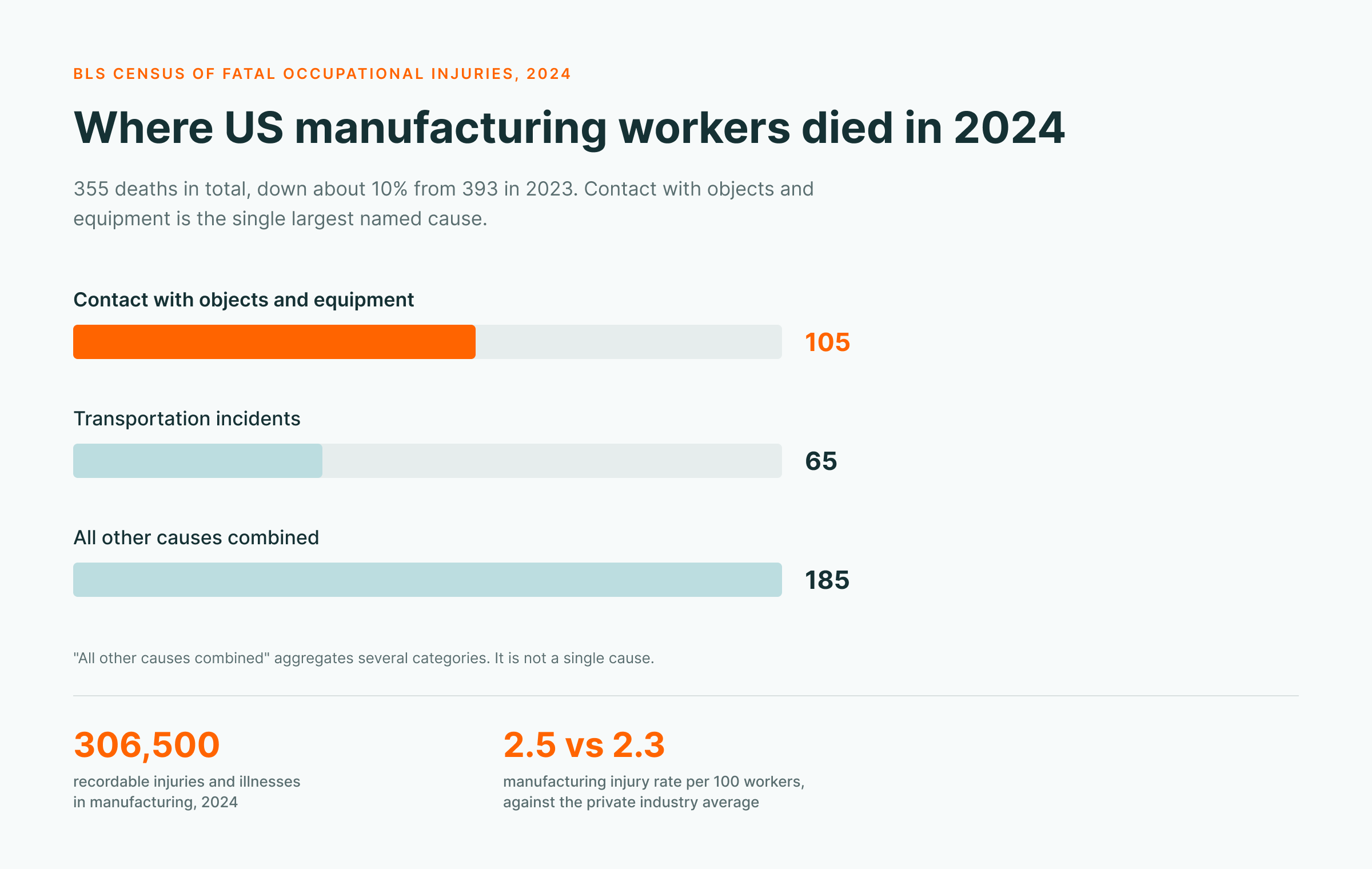
US manufacturing recorded 355 workplace deaths in 2024, down about 10% from 393 the year before, according to the Bureau of Labor Statistics Census of Fatal Occupational Injuries.
The breakdown is what should shape your training plan:
| Cause of death | Manufacturing deaths, 2024 |
|---|---|
| Contact with objects and equipment | 105 |
| Transportation incidents | 65 |
| All other causes | 185 |
"Contact with objects and equipment" is the category that includes being caught in or compressed by running powered equipment, and struck by falling or suspended objects. It is the single largest killer in manufacturing, and it fell 12.5% year over year.
On the non-fatal side, manufacturing logged 306,500 recordable injuries and illnesses in 2024, at a rate of 2.5 per 100 full-time workers. Private industry overall ran at 2.3. Manufacturing is above the national average and has been for years.
Three of OSHA's ten most-cited standards are manufacturing standards
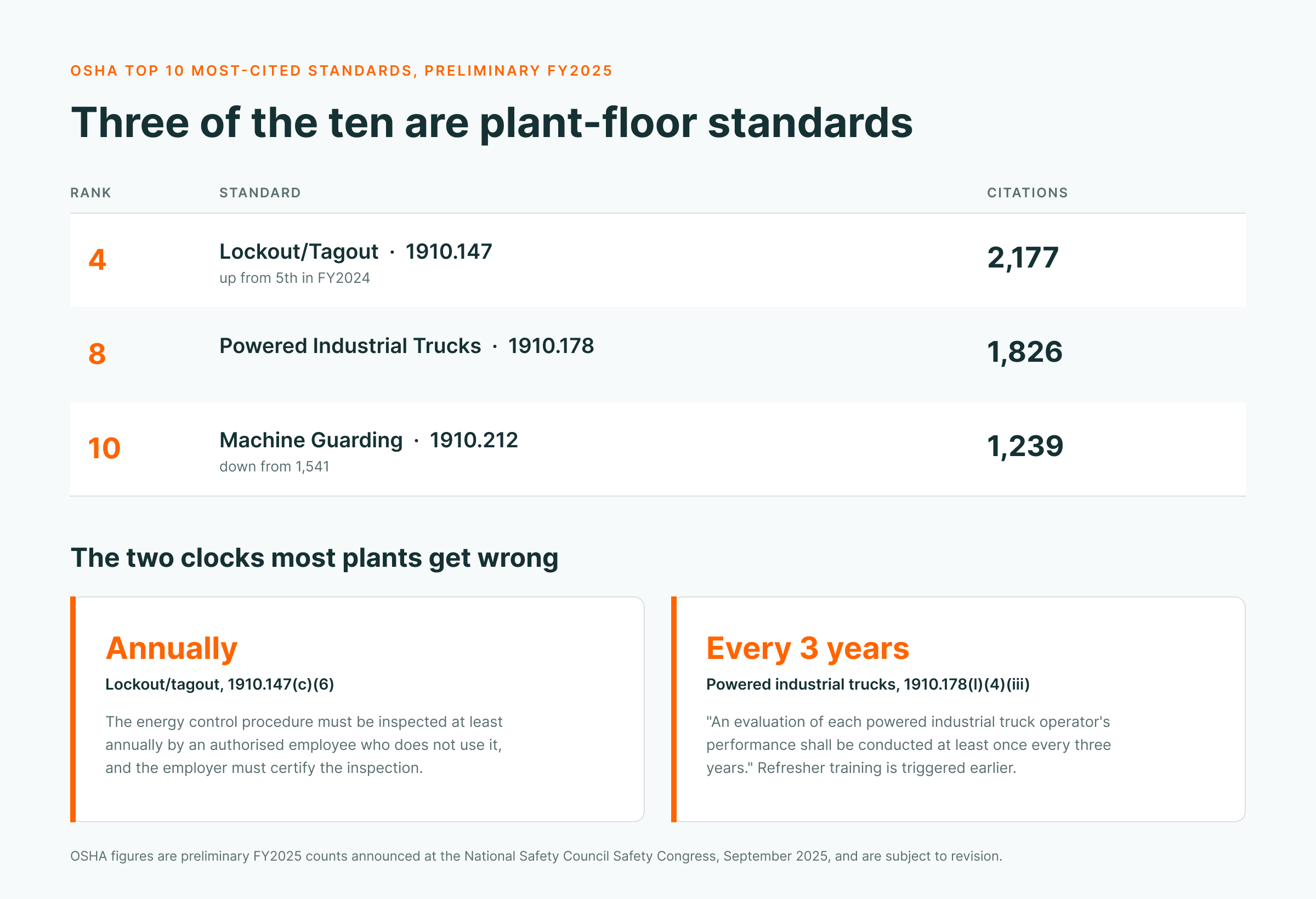
OSHA released preliminary Top 10 figures for fiscal year 2025 at the National Safety Council Safety Congress in September 2025. Three entries are squarely plant-floor issues:
| Rank | Standard | Citations, FY2025 |
|---|---|---|
| 4 | Lockout/Tagout, 1910.147 | 2,177 |
| 8 | Powered Industrial Trucks, 1910.178 | 1,826 |
| 10 | Machine Guarding, 1910.212 | 1,239 |
Lockout/tagout moved up from fifth place in FY2024. Machine guarding stayed at tenth, with citations falling from 1,541 to 1,239.
Hazard Communication (1910.1200) at number two and Respiratory Protection (1910.134) at number five also land heavily on manufacturing sites.
These figures are preliminary. OSHA revises them, and the National Safety Council publishes a fuller analysis in December.
The two compliance clocks most plants get wrong
Buyers tend to think of safety training as an annual event. Two of the standards above do not work that way, and this is where VR documentation earns its place.
Lockout/tagout, 1910.147(c)(6): the energy control procedure must be inspected at least annually, by an authorised employee who is not the one using the procedure being inspected. The employer must then certify that the inspection happened, naming the machine, the date, the employees included, and the inspector. Retraining is separately triggered by a change in job assignment, a change to the machine or process that introduces a new hazard, a change to the procedure itself, or an inspection that finds deviations.
Powered industrial trucks, 1910.178(l)(4)(iii): "An evaluation of each powered industrial truck operator's performance shall be conducted at least once every three years." Refresher training is triggered earlier by unsafe operation, an accident or near miss, a failed evaluation, assignment to a different truck type, or a change in workplace conditions.
Neither standard asks for a certificate on a wall. Both ask for evidence that a named person demonstrated something on a named date. A VR platform that logs every session against an employee ID produces that evidence as a by-product of the training itself, rather than as a separate administrative task someone has to remember.
Where VR earns its place on a plant floor
Lockout/tagout. Isolating a live line to run a drill costs production hours and nobody wants to do it twice. In VR an operative can work through isolation, verification, and restart on a machine that looks like theirs, get it wrong, and try again. The failure is free.
Confined spaces. Entry permits, gas testing, rescue roles. Rehearsing a rescue in a real tank is itself a confined space entry, with all the permitting that implies.
Fire response. Extinguisher selection and use under time pressure, with smoke and noise. OSHA 1910.157(g) requires extinguisher education on initial employment and at least annually for employees expected to use them, which makes this the most frequently repeated training in many plants.
Working at height. Harness checks, anchor selection, and the decisions people make when a job looks like it will take two minutes.
Forklift interaction. Not replacing the seat time, but rehearsing pedestrian awareness, blind corners, and load stability judgement for the people who work around trucks rather than on them.
Electrical isolation. Arc flash boundary decisions and PPE selection, which are judgement calls made before anyone touches anything.
Where it does not
Machine guarding. This is the gap worth stating plainly, because it is the hazard category that kills the most manufacturing workers. Guarding is a physical and engineering control: interlocks, fixed barriers, light curtains, presence-sensing devices. A VR module can teach someone to recognise a missing guard or an interlock that has been defeated, and that has real value. It cannot substitute for the guarding assessment itself, and no VR catalogue on the market has a dedicated machine guarding simulation that matches the depth of the LOTO or confined space modules. If a vendor tells you otherwise, ask to see the module.
Physical skill under real load. Torque, weight, the resistance of an actual valve. Hand tracking has improved and mixed reality helps, but a headset does not tell your hands what 40 kilos feels like.
Anything you have not already proceduralised. VR trains people to follow a procedure. If the plant's isolation procedure is three people's memory, buying headsets will not fix that. Write the procedure first.
Culture. If a supervisor tells a new starter to ignore what they learned in training, the headset loses.
What manufacturers actually run on the Ludus platform
Ludus Global's catalogue runs to 23 simulations and more than 700 exercises across 17 languages, with customers in 18 countries. The manufacturing-relevant modules are:
| Hazard | Module |
|---|---|
| Lockout/tagout | LOTO |
| Confined space entry | Confined spaces |
| Fire response | Fire safety, Use and handling of FHCs |
| Working at height | Fall protection, Safety officer at heights, MEWPs |
| Forklift and pedestrian safety | Forklift risks |
| Electrical | Electrical hazards |
| PPE selection, including chemical | PPE |
| Medical emergency | CPR |
Machine guarding is covered inside the plant risk prevention and plant risk assessment modules rather than as a standalone simulation. That is the honest position, and it is the same for every platform we have evaluated.
Manufacturers running the platform include Ford, Henkel, Lear, Owens Corning and Coca-Cola. Across the whole customer base of more than 250 organisations, around 94,750 training sessions are completed each year, and subscription renewal runs at 97%.
Ludus was shortlisted as a finalist in the IOSH Awards 2026, in the Digital Transformation of the Year category, for a submission on behavioural analytics in XR safety training.
The data layer is the part buyers underrate
Most plants buy VR for the simulation. The thing that changes how a prevention team works is the record underneath it.
Every exercise logs the decisions an operative made, where they hesitated, what they got wrong, and how many attempts it took. Aggregate that across a site and patterns surface: a particular isolation step that half the maintenance team skips, a shift that consistently selects the wrong extinguisher class, a line where near-miss behaviours cluster.
That turns training from a compliance cost into a leading indicator. You are no longer waiting for an incident report to tell you where the risk sits.
It also answers the LOTO certification requirement without extra admin, because the record of who trained, on what, on which date, already exists in the format the standard asks for.
What it costs to run
Pricing depends on headcount and deployment model, so treat the following as the shape of the decision rather than a quote.
A standalone headset suitable for enterprise training runs between roughly $350 and $1,000 per unit at current pricing. A plant does not need one per employee. Most sites run a shared pool, booked by shift, because a 20-minute exercise repeated across 300 operatives over a quarter needs perhaps 8 to 12 devices, not 300.
The licence is the larger line. Ludus licences the full catalogue rather than per module, so adding a hazard later does not reopen the commercial conversation. If a site lacks compatible hardware, devices can be supplied on a rental model rather than purchased outright.
The number to build your case on is not cost per headset. It is cost per operative per year against the production hours you currently lose to live drills, plus the cost of the incidents the training is meant to prevent. If your plant has never priced a single lost-time incident, do that first. It is usually the number that settles the argument.
Our VR training ROI calculator walks through the inputs and, more usefully, the assumptions that make most vendor ROI claims unreliable.
How to evaluate a platform for a plant
- Ask which of your specific hazards have a dedicated module, not a category. "Industrial safety" is not an answer. LOTO is.
- Ask to see the reporting output, not a dashboard screenshot. Ask for a sample export of a real session record, anonymised.
- Check the language list against your actual workforce, including contractors and agency staff.
- Ask whether it runs standalone, without a tethered PC, because a plant floor is not an office.
- Ask what happens when you need a hazard they do not have. Custom build timelines and costs vary enormously between vendors.
- Ask for a reference in your sector, at your size, that you can call.
Frequently asked questions
Does VR safety training satisfy OSHA requirements?
It can form part of compliant training, but no standard names VR as a method. OSHA requires that employees are trained, that they can demonstrate understanding, and in some cases that competence is evaluated. VR produces strong evidence for the first two. For standards requiring hands-on demonstration, such as designated-employee extinguisher training under 1910.157(g)(3), VR supplements rather than replaces physical practice. Check each standard individually.
How long does a typical VR safety session take?
Most industrial exercises run 8 to 25 minutes, with a short briefing before and an automatic score and decision review after. Plants generally schedule 30-minute slots.
How many headsets does a plant need?
Fewer than most buyers expect. A shared pool of 8 to 12 devices covers a 300-person site running quarterly refreshers. Calculate from session length, shift pattern, and refresher frequency rather than headcount.
Can VR training replace our annual lockout/tagout inspection?
No. The annual periodic inspection under 1910.147(c)(6) is an inspection of the procedure, performed by an authorised employee who does not use that procedure. VR covers the training and retraining obligations under (c)(7) and generates the certification record, but the inspection is a separate requirement.
Does it work for workers who have never used VR?
Yes, with a short orientation. Hand tracking removed most of the controller learning curve. The more common friction is motion sensitivity in a small minority of users, which is why seated and teleport movement options matter.
What about contractors and agency staff?
This is where multilingual coverage earns its cost. Contractor populations in manufacturing are often more linguistically mixed than the direct workforce, and contractors are statistically over-represented in serious incidents across industrial sectors.
Methodology and sources
Fatality and injury figures are from the US Bureau of Labor Statistics: the Census of Fatal Occupational Injuries for 2024, released February 2026, and the Survey of Occupational Injuries and Illnesses for 2024. OSHA citation counts are preliminary FY2025 figures announced at the National Safety Council Safety Congress and Expo in September 2025 and are subject to revision. Regulatory text is quoted from the current published standards at osha.gov. Platform details reflect the Ludus catalogue as listed at ludusglobal.com. Headset pricing reflects published vendor list prices and moves frequently.
Reviewed and published 10 October 2026 by Álex Gutiérrez, Ludus Global.
Sources
- BLS. Census of Fatal Occupational Injuries Summary, 2024.
- Manufacturing Dive. Manufacturing deaths in the 2024 CFOI.
- BLS. Number and rate of nonfatal work injuries by industry subsector.
- OSHA Top 10 most-cited standards, FY2025.
- OSHA. 1910.147, Control of hazardous energy.
- OSHA. 1910.178, Powered industrial trucks.
Related reading
- VR safety training for oil and gas
- When VR safety training works, and when it doesn't
- Best VR fire safety training platforms 2026
---------------------------------------------------------------------------