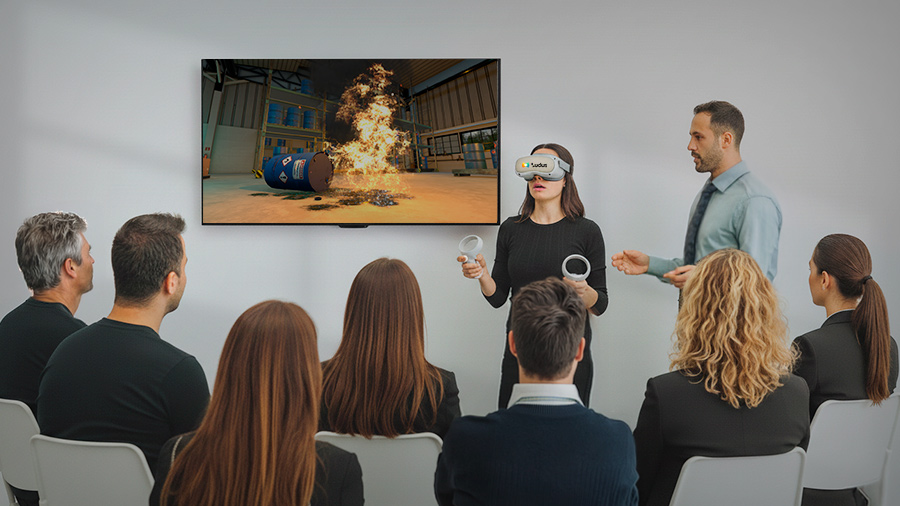
A VR training simulator is three things: a headset, a software platform, and the scenarios that run on it. The headset is the part buyers spend the most time on and the part that matters least to whether the training works.
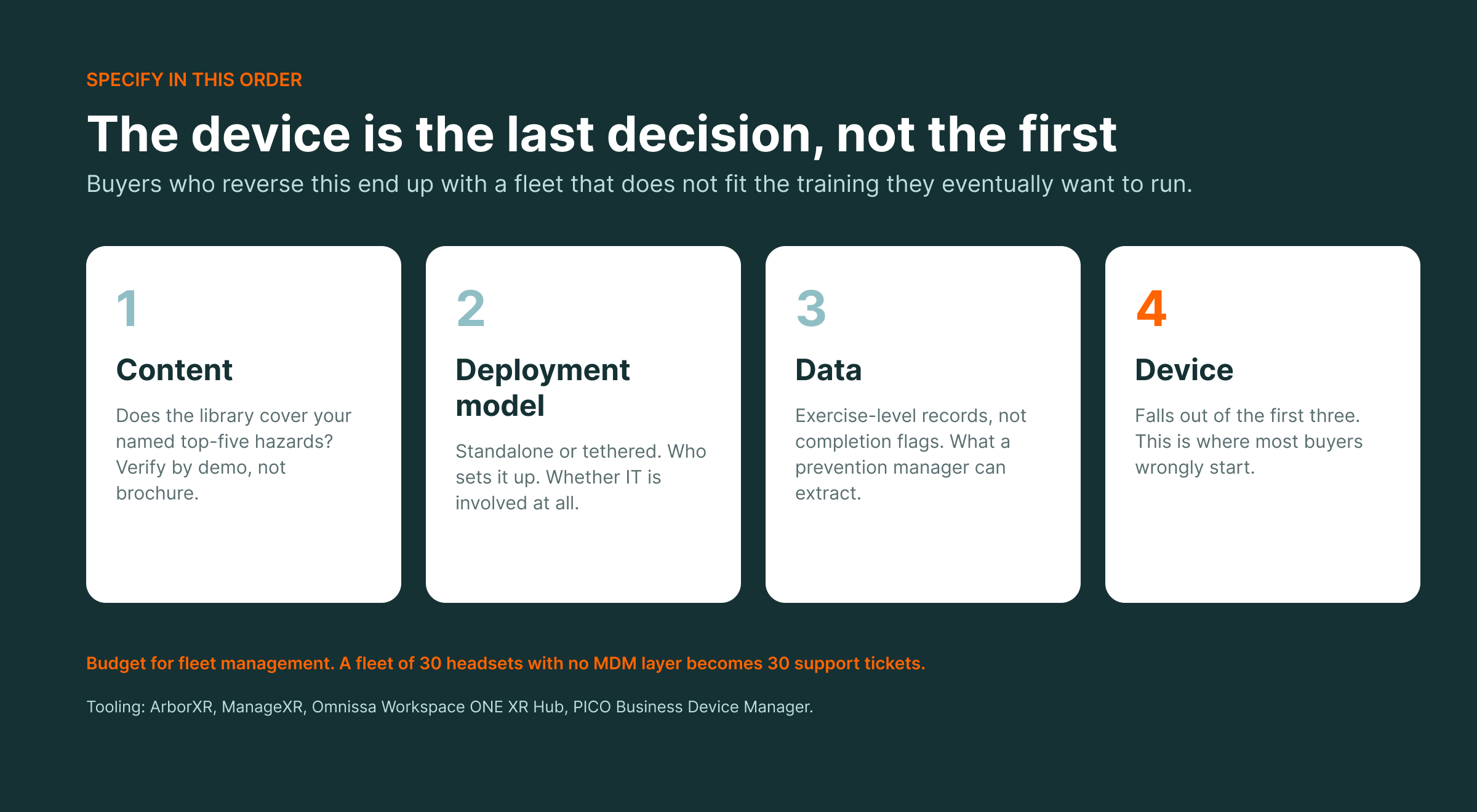
Pick the content first. Pick the deployment model second. Let those two decide the device. Buyers who reverse that order end up with a fleet that does not fit the training they eventually want to run.
If you want the hardware answer without the reasoning: the PICO 4 Ultra Enterprise at $699 is the strongest all-round choice for a managed fleet in 2026. The Meta Quest 3S at $349.99 is the cheapest credible way to run a large pilot. The HTC VIVE Focus Vision at roughly $999–$1,070 is the pick when visual fidelity is critical or you need hot-swappable batteries for continuous sessions.
Last reviewed 27 July 2026. Hardware pricing moved materially this year — corrections to previous pricing figures are listed at the end of this article.
The Four Questions That Actually Decide the Specification
How many people, in how many places, how often? A single training room running 40 sessions a month has different requirements from 12 sites each running four. The second case is where fleet management stops being optional.
Who sets the headsets up? If the answer is "an HSE trainer, not IT," the device needs to work out of the box with no PC, no cables and no configuration. This is the requirement that eliminates most tethered systems immediately.
What is the training actually asking the worker to do? Procedures that depend on grip, hand positioning or tool handling need hand tracking rather than controllers. A worker practising chest compressions should be using their hands, not holding a plastic controller and pretending.
Who inherits the fleet in year two? Someone has to push content updates, manage device enrolment, wipe headsets between users and handle warranty claims. If nobody has answered this, the pilot will succeed and the rollout will stall.
Hardware Landscape, July 2026
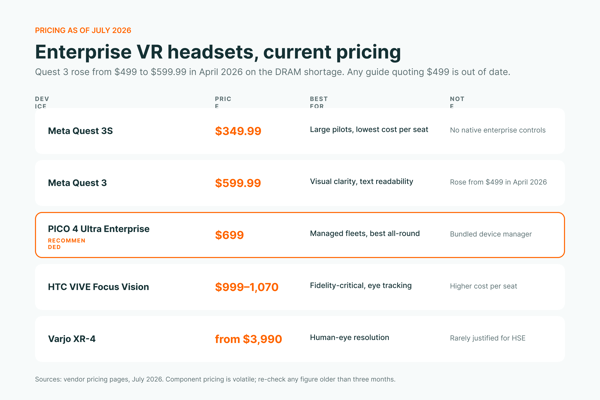
Prices below are current as of 27 July 2026. This market repriced during the year and it will move again.
| Device | Price | Best for | Watch out for |
|---|---|---|---|
| Meta Quest 3S (128GB) | $349.99 | Large pilots, lowest cost per seat | No native enterprise controls |
| Meta Quest 3 | $599.99 | Visual clarity, text readability | Rose from $499 in April 2026 |
| PICO 4 Ultra Enterprise | $699 | Managed fleets, all-round enterprise | Some MDM docs still list older PICO models |
| HTC VIVE Focus Vision | ~$999–1,070 | Fidelity-critical work, eye tracking | Higher cost per seat |
| Varjo XR-4 | from $3,990 | Human-eye resolution simulation | Niche; rarely justified for HSE |
The procurement change most buyers have not registered: Meta stopped selling commercial Quest SKUs in February 2026 and moved its Horizon managed services into maintenance mode. Consumer Quest devices can still be enrolled through third-party platforms such as ArborXR and ManageXR, and plenty of large fleets run this way successfully. But if you are writing a three-year hardware plan around Meta's own enterprise programme, check its current status before you commit. This is exactly the kind of detail that does not surface in a vendor demo.
The April 2026 price rise across the Quest line was attributed to the global DRAM shortage driven by AI data-centre demand. Component pricing is not stable right now, which is an argument for renting during evaluation rather than buying early.
Fleet Management: the Part That Is Missing from Most Business Cases
A headset is a computer that several people will wear. That creates four ongoing jobs: enrolling devices, pushing content updates, controlling what the device can run, and wiping user data between sessions.
The tooling that does this is mobile device management adapted for XR. The established options are ArborXR, ManageXR, and Omnissa Workspace ONE XR Hub, alongside vendor-native tooling such as PICO Business Device Manager. PICO bundles its business suite with the Enterprise SKU, which is a large part of why that device tends to win all-round recommendations.
Kiosk mode deserves specific attention. It locks a headset to a single application so a worker cannot exit into a general menu, which matters both for training focus and for anyone whose security team will ask what else the device can do.
Budget for this. A fleet of 30 headsets with no management layer becomes 30 individual support tickets.
Standalone vs. Tethered: Settled
For safety training, standalone has won. A tethered system needs a PC, cables, sometimes external sensors, and a dedicated space. That is workable in a permanent training centre and unworkable everywhere else.
The clearest demonstration of why is offshore. When Deepsea Networks deployed VR CPR training on an active drillship with Ludus, the setup requirement for the vessel team was zero. A wireless standalone headset, a standard CPR manikin, and a connectivity service. Crew participation ran at roughly three times a normal offshore session. A tethered rig would not have made it onto the vessel at all.
The same logic applies to any multi-site industrial employer. If the kit fits in a case and a trainer can run it without calling IT, sessions happen. If it needs a room and a technician, they get scheduled quarterly and then cancelled.
Ludus is built standalone-first for this reason, with wireless delivery, hand tracking, and compatibility with any standard CPR manikin. Where a client lacks compatible hardware, the device can be rented rather than bought, and the licence covers unlimited platform and product access independently of the hardware decision.
Where the Simulator Stops Being About Hardware
Two headsets running the same scenario produce nearly identical training outcomes. Two platforms running on the same headset do not.
Content depth. How many of your actual hazards have ready-built scenarios? A library heavy on office and generic awareness content is not useful on a refinery. Ludus runs 23 products and over 700 exercises across VR and Mixed Reality under a single licence — the practical difference between a platform and a content marketplace where each module is a separate purchase.
Language coverage. Native voice-over and localised scenarios, not subtitles. Ludus's catalogue is available in 17 languages. For multi-country operations this is usually the requirement that shortens the vendor list fastest.
What gets logged. This is the question most buyers ask last and should ask first. A completion record tells you a worker attended. Exercise-level data tells you what they did. Ludus's predictive statistics panel logs every exercise, generates personalised reports per training programme, and surfaces patterns across the workforce: recurring errors, the scenarios that produce the most virtual accidents, the decision points where people hesitate. That is a leading indicator of unsafe behaviour — a fundamentally different thing from a training record.
Named deployments give a sense of where this lands in practice. Ludus is used by Henkel, Coca-Cola, Ford, Moeve, Lear, DHL, Owens Corning and UNOPS (the United Nations), across 250+ customers in 18 countries with a 97% annual renewal rate.
A Specification Checklist You Can Paste into a Procurement Document
- Standalone operation with no PC or cabling required
- Hand tracking supported for procedures where grip and positioning matter
- Compatible with third-party MDM (ArborXR, ManageXR) or ships with native fleet tooling
- Kiosk mode available
- Offline capability for sites without reliable connectivity
- Content library covering your named top-five hazards, verified by demo rather than by brochure
- Native language support for every language in your workforce
- Exercise-level data export, not just completion records
- Written confirmation of the vendor's current enterprise hardware roadmap
That last item is the one that would have caught the Meta commercial SKU change before it became somebody's problem.
What to Do Next
Run one of your own hazard scenarios on a shortlisted platform before you specify any hardware. It is the fastest way to find out whether the content depth is real, and it makes the device decision straightforward afterwards.
Get a 20-minute walkthrough with the Ludus team →
Frequently Asked Questions
What is a VR training simulator?
A headset, a software platform, and the scenarios that run on it. The headset matters least of the three to training outcomes.
What does the hardware cost in 2026?
Quest 3S $349.99, Quest 3 $599.99 (up from $499 in April 2026), PICO 4 Ultra Enterprise $699, HTC VIVE Focus Vision roughly $999–$1,070, Varjo XR-4 from $3,990.
Can I still buy Meta Quest for enterprise?
Meta stopped selling commercial Quest SKUs in February 2026 and moved Horizon managed services into maintenance mode. Consumer devices can still be enrolled via ArborXR or ManageXR. Confirm the current position before building a multi-year plan on it.
Do I need a PC or a dedicated room?
No, for standalone-first platforms. A room and a power socket is the whole requirement.
Is hand tracking worth specifying?
For procedures involving grip, tool handling or chest compressions, yes. For scenarios that are mostly navigation and decision-making, controllers are adequate.
Should I rent or buy?
Rent for the pilot, buy for the rollout. Renting keeps capital approval out of the evaluation decision. Ludus offers the headset on a hire basis alongside its VR training platform.
How many headsets do I need?
Work backwards from sessions. One headset supports roughly 8 to 12 sessions per day at 20 minutes each with changeover. Most multi-site programmes start with two to four per site.
What is the most common specification mistake?
Choosing hardware before content. The second most common is omitting fleet management from the budget.
Methodology and Corrections
Hardware pricing and availability verified 27 July 2026 against vendor pricing pages and current market reporting.
Correction affecting previously published Ludus articles: several existing posts quote approximately $499 for a Meta Quest 3 and approximately €549 for a Pico 4 Ultra. Both figures are superseded. The Quest 3 rose to $599.99 in April 2026 and the PICO 4 Ultra Enterprise is listed at $699 MSRP. Those articles are being updated.
On sourcing: hardware pricing in this category is volatile and vendor pricing pages are the only reliable source. Any figure in a training-industry article older than about three months should be re-checked before it goes into a budget.
Sources
- Meta Quest pricing changes, April 2026, as reported across current market roundups.
- PICO business pricing page, PICO 4 Ultra Enterprise MSRP, 2026.
- HTC VIVE Focus Vision pricing and specification, 2026.
- VR Expert, enterprise headset reviews and comparisons, 2026.
- ArborXR and ManageXR, supported device documentation.
- Ludus Global, Deepsea Networks case study and platform pages. ludusglobal.com/en
Related Reading
- What is VR safety training?
- VR safety training: 9 industries using it for high-risk work
- VR training statistics 2026: 40 verified numbers
- Best safety training software 2026: 11 platforms compared
- Deepsea drillship VR CPR case study
- All Ludus training simulations
---------------------------------------------------------------------------