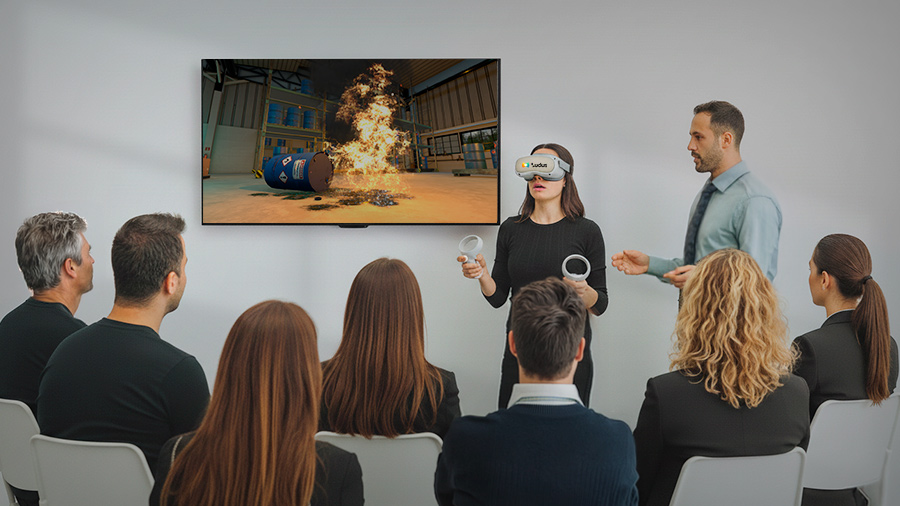
On an offshore drillship, the nearest hospital can be hours away by helicopter. If a crew member collapses with a suspected cardiac arrest, the four to six minutes before brain damage starts belong to the person standing next to them. That person needs to know what to do.
The offshore industry's answer is the OPITO BOSIET certification, which covers CPR as one of several modules and is typically renewed once every four years. That is the standard, and it is foundational. It is also a long time between practice sessions for a skill where seconds matter.
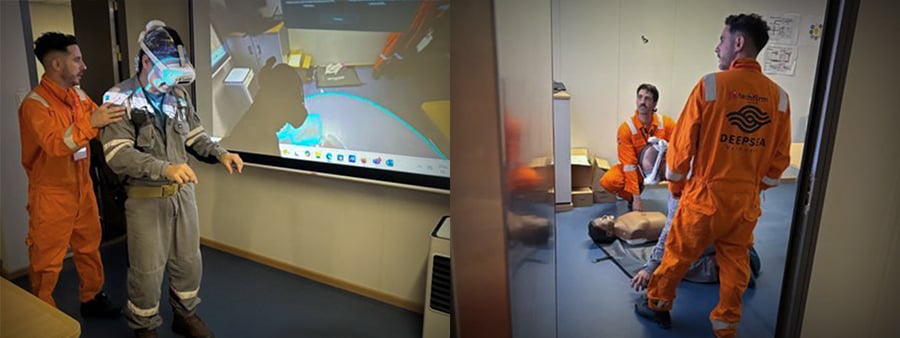
In 2025, Deepsea Networks and Ludus ran what is, as far as both partners are aware, the first immersive VR CPR training delivered live on an active drillship. The pilot's headline outcome: three times more crew participation than the typical offshore training session, with zero technical setup required from the vessel's team.
The Problem: a Four-Year Gap Between Life-Saving Practice Sessions
CPR is one of those skills that decays fast without repetition. Studies of in-hospital teams have repeatedly shown that compression technique, depth and rate drop within months of training. Out at sea, with no continuous practice between BOSIET certifications, the skill loss is real and the consequences are direct.
Two specific challenges stack on top of each other on an offshore asset:
- Frequency. The BOSIET refresher cadence is set by an industry-wide standard, not by what's optimal for muscle memory. Closing that gap with in-person training means flying instructors out to remote vessels — expensive, weather-dependent, and disruptive to operations.
- Realism. Traditional CPR sessions on a manikin in a meeting room don't replicate the cognitive load of a real emergency. The crew member who collapses won't be a clean rubber chest in a quiet room. They'll be a colleague, with bystanders, on a moving vessel, in the middle of a shift.
A way to deliver realistic, repeatable CPR training between BOSIET cycles — without flying anyone in — would change the equation entirely.
What Deepsea Networks Deployed
Deepsea Networks specialises in offshore connectivity and managed services. Their proposition for this pilot was to bundle four things into one drop-in package designed for a drillship environment:
- A standalone wireless VR headset that could be set up in the vessel's meeting room within minutes
- The Ludus CPR simulation, running wireless with hand tracking and compatible with any standard CPR manikin
- Built-in offshore connectivity so the simulation could be deployed and updated even at sea
- An OPITO-certified instructor who delivered the training and trained the vessel's Offshore HSE Advisor to lead future sessions independently
The combination matters. A VR headset that needs a PC, cables and a wired manikin is a non-starter offshore — there is rarely the IT capacity or space to support it. Ludus's wireless, hand-tracked CPR simulation removes the hardware footprint to almost nothing. Deepsea's connectivity service removes the bandwidth excuse. Together, the deployment fits in a briefcase.
"It was quite impressive to see how crew members could jump directly into CPR scenarios, practicing critical techniques in a high-pressure simulation — all without disrupting daily operations."
— Pablo Botello Comi, Onboard HSE Advisor
That last clause is the operationally important one. A drillship runs on a schedule. Training that interrupts the schedule gets cut. Training that fits in the gaps gets repeated.
What the Crew Said
The most useful evaluation of a training programme is whether the people who went through it want to do it again. The first answer from Deepsea's pilot was unambiguous.
"We'd like to send a big thank you for giving us the opportunity to participate in the CPR training using VR technology. It was an absolutely amazing experience — engaging, realistic, and a whole new way to learn something so important. We truly appreciate the chance to be part of something so innovative. This fresh and immersive approach not only made learning more effective, but also way more fun. We're genuinely impressed and excited about what the future of training looks like."
— Maciej Wilczynski, OIM / Master
The OIM (Offshore Installation Manager) is the senior on-vessel authority — the master of the rig. When that role's verdict is "more fun" and, more importantly, the crew want to do it again, the participation problem is solved before it starts.
The Measurable Outcome: 3× Participation
Pilots are small by design. The metrics from this one are not the kind of numbers a CFO would put in a forecast — they are the kind an HSE director would put in a memo recommending broader deployment.
- Crew participation roughly tripled compared to typical offshore training sessions
- Confidence and engagement were measurably higher, by the crew's own report
- Zero technical setup required by the vessel team — the unit arrived ready to use
- Feasibility proven for rapid deployment across other offshore assets
The 3× participation number deserves its own paragraph. Offshore training is not optional — the regulations require it — but turnout for elective refresher sessions on a busy rig is notoriously soft. When a new format triples uptake without adding compulsion, you have changed the economics of the safety programme. You are no longer chasing crew to attend; they are signing up.
What This Means for Offshore HSE Programmes
Three things follow from the pilot, in order of importance.
First, the BOSIET cadence stops being the ceiling. With a drop-in VR setup that the vessel's own HSE Advisor can run, CPR refresher sessions can happen monthly or quarterly between certifications — not once every four years. The OPITO standard becomes the floor, and the gap above it is yours to close.
Second, the per-session cost collapses. Flying an instructor offshore for a one-day course is the dominant cost driver in marine training. A locally-run VR session — where the OPITO instructor came once to train the on-board HSE Advisor, and the crew then runs sessions itself — moves most of that cost out of the model entirely.
Third, the training data starts to compound. Every session run on the Ludus platform feeds into its statistics dashboard. The HSE Advisor can see which crew members struggle with compression depth, which scenarios trigger hesitation, and which mistakes are most common across the team. Over a year of monthly sessions, that data builds into a real picture of crew readiness — far richer than a BOSIET certificate that says somebody passed a course in 2023.
What's Next
Following the pilot, Deepsea Networks and Ludus are in discussions to expand the programme in two directions: additional vessels in Deepsea's network, and more scenarios beyond CPR. Ludus's catalogue includes first aid, fire safety, confined spaces, and other modules that map directly onto common offshore emergencies — all on the same wireless, hand-tracked, no-IT-required deployment model.
If the next phase confirms the pilot results at scale, the operational case for VR-based interval training between BOSIET certifications becomes hard to argue against.
"The goal is helping offshore teams train smarter, safer, and faster — using immersive technology that works where it matters most. It's not the future. It's already offshore."
Why This Matters for the Broader Oil & Gas Industry
There is a fair counterargument that this is one pilot, on one drillship, with one operator. That is true, and worth saying out loud.
What's harder to argue with is the structural fit. Offshore safety training has three persistent problems: distance, cost and frequency. A wireless VR deployment that arrives in a briefcase, runs offline-capable on built-in connectivity, requires no IT setup, and lets the on-board HSE Advisor run repeat sessions independently addresses all three at once. That isn't a story about VR being a more engaging training format. It is a story about a delivery model that fits the operational reality of offshore work.
That model needs more pilots like this to validate it at scale.
Frequently Asked Questions
What is the OPITO BOSIET certification?
Basic Offshore Safety Induction and Emergency Training — the standard safety qualification for offshore workers in oil and gas, run by OPITO. Typically renewed every four years, it covers fire safety, sea survival, helicopter safety and first aid including CPR.
Why is the four-year gap a problem for CPR?
CPR is a perishable skill. Compression depth, rate and rhythm decay within months of practice. A four-year gap between certifications leaves crews relying on muscle memory that has long since decayed by the time it's needed in an emergency.
What hardware was needed offshore?
A standalone VR headset, a standard CPR manikin (any brand), and Deepsea Networks' connectivity service. No PC, no cables, no specialist IT setup from the vessel team.
How does the Ludus CPR simulation work?
It runs wireless on a standalone headset and uses hand tracking so crew interact with their own hands rather than controllers, and it's compatible with any CPR manikin. The simulation logs every exercise into a predictive statistics dashboard so the HSE Advisor can extract personalised reports per crew member and detect trends — common errors, frequent virtual incidents — before they show up as real incidents.
Is the programme being rolled out to other vessels?
Following this pilot, Deepsea Networks and Ludus are in active discussion to expand to additional vessels in the network and to other emergency scenarios — first aid, fire extinguishing — that are also in Ludus's catalogue.
How does this compare to traditional BOSIET refresher training?
BOSIET is a multi-day in-person course, typically delivered at a shore-based training centre. This VR programme doesn't replace BOSIET — it supplements it with shorter, more frequent, vessel-based refresher sessions in the years between BOSIET renewals.
See if Ludus Fits Your Operation
If you run offshore or remote-site safety training and the cost-distance-frequency problem looks familiar, the Deepsea deployment model is the conversation to have. A short call with the Ludus team can establish whether the same wireless, no-IT setup would work for your vessels or remote sites.
Related resources:
- Ludus CPR simulation — hand tracking, real-time compression feedback, any manikin
- Ludus platform overview — 23 simulations across 17 languages, with 700+ exercises
- Deepsea Networks success story — full case study
- Europreven success story — 7,000+ workers trained
- Ludus vs Pixaera
- VR safety training: what it is and how it works
- Workplace safety law & VR: Italy leads the EU regulatory shift
Sources
- Ludus Global & Deepsea Networks. Ludus & Deepsea: VR safety training sets sail! Customer success story. ludusglobal.com/en/deepsea-success-case
- OPITO. BOSIET certification standards. opito.com
- Deepsea Networks. Offshore connectivity and managed services. deepsea-networks.com
Customer names, job titles, quotes and quantitative outcomes verified against the published Deepsea customer story on ludusglobal.com (May 2026). Used with Ludus Global's permission.
---------------------------------------------------------------------------