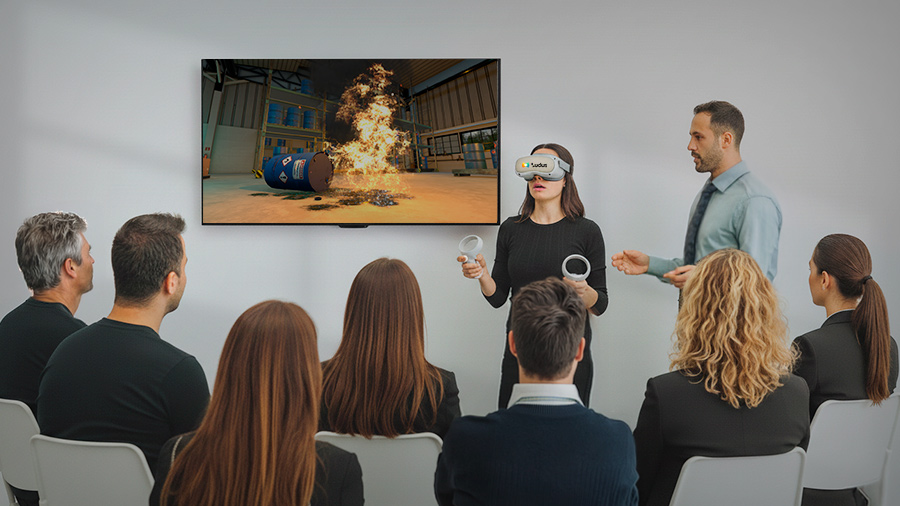
The headline industry figure is 219% ROI over three years with payback in under six months. It comes from a Forrester Total Economic Impact study modelling a composite organisation of 10,000 employees with 3,300 trained in VR: $6.1 million in benefits against $1.9 million in costs, net present value $4.2 million.
Before you put that in a slide, three things you need to know about it. The study was commissioned by Meta. It was built from interviews with four organisations. And the "composite organisation" is a modelling construct, not a real company. None of that makes it worthless, but it makes it directional evidence rather than proof — and a competent CFO will find all three facts in about four minutes.
The defensible move is to use industry figures to establish that the category works, then build your actual number from your own cost base. This article shows how.
Last reviewed 27 July 2026. Hardware pricing and source disclosures updated.
Why Most VR Business Cases Fail Finance Review
Four failure patterns, in rough order of frequency.
Leading with incident reduction. It is the biggest number available and the hardest to defend. You cannot prove in advance that training will prevent an accident that has not happened. Finance knows this. Put incident reduction in a sensitivity case, never the base case.
Citing vendor-commissioned studies as independent. The Forrester figure is legitimate research, but it was paid for by a headset manufacturer. Present it as what it is and your credibility survives the discovery. Present it as neutral and it does not.
Ignoring the ongoing costs. Fleet management tooling, content updates, device replacement cycles, trainer time. A business case with only hardware and licence costs in it looks naive.
Using stale hardware prices. Meta Quest 3 pricing moved from $499 to $599.99 in April 2026 on the back of the DRAM shortage. Any model built on last year's figures is already wrong.
The Cost Side
Hardware. $349.99 for a Meta Quest 3S, $599.99 for a Quest 3, $699 for a PICO 4 Ultra Enterprise. Most programmes need two to four devices per site. Assume a three-year replacement cycle.
Platform subscription. Varies by seat count and vendor model. The structural question is whether you are buying a platform with everything included or a marketplace where each module is a separate line item. Ludus licences unlimited access to 23 products and 700+ exercises across VR and Mixed Reality, which makes the subscription a single predictable number rather than a running total.
Content development. Bespoke scenario builds typically start around $40,000 per module. This is the line that off-the-shelf libraries remove entirely, and for most HSE programmes it is the difference between a viable case and a dead one.
Fleet management. MDM tooling for XR (ArborXR, ManageXR, or vendor-native equivalents). Small per-device cost, frequently omitted, always eventually necessary.
Trainer time. Onboarding your trainers, then their time running sessions. In the Deepsea Networks deployment, an OPITO-certified instructor trained the vessel's own HSE Advisor to run subsequent sessions independently — which moves most of this cost out of the recurring model after the first visit.
The Benefit Side, Ranked by How Well Each One Defends
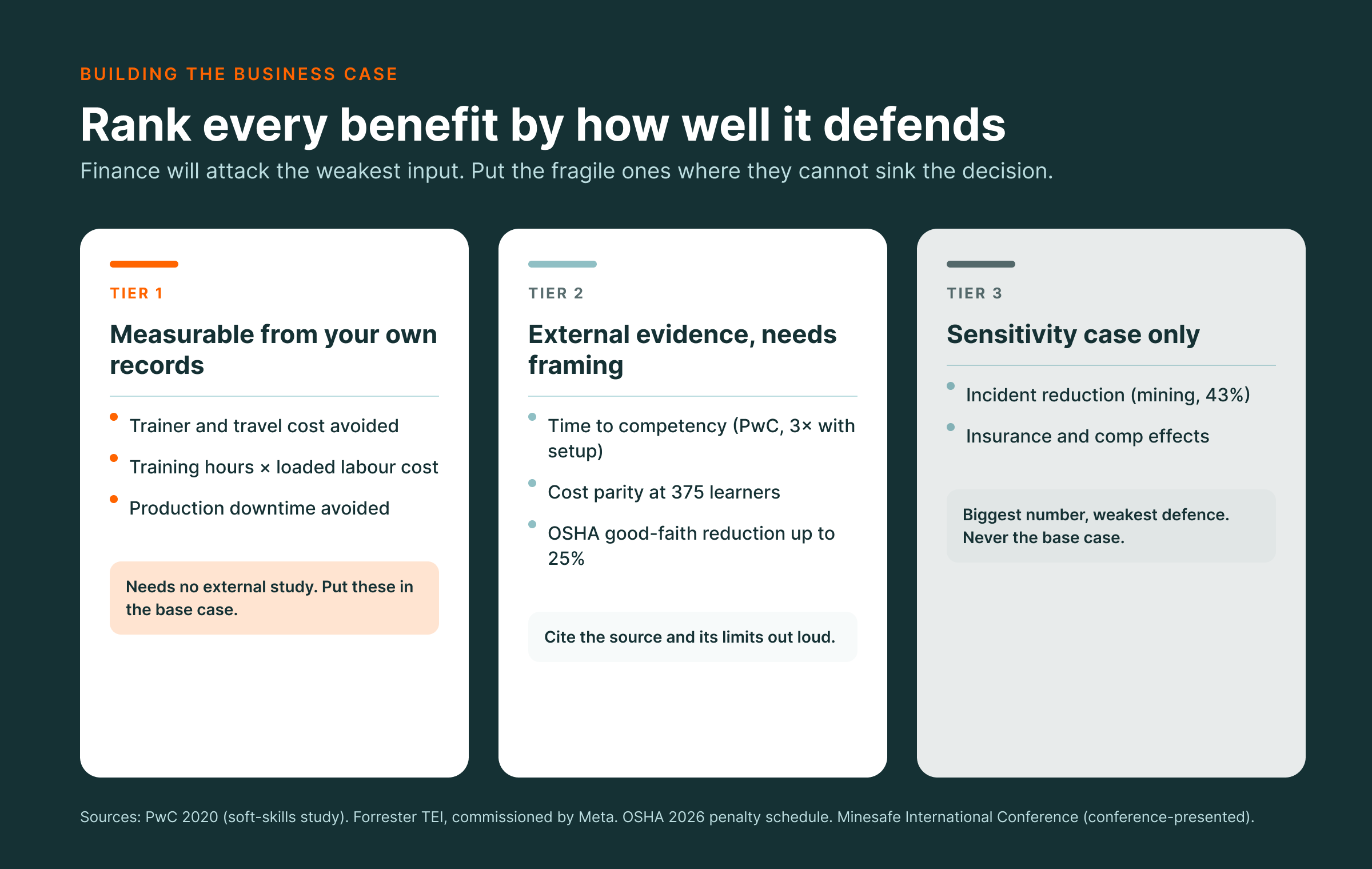
Tier 1: measurable from your own records
Trainer and travel cost avoidance. You know what you spent last year flying instructors to sites or backfilling shifts during training. This is the strongest line in any VR business case because it needs no external study at all.
Training time reduction. Also measurable from your own data. Multiply hours saved by loaded labour cost. Walmart's most-quoted result — an eight-hour course compressed to fifteen minutes — was operational rather than safety training, so use it as an illustration of the mechanism rather than as your assumption.
Production downtime avoidance. If training currently requires taking a line down, this can be the largest single number in the model, and it comes straight from your own operational data.
Tier 2: supported by external evidence, needs framing
Faster time to competency. PwC found VR learners completed training four times faster than classroom learners, or three times faster once headset orientation for first-time users is included. Use the three times figure. Note that PwC tested soft skills rather than safety procedures.
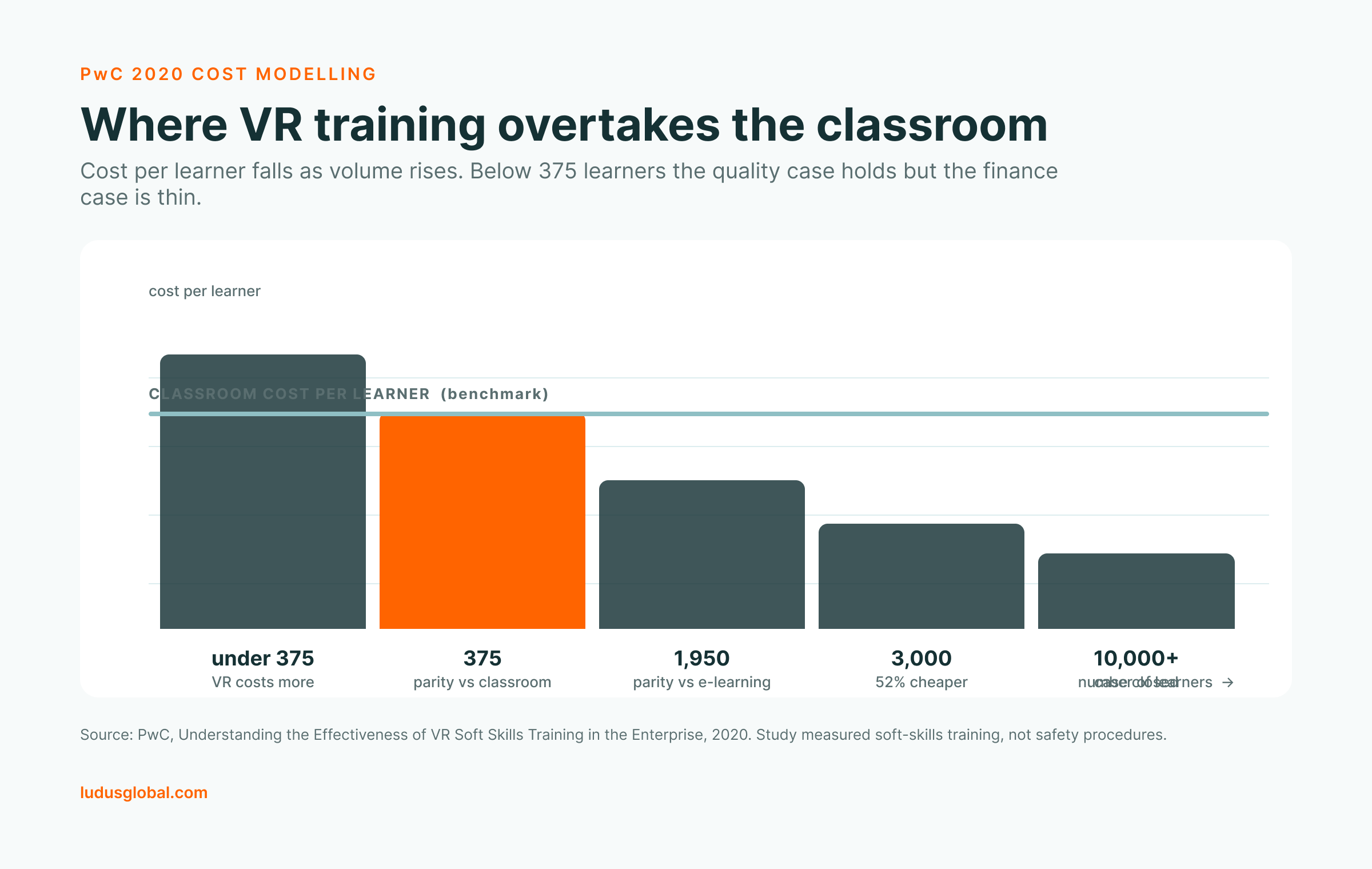
Cost parity at scale. PwC's modelling puts parity with classroom at 375 learners, parity with e-learning at 1,950, and 52% cheaper than classroom at 3,000. This is the most useful single input for deciding whether you clear the bar.
Penalty reduction. OSHA applies a good-faith reduction of up to 25% for employers with effective safety programmes and documented training, on top of size-based reductions of up to 60% for employers under 250 employees and up to 10% for clean history. Against 2026 maximums of $16,550 per serious violation and $165,514 per willful or repeat violation, and given penalties apply per violation rather than per inspection, this is a real and quantifiable control. Most business cases miss it entirely.
Tier 3: sensitivity case only
Incident reduction. The largest potential benefit and the least defensible in advance. The strongest available reference is a 43% reduction in lost time due to injury in mining following VR safety training, from research presented at the Minesafe International Conference. That is conference-presented rather than peer-reviewed. Present it as an upside scenario with the qualification attached.
Insurance and workers' compensation effects. Real, but slow and hard to attribute. Mention, do not model.
A Worked Example
A manufacturer with 1,400 operators across four European sites, currently running annual classroom refreshers plus one live drill per site.
Current state. Instructor travel and fees across four sites. Operator time at loaded cost for a six-hour classroom day. One line shutdown per site for the live drill. Roughly 8,400 operator-hours consumed annually.
Proposed state. Eight headsets (two per site) at $699 each. Platform subscription covering all four sites. Two days of trainer onboarding. Sessions run by site HSE staff thereafter.
Base case benefits. Instructor travel and fees avoided. Operator hours reduced from six to roughly two per person per cycle. No line shutdown for the VR component. All three lines are calculable from the company's own prior-year spend, which means none of them depend on a third-party study.
Sensitivity case. Applying the mining sector's 43% lost-time reduction to the company's own historical lost-time cost, clearly labelled as an upside scenario drawn from conference-presented research in a different industry.
What makes this pass review: the base case does not rely on any external number. The external evidence appears only in the sensitivity case, correctly attributed. The CFO can attack the sensitivity case without touching the base case, which means the decision survives the argument.
Deployment Evidence Worth Citing
These are named, published results rather than modelled ones.
Deepsea Networks, offshore drillship. Roughly three times the crew participation of a standard offshore refresher session, with zero technical setup required from the vessel team. Relevant because participation rate is a leading indicator most programmes never move.
Europreven, external prevention service. More than 7,000 workers trained on-site and over 2,000 remotely across Italy, Saudi Arabia and the Netherlands. Relevant to any organisation delivering training across borders.
Rail-sector multinational. 2,700 employees trained across multiple countries within months, standardising the programme across sites with in-person delivery for plant operators and remote delivery for office staff.
Verizon. 97% of more than 22,000 frontline retail associates reported feeling better prepared to handle a dangerous situation after VR training. Vendor-published, but a large and specific sample.
Renewal rate. Ludus reports a 97% annual subscription renewal rate across 250+ customers including Henkel, Coca-Cola, Ford, Moeve, Lear, DHL, Owens Corning and UNOPS. In a business case this is worth more than any single case study, because renewals are hundreds of independent decisions to keep paying rather than one story told well.
The Four Inputs to Gather Before You Start
- Last year's total spend on external safety trainers, including travel
- Operator hours consumed by safety training, times loaded labour cost
- Production downtime attributable to training, in hours and in margin
- Your OSHA or equivalent inspection history, and whether you currently qualify for the good-faith reduction
With those four numbers, the base case builds itself and does not need a single industry statistic to stand up.
If you want to pressure-test the model against a live platform, running one of your own hazard scenarios is the fastest way to check whether the content depth supports the assumptions.
Frequently Asked Questions
What is the ROI of VR safety training?
The most-cited figure is 219% over three years with payback under six months, from a Forrester TEI study of a composite 10,000-employee organisation. That study was commissioned by Meta and built from four interviews. Treat it as directional.
At what scale does VR beat classroom on cost?
Parity at 375 learners, 52% cheaper at 3,000, per PwC's modelling.
What should I not put in the base case?
Incident reduction. It is the biggest number and the least defensible in advance. Put it in a sensitivity case.
What is the strongest benefit line?
Trainer and travel cost avoidance, because it comes from your own records and needs no external study.
Can training reduce an OSHA penalty?
Yes, by up to 25% under the good-faith reduction, stacked with size and history reductions.
What are current hardware costs?
$349.99 Quest 3S, $599.99 Quest 3, $699 PICO 4 Ultra Enterprise. Quest 3 pricing rose in April 2026 — check any model built on earlier figures. Ludus offers the headset on a hire basis alongside its VR training platform.
How do I avoid the $40,000 content build cost?
Choose a platform with a ready-built library covering your hazards. Custom development is only necessary for genuinely site-specific scenarios that no library covers.
What payback period is realistic?
The Forrester model says under six months for a 10,000-employee composite. For a mid-sized industrial employer building from trainer and travel avoidance alone, 12 to 18 months is a more conservative and defensible planning assumption.
Methodology and Disclosure
Disclosure on the Forrester study. The 219% ROI figure comes from a Total Economic Impact study commissioned by Meta, based on interviews with four organisations using Meta Quest for training, aggregated into a composite 10,000-employee organisation with 3,300 trained. TEI is a recognised methodology, and the sponsorship and sample size are both material context.
Disclosure on PwC. The 2020 study measured soft-skills training — specifically inclusive leadership — not safety procedures. The mechanism transfers plausibly. The measurement does not transfer directly.
Disclosure on the mining figure. The 43% lost-time reduction comes from research presented at the Minesafe International Conference, which is conference-presented rather than peer-reviewed.
Removed: a claim of 300% ROI over five years attributed to Intel appears in earlier Ludus content and in wider industry material. No primary source is locatable and it should not be used.
Note on hardware pricing: earlier Ludus articles quote approximately $499 for a Meta Quest 3. That figure is superseded following the April 2026 increase to $599.99.
Sources
- Forrester Consulting. Total Economic Impact of Meta Quest. Commissioned by Meta, 2025.
- PwC. Understanding the Effectiveness of VR Soft Skills Training in the Enterprise. 2020.
- OSHA. 2026 Annual Adjustments to Civil Penalties. Effective 15 January 2026.
- U.S. Bureau of Labor Statistics. National Census of Fatal Occupational Injuries in 2024. USDL-26-0230.
- Minesafe International Conference. VR safety training research.
- Strivr. Walmart and Verizon customer stories.
- Ludus Global. Deepsea Networks and Europreven case studies. ludusglobal.com/en
Related Reading
- VR training statistics 2026: 40 verified numbers
- VR training simulator: how to choose the hardware in 2026
- What is VR safety training?
- Best safety training software 2026: 11 platforms compared
- Deepsea drillship VR CPR case study
- All Ludus training simulations
---------------------------------------------------------------------------