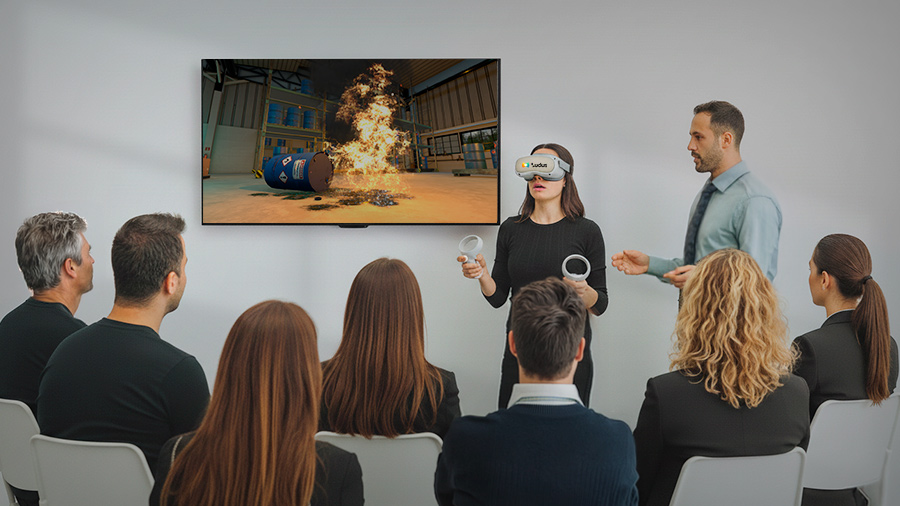
These two platforms are frequently shortlisted together and rarely compete for the same budget, because they solve problems at opposite ends of the employment lifecycle.
Transfr prepares people for jobs. It is a workforce development platform, sold predominantly to community colleges, workforce boards, state agencies and training providers across the United States. Its purpose is upward mobility: teaching someone the skills to enter a middle-skills career in manufacturing, healthcare, construction or the automotive trades.
Ludus trains people in jobs. It is an industrial HSE platform sold to employers and external prevention services, built around recurring safety obligations, competency evidence and audit records. It also serves a significant number of clients in the education sector, including schools and vocational training centres.
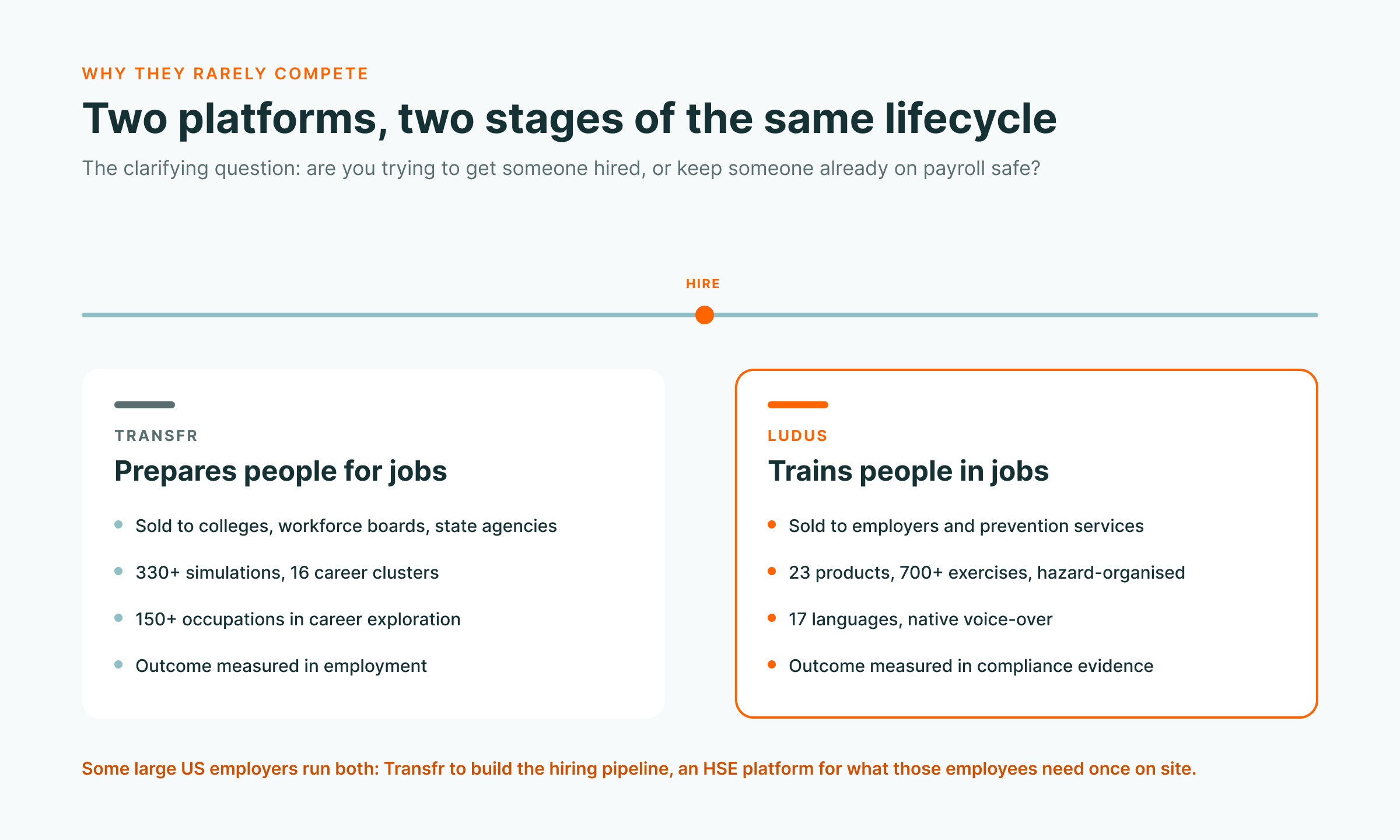
The clarifying question: are you trying to get someone hired, or trying to keep someone who already works for you safe and your training file defensible? Transfr is strong at the first. It is not built for the second.
Disclosure: published by Ludus. Transfr figures come from TechCrunch, Crunchbase, transfrinc.com and Transfr's own partner announcements, and are cited so you can verify them.
Where Each One Came From
Transfr was founded on a workforce mobility thesis. CEO Bharani Rajakumar has framed the company's target as "middle-skills" roles — jobs requiring more preparation than a high school diploma but less than a four-year degree. Those roles account for close to half the US labour market, while only around 40% of workers are trained to that level. The company has raised roughly $90 million in total, including a $40 million Series C led by ABS Capital, with participation from JPMorgan Chase Impact Finance and Advisory, Lumos Capital Group, Akkadian Ventures, Spring Tide Capital, Firework Ventures and Album.
The product reflects that thesis. Transfr Trek is career exploration, letting learners sample day-in-the-life simulations across more than 150 high-demand occupations. Transfr Train builds job-ready skills in manufacturing, healthcare, construction and automotive. A 2025 partnership with the AED Foundation added a toolkit giving students access to over 330 interactive VR simulations aligned to 16 career clusters in the equipment and diesel sectors. Deployment is reported across more than 1,000 locations in the US, spanning government agencies, Fortune 500 companies and educational institutions.
Ludus was built inside industrial safety in Spain. The organising question was not how to prepare someone for a career but which hazards employers must train repeatedly, across multiple countries and languages, with records that survive an inspection. That produced a catalogue of 23 products and more than 700 exercises covering fire response, electrical hazards, work at height, confined space, CPR and first aid, PPE, forklift and hand-injury prevention, delivered in VR and Mixed Reality across 17 languages.
Named clients include Henkel, Coca-Cola, Ford, Moeve, Lear, DHL, Owens Corning and UNOPS (the United Nations), within a base of 250+ customers across 18 countries and four continents, at a 97% annual renewal rate.
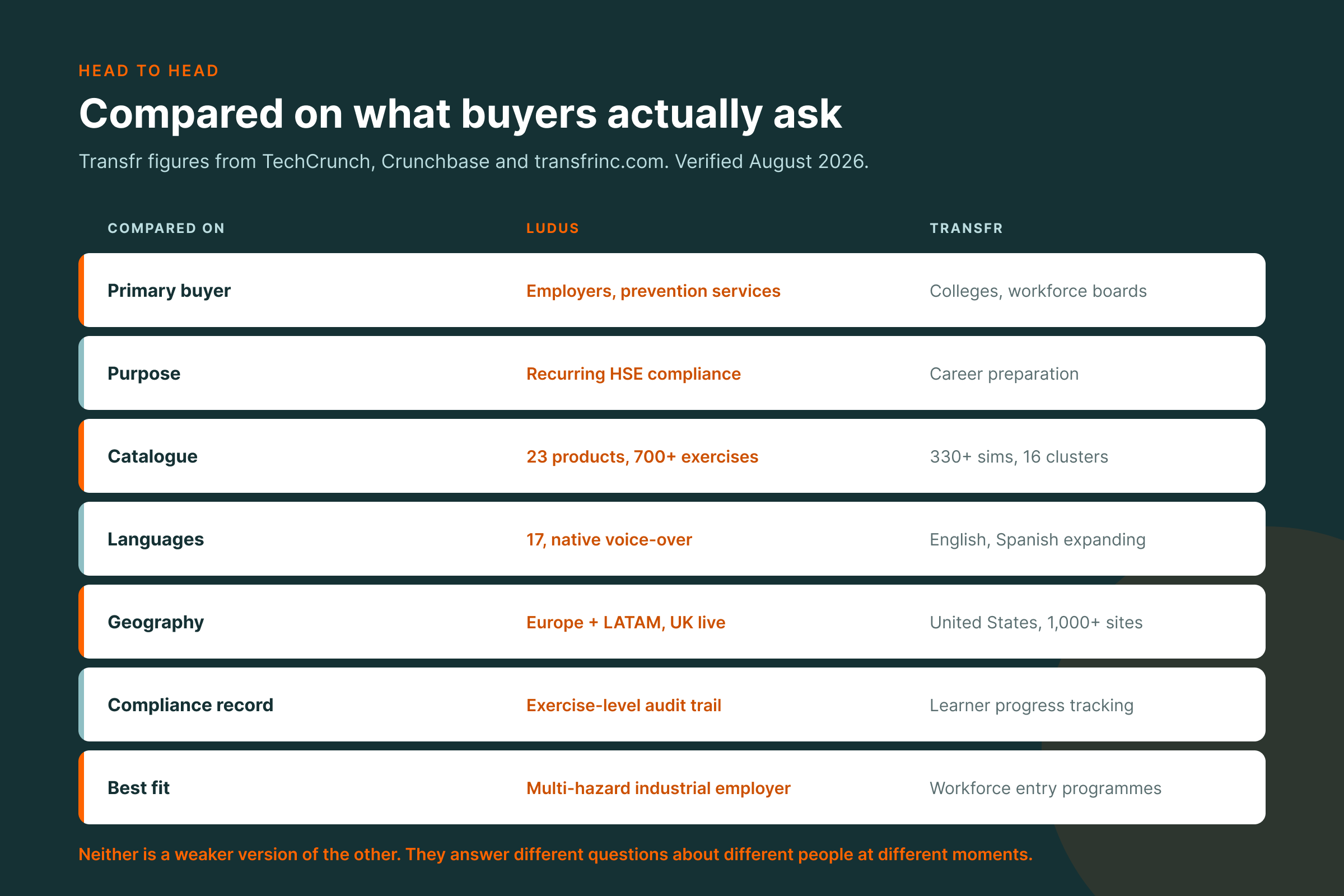
At-a-Glance Comparison
| Dimension | Ludus | Transfr |
|---|---|---|
| Primary buyer | Large companies and external prevention services | Community colleges, workforce boards, state agencies, training providers |
| Purpose | Recurring HSE compliance and competency evidence | Career preparation and workforce entry |
| Catalogue | 23 products, 700+ exercises, hazard-organised | 330+ simulations, 16 career clusters; 150+ occupations in Trek |
| Languages | 17, native voice-over and localised scenarios | English, with stated plans to expand Spanish |
| Named clients | Henkel, Coca-Cola, Ford, Moeve, Lear, DHL, Owens Corning, UNOPS | Alabama Ready to Work, JumpstartAL, Workforce Solutions of West Central Texas, AED Foundation |
| Geography | Europe and LATAM focus; Spain HQ, Mexico City LATAM office; UK live, Italy expanding | United States, 1,000+ locations |
| Funding | Privately held | ~$90M total, $40M Series C |
| Formats | VR and Mixed Reality | VR with digital coach guidance |
| Analytics | Predictive statistics panel; exercise-level logging, personalised reports per programme | Performance assessment and feedback per learner |
| Compliance orientation | Built around documented recurring training obligations | Built around skill acquisition and job readiness |
| Best fit | Industrial employer with recurring multi-hazard, multilingual obligations | Education or workforce body preparing people to enter skilled trades |
The Distinction That Matters Most: Compliance Cycles
A career-training platform teaches a skill once. A compliance platform teaches the same skill again, on a schedule, and proves it happened.
That is not a quality judgement about either product. It is a structural difference with direct operational consequences.
An employer subject to OSHA's general industry standards, or to Spain's Ley 31/1995 and Royal Decree 39/1997, is not simply obliged to train. They are obliged to train against site-specific hazards, in a language the worker understands, with a demonstration of competency, documented, and repeated periodically. When an inspector arrives, the artefact they ask for is the record.
For 2026 the exposure is $16,550 per serious violation and $165,514 per willful or repeat violation, applied per violation rather than per inspection. Less widely known is the reduction side: OSHA applies a good-faith reduction of up to 25% for employers demonstrating effective safety programmes and documented training. Competency records are therefore both an obligation and a financial control.
Ludus logs every exercise into a predictive statistics panel, from which a prevention manager extracts personalised reports per training programme and reads workforce-level patterns: which errors recur, which scenarios produce the most virtual accidents, where crews hesitate. That is the evidence layer a compliance programme runs on.
Transfr's assessment is oriented toward the learner's progress toward job readiness — the correct design for its buyer. It is not built to be the audit trail for an employer's recurring statutory obligations.
Language Coverage
Transfr operates in a domestic US market and has publicly signalled intent to expand its Spanish-language offering. That is a sensible priority for its buyer base.
Ludus ships in 17 languages with native voice-over and localised scenarios, which reflects a customer base spread across 18 countries on four continents. The practical test of that is Europreven, a Spanish external prevention service that trained more than 7,000 workers on-site and over 2,000 remotely across Italy, Saudi Arabia and the Netherlands. Separately, a rail-sector multinational trained 2,700 employees across several countries within months, running in-person sessions for plant operators and remote sessions for office staff on the same platform.
If your workforce operates in one language, this is not a differentiator. If it operates in six, it usually decides the shortlist before any other feature is discussed.
Hardware and Deployment
Both platforms run on standalone headsets and both have solved the fleet management problem, though differently.
Transfr manages its devices through ManageXR, giving control over device access, blocking unapproved applications, simplifying the home screen for first-time users and pushing content updates remotely. For a college running lab sessions with rotating students, that matters considerably.
Ludus is standalone-first with hand tracking, so trainees use their own hands rather than controllers, and the CPR simulation works with any standard manikin rather than a proprietary sensorised unit. The demanding test of that model was the Deepsea Networks drillship deployment, where the vessel team required zero technical setup and crew participation ran at roughly three times a standard offshore refresher session. Where a client lacks compatible hardware, devices can be rented rather than purchased.
One point relevant to both: Meta withdrew its commercial Quest SKUs in February 2026 and moved Horizon managed services into maintenance mode. Consumer devices remain enrollable through third-party MDM platforms including ManageXR and ArborXR, but any multi-year fleet plan should confirm the current position. Quest 3 pricing also rose to $599.99 in April 2026, up from $499.
When Each Is the Right Answer
Choose Transfr when you are a workforce board, state agency or training provider preparing people to enter skilled trades; when your outcome measure is employment rather than compliance; when your learners are pre-hire rather than on payroll; and when you operate primarily in English within the United States.
Choose an HSE platform when you employ the people being trained; when the training exists to discharge a legal obligation and produce records; when the same hazards must be retrained on a defined cycle; when your workforce spans multiple languages; and when an inspector may one day ask what evidence you hold. Also if you offer training to other companies as a service, or if you want to train students in an educational institution.
Use both when you are a large US industrial employer with a hiring pipeline problem and a compliance obligation. Transfr can prepare candidates before they arrive. An HSE platform handles what they need once they are on site. These are complementary rather than competing purchases, and treating them as alternatives is the most common analytical error in this comparison.
The quickest way to establish which side of the line you sit on: list the three hazards generating your incidents or audit findings, and ask each vendor to show you those exact scenarios running today, with the record they would produce.
See your own scenario in the Ludus simulator →
Frequently Asked Questions
What is the main difference between Ludus and Transfr?
Buyer and purpose. Transfr prepares people for careers, sold mainly to colleges, workforce boards and agencies. Ludus trains existing employees against HSE obligations and produces the compliance record.
Is Transfr suitable for OSHA compliance training?
Its catalogue includes foundational workplace safety within career preparation. It is not structured around recurring documented refresher cycles, which is what an employer's compliance file requires.
How large is Transfr?
Approximately $90 million raised in total, including a $40 million Series C led by ABS Capital. Reported in use across more than 1,000 US locations, with 330+ simulations across 16 career clusters.
Which supports more languages?
Ludus ships natively in 17. Transfr has stated plans to expand Spanish but publishes no comparable count.
Which has better analytics?
Different purposes. Transfr assesses learner progress toward job readiness. Ludus logs exercise-level data into a predictive statistics panel built for prevention managers tracking workforce error patterns.
Can they be used together?
Yes. Transfr before hire, an HSE platform after. They address different stages of the same lifecycle.
Which is better for a 3,000-person manufacturer in Europe?
An HSE platform, almost certainly. Transfr's model, market and language coverage are built around US workforce development rather than European industrial compliance.
What hardware does each need?
Both run standalone. Transfr manages fleets via ManageXR. Ludus runs hand-tracked, works with any standard CPR manikin, and offers hardware rental where a client lacks compatible kit.
Methodology
On sourcing Transfr. Funding, investor and scale figures come from TechCrunch reporting, Crunchbase, transfrinc.com product pages, the ManageXR customer story and the 2025 AED Foundation partnership announcement. Transfr does not publish list pricing, so no pricing comparison is offered here rather than presenting an estimate as fact.
On framing. This comparison treats Transfr as a workforce development platform because that is how the company describes itself and how its published deployments read. Positioning it as a failed HSE platform would misrepresent it. The purpose here is to help a buyer determine which category they are actually shopping in.
On Ludus figures. Platform data as supplied May 2026: 23 products, 700+ exercises, 17 languages, 250+ customers across 18 countries and four continents, 97% annual renewal.
Sources
- TechCrunch. Transfr, a VR platform for workforce training, raises $40M. 28 September 2023.
- Crunchbase. Transfr company profile.
- Transfr. Products: Transfr Train and Transfr Trek.
- ManageXR. Transfr customer story.
- EdTech Innovation Hub. Transfr and AED Foundation launch VR training for diesel and equipment careers. July 2025.
- OSHA. 2026 annual adjustments to civil penalties. Effective 15 January 2026.
- Ludus Global. Deepsea Networks and Europreven case studies. ludusglobal.com/en
Related Reading
- Best safety training software 2026: 11 platforms compared
- Ludus vs Strivr: which VR training platform fits an industrial HSE programme?
- Ludus vs PIXO VR
- VR safety training: 9 industries using it for high-risk work
- What is VR safety training?
- All Ludus training simulations
Written by Álex Gutiérrez, Content Marketing Specialist at Ludus. Methodology and full source list above. Last reviewed 19 August 2026.
---------------------------------------------------------------------------