Written for: EHS leads and L&D managers building an internal business case who have been asked "who else is doing this?" by a sceptical executive. Also useful if you are shortlisting vendors and want to know which sectors each one actually serves rather than which ones they claim.
Short answer
VR training is in production at large employers across manufacturing, energy, logistics, retail, healthcare, aviation and the public sector. Manufacturing and energy adopted it first and run it hardest, because those sectors have hazards that are expensive or dangerous to rehearse live.
A warning before the list: most published VR training results come from vendor case studies with no independent verification, no control group and no methodology. We have marked which claims can be traced to a named source and which cannot. If you are putting numbers in front of a CFO, use the first kind.
Before the list: how to read vendor claims
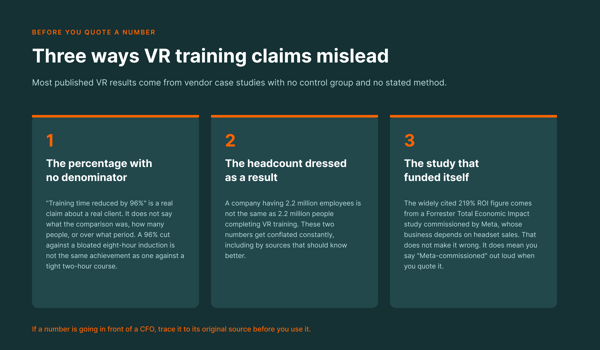
Three patterns to watch for, because you will meet all of them within an hour of searching.
The percentage with no denominator. "Training time reduced by 96%" is a real claim from a real vendor about a real client. What it does not say is what the comparison was, how many people, over what period, or whether the classroom course being replaced was any good. A 96% reduction against a bloated eight-hour induction is not the same achievement as a 96% reduction against a tight two-hour one.
The headcount dressed as a result. A company having 2.2 million employees is not the same as 2.2 million people completing VR training. These two numbers get conflated constantly, including by sources that should know better.
The study that funded itself. The widely cited 219% ROI figure for enterprise VR training comes from a Forrester Total Economic Impact study commissioned by Meta, whose business depends on headset sales. That does not make it wrong. It does mean you should say "Meta-commissioned" out loud when you quote it.
With that said, here is what is actually running.
Manufacturing
The sector with the longest production track record, because the hazards are standardised and the training obligations repeat annually.
Ford, Henkel, Lear, Owens Corning and Coca-Cola run VR safety training on the Ludus Global platform. The deployments cover lockout/tagout, confined space entry, fire response, working at height, forklift interaction and electrical isolation. Across the full Ludus base of more than 250 organisations, roughly 94,750 training sessions are completed annually, and subscription renewal sits at 97%.
Manufacturing has the strongest case for VR of any sector, and the fatality data explains why. US manufacturing recorded 355 workplace deaths in 2024, with 105 of them caused by contact with objects and equipment, according to the Bureau of Labor Statistics. Three of OSHA's ten most-cited standards in FY2025 were plant-floor standards: lockout/tagout at number four, powered industrial trucks at eight and machine guarding at ten.
More detail in our guide to VR safety training for manufacturing.
Energy, oil and gas
The sector where the cost of getting it wrong is highest, and the one where offshore logistics make live drills hardest to schedule.
Moeve runs VR safety training with Ludus. Across the wider sector, Shell and BP appear in published deployments with specialist oil and gas VR vendors.
The driver here is a fatality rate that does not behave like the rest of industry. The International Association of Oil and Gas Producers recorded 32 fatalities across 21 incidents in 2024, with an offshore fatal accident rate of 1.31 against 0.56 onshore. Contractors accounted for 26 of the 32 deaths. Explosions, fires and burns caused 41% of fatalities from just five incidents.
More detail in our guide to VR safety training for oil and gas.
Logistics and warehousing
DHL runs VR safety training with Ludus, covering forklift risks and warehouse hazards.
Warehousing is the sector where the pedestrian-and-vehicle interaction problem is sharpest. Powered industrial trucks were OSHA's eighth most-cited standard in FY2025 with 1,826 citations, and the standard requires an evaluation of each operator's performance at least once every three years, plus refresher training triggered by near misses, accidents or a change in truck type.
Retail
The sector with the largest published deployments by headcount, and the one where the published numbers need the most care.
Walmart is the most-cited retail example, running VR through Strivr across its US store network. Verizon and Bank of America also appear in Strivr's published customer list. These are genuine, large-scale deployments. The frequently repeated statistics attached to them, including the 96% training time reduction, come from the vendor rather than from an independent evaluation.
Retail VR training is mostly customer service, de-escalation and new-hire onboarding rather than hazard work. If you are in an industrial sector, these deployments tell you the technology scales. They tell you very little about whether it will reduce your incident rate.
Healthcare
Clinical skills, emergency response and procedural rehearsal.
Healthcare has the best independent evidence base of any sector, because medical education has been running controlled trials on simulation for decades. The evidence is strongest for procedural and psychomotor skills with clear pass criteria, and weakest for anything requiring real tissue feedback.
Ludus runs CPR training in healthcare and industrial settings, including the Deepsea drillship deployment where the constraint was a crew that could not reach shore-based training.
More detail in our guide to VR medical training.
Public sector and international organisations
UNOPS, the United Nations Office for Project Services, runs VR safety training with Ludus. Public-sector and intergovernmental deployments tend to be driven by multilingual and multi-site requirements rather than by cost per seat, because the alternative is flying trainers to field locations.
Aviation and defence
The sector that invented the category. Full-motion flight simulators predate consumer VR by fifty years and the training transfer evidence is better established here than anywhere else. Boeing and Airbus both use immersive training in production and maintenance contexts.
Worth noting for buyers: aviation's simulation success is regularly quoted as proof that VR works for workplace safety. It is not quite the same argument. Aviation simulators are high-fidelity, physically instrumented, and used by people training to a licensed standard over hundreds of hours. A 20-minute headset exercise is a different thing.
The pattern across sectors
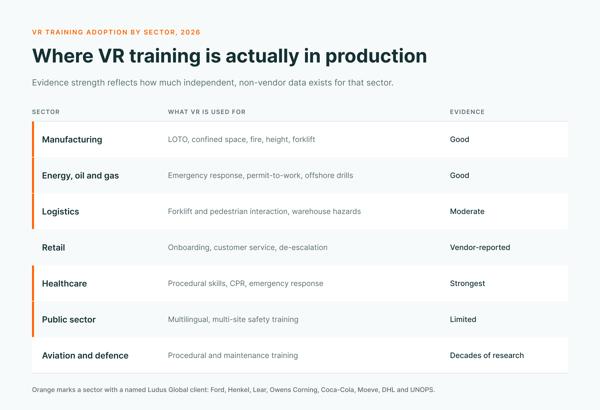
| Sector | What VR is used for | Strength of public evidence |
|---|---|---|
| Manufacturing | LOTO, confined space, fire, height, forklift | Good, backed by regulatory and injury data |
| Energy and oil and gas | Emergency response, permit-to-work, offshore drills | Good, with strong IOGP incident data |
| Logistics | Forklift and pedestrian interaction, warehouse hazards | Moderate |
| Retail | Onboarding, customer service, de-escalation | Large scale, vendor-reported results |
| Healthcare | Procedural skills, CPR, emergency response | Strongest independent research base |
| Public sector | Multilingual, multi-site safety training | Limited published data |
| Aviation and defence | Procedural and maintenance training | Decades of transfer research |
The honest read across all of it: adoption is real and growing, the technology is past the novelty stage, and the published effectiveness numbers are far less reliable than the adoption numbers.
What the research actually supports
Three findings hold up reasonably well across the independent literature.
Emotional engagement is the mechanism, not the graphics. A 2025 study in Engineering, Construction and Architectural Management put participants through a simulated accident and measured significant emotional arousal with a strong effect size, along with distress, guilt, fear and shame. That emotional response is what makes the lesson stick, and it is the thing a slide deck cannot reproduce.
Transfer is strongest for decision-making, weakest for fine motor skill. Choosing the right extinguisher class under time pressure transfers well. Knowing how heavy a valve is does not.
Completion is not competence. Every platform reports completion rates. Very few report whether behaviour changed on the floor. Ask your vendor which they measure.
Our full review of the evidence, including where it does not support the sales pitch, is in when VR safety training works, and when it doesn't.
Questions to ask before you join the list
- Which companies in my sector, at my size, in my country, can I speak to directly?
- What is the source of every statistic in this proposal, and was it independent?
- What does the platform record about each session, and can I export it?
- Which of my specific hazards have a dedicated module today, not on a roadmap?
- What happens in year two, when the novelty has gone and completion rates drop?
Frequently asked questions
How many companies use VR for training?
There is no reliable public count. Figures circulating in listicles come from market-research summaries with undisclosed methodologies. What can be said with confidence is that VR training is in production at large employers across every industrial sector, and that adoption is concentrated among organisations with repeating regulatory training obligations.
Which industry uses VR training the most?
Manufacturing and energy, by a clear margin, because both have standardised hazards, annual retraining requirements, and live drills that are expensive to run. Retail has the largest single deployments by headcount but uses VR mostly for soft skills.
Are the published VR training results trustworthy?
Treat vendor case studies as directional, not evidential. Most lack a control group, a stated methodology or an independent reviewer. The academic literature is more reliable and more modest in its claims. When a number matters to your business case, trace it to its original source before you use it.
Do smaller companies use VR training?
Yes, increasingly, though the economics work differently. A shared headset pool makes VR viable well below the thousand-employee mark, but below roughly 50 operatives the per-seat cost rarely beats conventional training unless the hazard is unusually expensive to rehearse.
What does a company need before adopting VR training?
Written procedures for the hazards being trained. VR teaches people to follow a procedure correctly. If the procedure does not exist or is inconsistent between shifts, the technology will train people into the inconsistency.
Methodology and sources
Client names attributed to Ludus Global are confirmed by Ludus Global directly. Deployments attributed to other vendors are drawn from those vendors' own published customer listings and are labelled as vendor-reported where no independent verification exists. We have not independently audited any third-party deployment.
Injury and fatality figures are from the US Bureau of Labor Statistics Census of Fatal Occupational Injuries 2024 and the International Association of Oil and Gas Producers safety performance data for 2024. OSHA citation counts are preliminary FY2025 figures announced at the National Safety Council Safety Congress in September 2025.
This article names competitors and their clients. We have not removed or minimised competitor deployments, and where a competitor's published result is stronger than ours we have said so.
Reviewed and published 10 October 2026 by Álex Gutiérrez, Ludus Global.
Sources
- BLS. Census of Fatal Occupational Injuries Summary, 2024.
- Manufacturing Dive. Manufacturing deaths in the 2024 CFOI.
- OSHA Top 10 most-cited standards, FY2025.
- OSHA. 1910.178, Powered industrial trucks.
- Enhancing construction safety training through emotion-eliciting virtual reality. Engineering, Construction and Architectural Management, 2025.
Related reading
- VR safety training for manufacturing
- VR safety training for oil and gas
- When VR safety training works, and when it doesn't
---------------------------------------------------------------------------