Written for: EHS and HSE managers who have found Humulo through its comparison content and need to work out whether a focused five-module product covers a multi-hazard or multi-country programme.
Evaluated: 15 September 2026. Humulo figures are drawn from humulo.com published material and cited so you can check them. Methodology note at the end.
The short answer
Humulo and Ludus are both purpose-built safety platforms rather than general VR training companies, which already separates them from most of the market. The difference is scope.
Humulo Virtual Reality is a single-product company based in Edgewater, Maryland, and describes itself as a Service-Disabled Veteran-Owned Small Business with roughly seven years of operation. Its catalogue centres on a small set of OSHA-aligned simulations: forklift operation, fire extinguisher use, lockout tagout, confined space entry and PPE selection. It sells per-module licences without subscription, and the modules run offline. Published customers include Department of Defense facilities across the Air Force and Navy, Kaiser Aluminum, Central Washington University and the University of Wisconsin.
Ludus licenses 23 products and more than 700 exercises in 17 languages under one unlimited licence, across VR and Mixed Reality, to 250-plus customers in 18 countries. Named clients include Henkel, Coca-Cola, Ford, Moeve, Lear, DHL, Owens Corning and UNOPS (the United Nations), with a 97% annual renewal rate.
The decision usually resolves on two questions: how many hazards do you need to train, and in how many languages.
Where Humulo is genuinely strong
Worth stating plainly, because a comparison that finds no merit in the alternative is not useful to a buyer.
The licensing model is buyer-friendly for narrow needs. Per-module purchase with no subscription lock-in means an organisation that needs forklift and lockout tagout and nothing else pays once rather than annually. If your requirement is genuinely that contained, this is a lower total cost than any subscription platform including ours.
Offline operation is a real advantage for facilities with restricted network access, which is part of why the Department of Defense customer base makes sense.
Single-product focus. Humulo's own positioning is that VR safety training is the entire business rather than one line among several, and that focus does tend to show in module quality.
If you are a US employer with two or three specific OSHA gaps, no multilingual requirement, and a preference for capital purchase over subscription, Humulo is a sensible choice and this comparison probably ends here.
Side by side
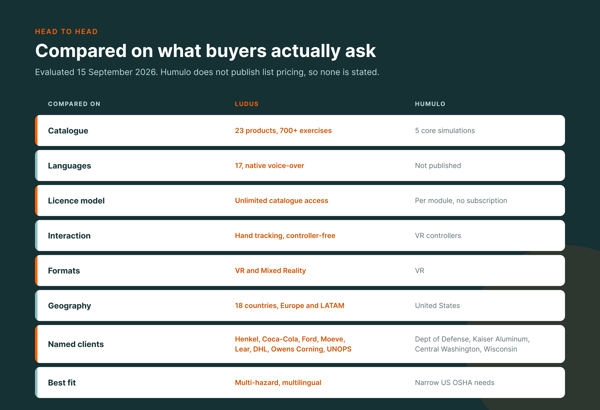
| Ludus | Humulo | |
|---|---|---|
| Company | Founded 2011, Bilbao | Edgewater, Maryland; SDVOSB, ~7 years |
| Catalogue | 23 products, 700+ exercises | 5 core simulations published |
| Hazards covered | Fire, electrical, work at height, confined space, LOTO, PPE, forklift, CPR and first aid, hand injury, waste, ergonomics, overhead crane, MEWPs | Forklift, fire extinguisher, LOTO, confined space, PPE |
| Languages | 17, native voice-over and localised scenarios | Not published |
| Licensing | Unlimited platform and product access under one licence | Per-module licence, no subscription |
| Offline | Yes, standalone-first | Yes |
| Interaction | Hand tracking, controller-free | VR controllers |
| Formats | VR and Mixed Reality | VR |
| Named clients | Henkel, Coca-Cola, Ford, Moeve, Lear, DHL, Owens Corning, UNOPS | Department of Defense, Kaiser Aluminum, Central Washington University, University of Wisconsin |
| Geography | 18 countries, 4 continents; Europe and LATAM | United States |
| Scale reference | 250+ customers, 97% annual renewal | Not published |
| Analytics | Predictive statistics panel, exercise-level logging | Progress and completion tracking |
| Best fit | Multi-hazard, multilingual, multi-site programmes | Narrow US OSHA compliance needs |
The catalogue question decides most evaluations
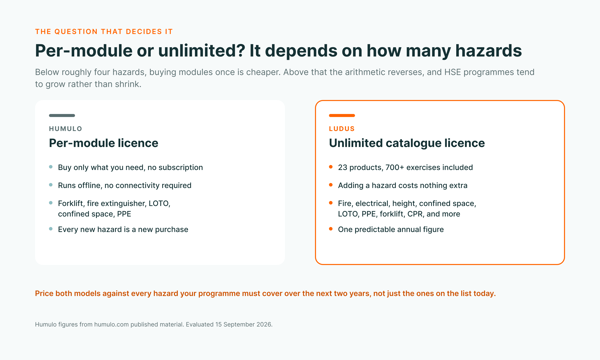
Under a per-module model, every hazard you add is a separate purchase. Under an unlimited licence, it is not.
For an employer training three hazards, per-module is cheaper. For one training ten, the arithmetic reverses, and it reverses faster than most buyers expect because HSE programmes tend to expand rather than contract. A confined space incident adds confined space training. A near miss on a mezzanine adds work at height. Two years in, the module count has doubled.
Ludus's catalogue covers the hazards a European or LATAM industrial employer typically carries across a full programme: fire response and extinguisher selection, electrical hazards, work at height including the electrical sector variant, confined space, lockout tagout, PPE, forklift and internal traffic, CPR and first aid, hand injury prevention, waste management, postural ergonomics, overhead crane and mobile elevating work platforms.
Humulo's published set covers five of those well. The gap is not quality, it is coverage.
Languages and geography
This is the cleanest dividing line between the two.
Humulo's documented customers are US federal, US higher education and US manufacturing. Nothing in its published material indicates multi-language delivery, and for its customer base there is no reason it would.
Ludus ships 17 languages with native voice-over and localised scenarios, operating from Bilbao and Madrid with presence across Spain, Mexico, Chile, Peru, Colombia, Argentina and Ecuador, plus an ambassador and partner network reaching Europe and the Middle East. The first UK client is live and Italy expansion is under way.
The practical demonstration is Europreven, a Spanish external prevention service that trained more than 7,000 workers on-site and over 2,000 remotely across Italy, Saudi Arabia and the Netherlands. Separately, a rail-sector multinational trained 2,700 employees across several countries within months.
If your workforce is entirely English-speaking and US-based, this section is irrelevant. If it is not, it is decisive.
Evidence, and one note on sourcing
Both companies publish efficacy claims. They are worth reading with different weight.
Humulo cites a Central Washington University study in which every participant reported improved comprehension and every participant wanted VR included in future training. Unanimous results on satisfaction measures are common in VR studies because the format is novel, so this tells you more about reception than about competence transfer, but it is a real study with a named institution.
Ludus publishes two deployment case studies with named participants. Deepsea Networks recorded roughly three times the crew participation of a standard offshore refresher session in a drillship CPR pilot, with zero technical setup required from the vessel team. Europreven documented the multi-country rollout above, with three named trainers on record.
One observation offered as a factual note rather than a criticism of the product. Several of Humulo's published comparison articles state that classroom training retains 8 to 10% at thirty days while immersive methods exceed 75%. That contrast originates in the NTL Learning Pyramid, for which no underlying study has ever been produced, and which the NTL Institute itself cannot substantiate. It circulates widely across the entire VR industry, including in material from vendors much larger than either company here. We exclude it from our own content, and any buyer comparing platforms should treat decks built on it with the same caution regardless of whose logo is on them.
When each is the right answer
Humulo fits when you are a US employer, your requirement is two to five specific OSHA modules, you have no multilingual need, you prefer per-module purchase to subscription, and offline operation matters.
Ludus fits when you train across many hazard types, you operate in more than one language, you need a single predictable licence rather than an expanding module count, you want exercise-level data rather than completion records, and your operations sit in Europe or LATAM.
The fastest way to settle it: list every hazard your programme must cover over the next two years, not just today, and price both models against that list. Per-module economics look very different at three modules than at twelve.
See your own scenario in the Ludus simulator →
Frequently asked questions
What is the main difference between Ludus and Humulo?
Scope. Humulo focuses on five OSHA-aligned modules sold per licence without subscription. Ludus licenses 23 products and 700+ exercises across 17 languages under one unlimited licence.
Does Humulo require a subscription?
No. It sells per-module licences and runs offline, which suits organisations with narrow, fixed requirements.
Which covers more hazards?
Ludus, substantially. Humulo publishes five core simulations; Ludus covers thirteen-plus hazard categories.
Which supports more languages?
Ludus ships 17 natively. Humulo publishes no multi-language count and its customer base is US-focused.
Who are their customers?
Humulo: Department of Defense facilities, Kaiser Aluminum, Central Washington University, University of Wisconsin. Ludus: Henkel, Coca-Cola, Ford, Moeve, Lear, DHL, Owens Corning and UNOPS, among 250+ customers.
Which is cheaper?
Depends entirely on module count. Below roughly three to four hazards, per-module purchase wins. Above that, an unlimited licence generally does, and HSE programmes tend to grow.
Do both work offline?
Yes. Both run standalone on headsets without ongoing connectivity.
Which has stronger deployment evidence?
Ludus publishes two named case studies with quantified outcomes and named participants. Humulo cites a university study on comprehension and satisfaction.
Methodology
Evaluation date: 15 September 2026.
How Humulo was assessed. All figures come from material published on humulo.com, including its own comparison articles, company description and customer references. Humulo does not publish list pricing, so no pricing figure is stated here rather than presenting an estimate as fact. Where its catalogue is described as five core simulations, that reflects what is published; the actual catalogue may be broader.
How Ludus figures were sourced. Platform data as supplied by Ludus Global: 23 products, 700+ exercises, 17 languages, 250+ customers across 18 countries and four continents, 97% annual renewal. Case study figures from the published Deepsea Networks and Europreven success stories.
Disclosure. This comparison is published by Ludus Global. We have identified where Humulo's model is stronger than ours and named the specific buyer profile for which we would not be the right choice.
On the retention figures. The 8-10% versus 75% retention contrast referenced in the evidence section is excluded from our own content because no underlying study exists. This is an industry-wide sourcing problem rather than a criticism specific to any one vendor.
Sources
- Humulo Virtual Reality. Company and comparison pages. humulo.com
- Ludus Global. Platform pages, Deepsea Networks and Europreven case studies. ludusglobal.com
- OSHA. 2026 annual adjustments to civil penalties. Effective 15 January 2026.
Related reading
- Ludus vs Strivr: which VR platform fits an industrial HSE programme?
- Ludus vs Transfr: talent development or industrial HSE compliance?
- VR safety training: 9 industries using it for high-risk work
- When VR safety training works (and when it doesn't)
- VR training ROI: the number your CFO will actually accept
- All Ludus training simulations
---------------------------------------------------------------------------