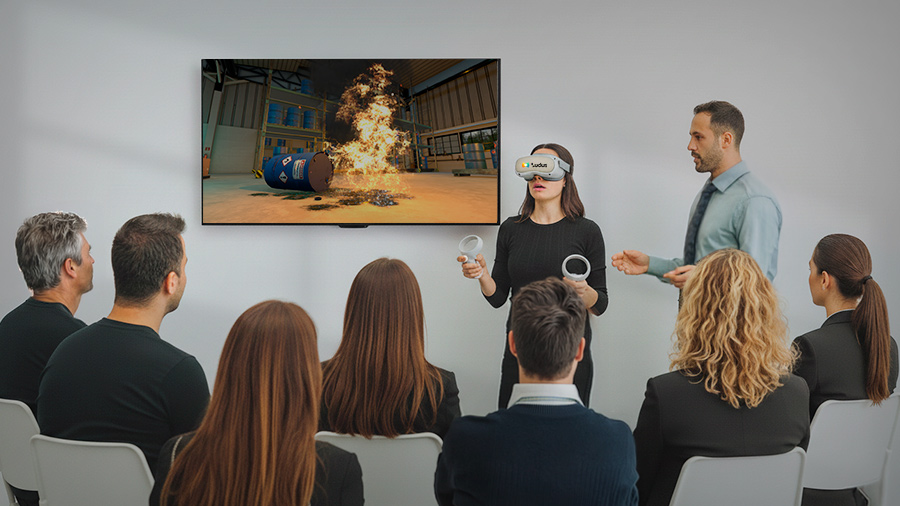
These two platforms are not really competing for the same budget, and a buyer who understands that will reach a decision faster.
Strivr is a custom immersive-content partner operating at Fortune 500 scale. It has completed more than two million VR training sessions and manages deployments including Walmart's 17,000+ headsets across 4,700 locations, alongside Bank of America and Verizon. Its strengths are behavioural analytics, 360-degree video production, and running enormous fleets across hundreds of locations.
Ludus is a ready-built industrial HSE platform. It ships 23 products and more than 700 exercises in 17 languages under one unlimited licence, used by Henkel, Coca-Cola, Ford, Moeve, Lear, DHL, Owens Corning and UNOPS (the United Nations) among 250+ customers across 18 countries, with a 97% annual renewal rate.
The practical dividing line: if your hazards are already covered by an existing safety catalogue, buying that catalogue is dramatically cheaper than commissioning custom scenarios. If your training need is genuinely bespoke, at very large scale, and you have the budget for a build, Strivr's model exists for exactly that.
Disclosure: this comparison is published by Ludus. Strivr's figures come from Strivr's own customer pages and from independent 2026 buyer guides, and are cited so you can check them. Where those sources conflict, the conflict is shown rather than resolved in our favour.
Where Each Platform Came From
Understanding the origin explains most of the differences.
Strivr began in sports performance, working with American football teams before moving into enterprise training. Based in Palo Alto and backed by more than $50 million in venture funding, it built its reputation on 360-degree video capture: filming real environments and real actors, then constructing training around that footage. The Verizon armed-robbery simulation is the clearest example, built from existing in-store security camera footage plus new 360-degree footage shot with hired actors in an actual Verizon store, delivered as three modules with debriefs between them. That is production work, and it is very good production work.
Ludus began in industrial safety in Bilbao, and built a catalogue rather than a studio. The organising question was not "what can we film for this client" but "what hazards do industrial employers need to train, repeatedly, across many countries and languages." That produced a library covering fire, electrical, work at height, confined space, CPR and first aid, PPE, forklift, hand-injury prevention and more, in VR and Mixed Reality, on standalone headsets.
Neither origin is better. They produce genuinely different products.
At-a-Glance Comparison
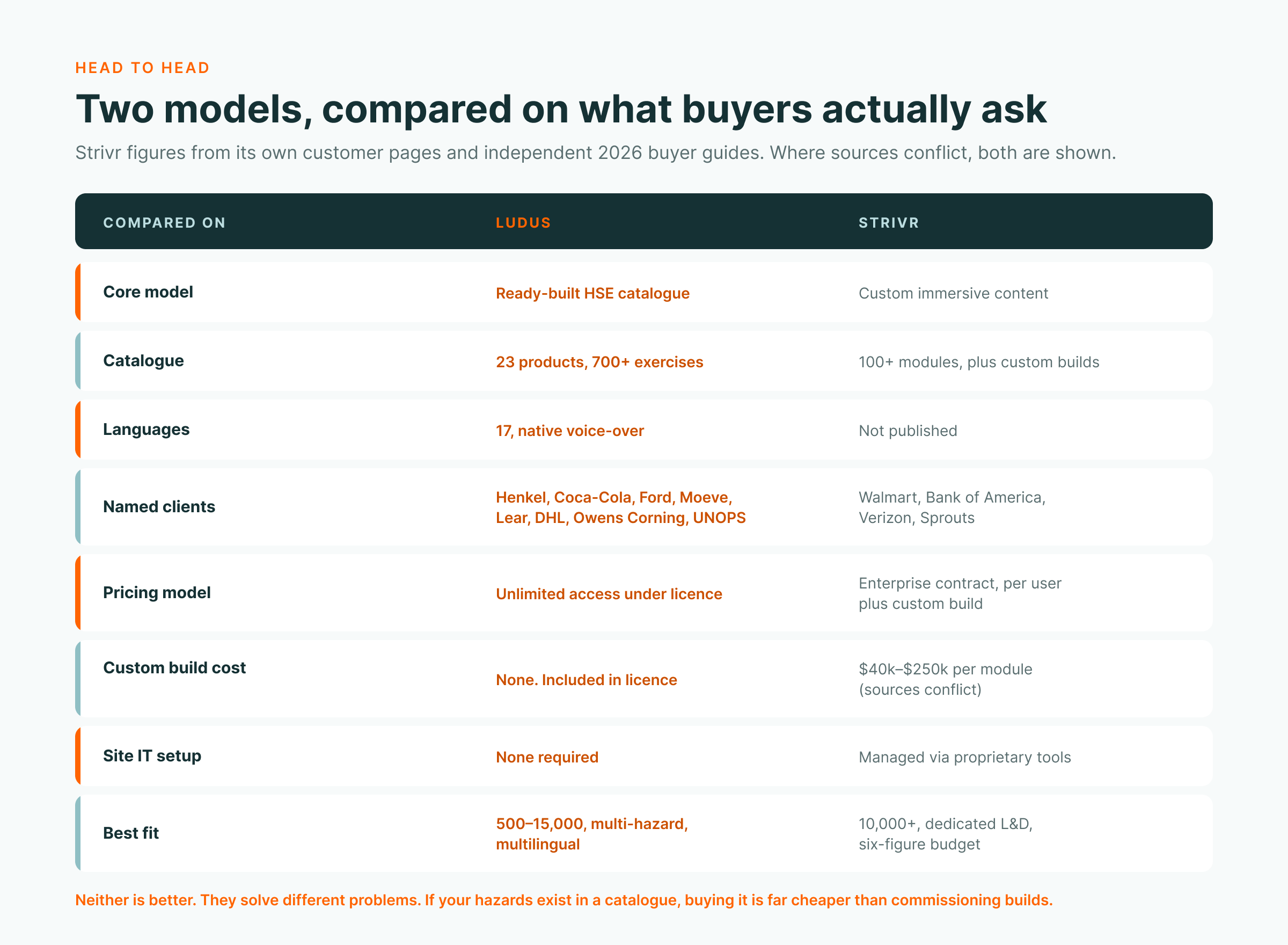
| Dimension | Ludus | Strivr |
|---|---|---|
| Core model | Ready-built HSE catalogue, unlimited licence | Custom immersive content, enterprise contract |
| Catalogue | 23 products, 700+ exercises | 100+ modules (third-party guides); custom builds per client |
| Languages | 17, native voice-over and localised scenarios | Not published; localisation scoped per project |
| Named clients | Henkel, Coca-Cola, Ford, Moeve, Lear, DHL, Owens Corning, UNOPS | Walmart, Bank of America, Verizon, Sprouts |
| Scale reference | 250+ customers, 18 countries, 4 continents, 97% renewal | 2M+ training sessions; Walmart 17,000+ headsets across 4,700 locations |
| Hardware | Standalone-first, hand tracking, any CPR manikin | Meta Quest 2/3 or Pico 4 Enterprise, proprietary fleet tooling |
| Formats | VR and Mixed Reality | VR, strong 360-degree video production |
| Analytics | Predictive statistics panel, exercise-level logging, personalised reports | Behavioural analytics tracking gaze, movement and decision patterns |
| Pricing model | Unlimited platform and product access under licence | Enterprise contract; per-user plus custom build costs |
| Published pricing | Quoted per deployment | ~$50K/yr for 100 users; $200–500/employee/yr; custom modules $40K–$250K (all third-party estimates) |
| Deployment | No site-level IT setup required | 4–8 weeks (one source); 3–6 months (another) |
| Geography | Bilbao HQ, Mexico City LATAM, partner network across LATAM/Spain/Europe/Middle East; UK and Italy expanding | Palo Alto; US-centred enterprise base |
| Best fit | Multi-hazard industrial HSE, multilingual, 500–15,000 employees | Custom training at 10,000+ employees with dedicated L&D and six-figure budgets |
Catalogue Depth Is the Decision Most Buyers Get Wrong
The temptation in a VR evaluation is to judge platforms on the quality of the demo. Both platforms demo well. The question that actually determines cost is: how many of your hazards already exist as finished scenarios?
Under a custom-build model, every hazard you want to train is a separate development project. Third-party estimates for Strivr custom content range from $40,000–$50,000 per experience in one source, and $75,000–$250,000 per module in another, depending on complexity. Even at the low end, an industrial employer wanting fire, electrical, confined space, work at height, forklift and CPR is looking at six scenario builds before anyone puts a headset on.
Under a catalogue model, those scenarios already exist. Ludus's licence covers unlimited access to all 23 products and 700+ exercises, so the marginal cost of adding a hazard to your programme is zero. This is the single largest structural difference between the two approaches, and it is why the comparison usually resolves on budget rather than preference.
The honest counterpoint: a catalogue only helps if it covers your hazards. If your training need is a specific proprietary process on a specific piece of plant that no library will ever contain, a custom partner is the correct answer and Strivr is one of the strongest in that category.
The Safety Catalogue Question
This is the part of the comparison where independent sources are more useful than either vendor.
Strivr's public safety work is genuinely strong in emergency response. The active-shooter module is one of the few dedicated armed-attack response simulations on the market. Verizon reported that 97% of its 22,000+ frontline retail associates felt more confident and prepared to navigate a dangerous situation after the training. Walmart's catalogue includes active shooter and tornado warning alongside customer service and operations modules.
What independent 2026 buyer guides note is that Strivr's safety training catalogue is limited compared with dedicated EHS platforms, and that organisations seeking OSHA-aligned forklift, lockout/tagout or fire safety training will likely need a different or complementary solution. That is a third-party assessment rather than our claim, and it is consistent with what Strivr itself emphasises: customer service, operations and soft skills at massive scale.
For an HSE manager whose programme is built around exactly those OSHA-aligned hazards, that gap is the whole decision. Ludus's catalogue covers fire response and extinguisher selection, electrical hazards and work at height in the electrical sector, confined space, LOTO, PPE, forklift and internal traffic, CPR and first aid, and hand-injury prevention.
Languages and Geography
Multilingual coverage is the requirement that quietly eliminates vendors from industrial shortlists, and it rarely surfaces until late in an evaluation.
Ludus ships 17 languages with native voice-over and localised scenarios, and operates from Bilbao with a LATAM office in Mexico City, supported by an ambassador and partner network across LATAM, Spain, Europe and the Middle East. The first UK client is live and expansion into Italy is underway. Deployment evidence spans borders: Europreven, a Spanish external prevention service, trained more than 7,000 workers on-site and over 2,000 remotely across Italy, Saudi Arabia and the Netherlands, and a rail-sector multinational trained 2,700 employees across several countries within months.
Strivr does not publish a comparable language count. Under a custom-build model, localisation is generally scoped as part of each project — workable, but it adds cost and time per language rather than shipping with the catalogue.
If your workforce operates in two languages, this difference is minor. If it operates in eight, it is decisive.
Analytics: Two Genuinely Different Philosophies
Both platforms take data seriously, and they point it at different questions.
Strivr captures behavioural signals during the session: gaze, movement, decision patterns, and in some configurations eye-tracking and reaction times. The orientation is performance measurement, which fits its origins in sports and its work in customer service and operations.
Ludus logs every exercise into a predictive statistics panel oriented around prevention. A prevention manager pulls personalised reports per training programme, then looks across the workforce for patterns: which errors recur, which scenarios generate the most virtual accidents, where crews hesitate. The intent is to surface unsafe behaviour as a leading indicator, before it appears in an incident report.
Both are legitimate. Which one you want depends on whether your question is "how did this person perform?" or "what is my workforce about to get wrong?"
Hardware and Deployment
Strivr's platform runs on Meta Quest 2/3 or Pico 4 Enterprise headsets managed through its own deployment tooling — a serious advantage at Walmart scale where 17,000+ devices need centralised control.
Ludus is standalone-first with hand tracking, so trainees use their own hands rather than controllers, and the CPR simulation works with any standard manikin rather than a proprietary sensorised unit. The practical test of that model was the Deepsea Networks drillship deployment, where the vessel team needed zero technical setup and crew participation ran at roughly three times a standard offshore refresher session. Where a client lacks compatible hardware, devices can be rented rather than purchased, keeping the capital decision separate from the platform decision.
One note relevant to both: Meta stopped selling commercial Quest SKUs in February 2026 and moved its Horizon managed services into maintenance mode. Consumer devices remain enrollable through third-party MDM platforms (ArborXR, ManageXR), but any multi-year fleet plan should confirm the current position rather than assume it.
Which One Fits Your Situation
A custom build is the right answer when your training need is genuinely unique to your operation, no catalogue will ever cover it, you have 10,000+ employees to amortise the cost across, you have a dedicated L&D function to manage the project, and six-figure annual commitments are within normal procurement. Strivr is among the strongest options in that category, and its Walmart, Bank of America and Verizon deployments demonstrate it.
A ready-built catalogue is the right answer when your hazards are the standard industrial set, you need several of them rather than one, you operate in more than a couple of languages, you want site teams to run sessions without IT involvement, and you would rather spend budget on frequency of training than on scenario development. That is the situation Henkel, Coca-Cola, Ford, Moeve, Lear, DHL, Owens Corning and UNOPS are in, and it is where Ludus is built to operate.
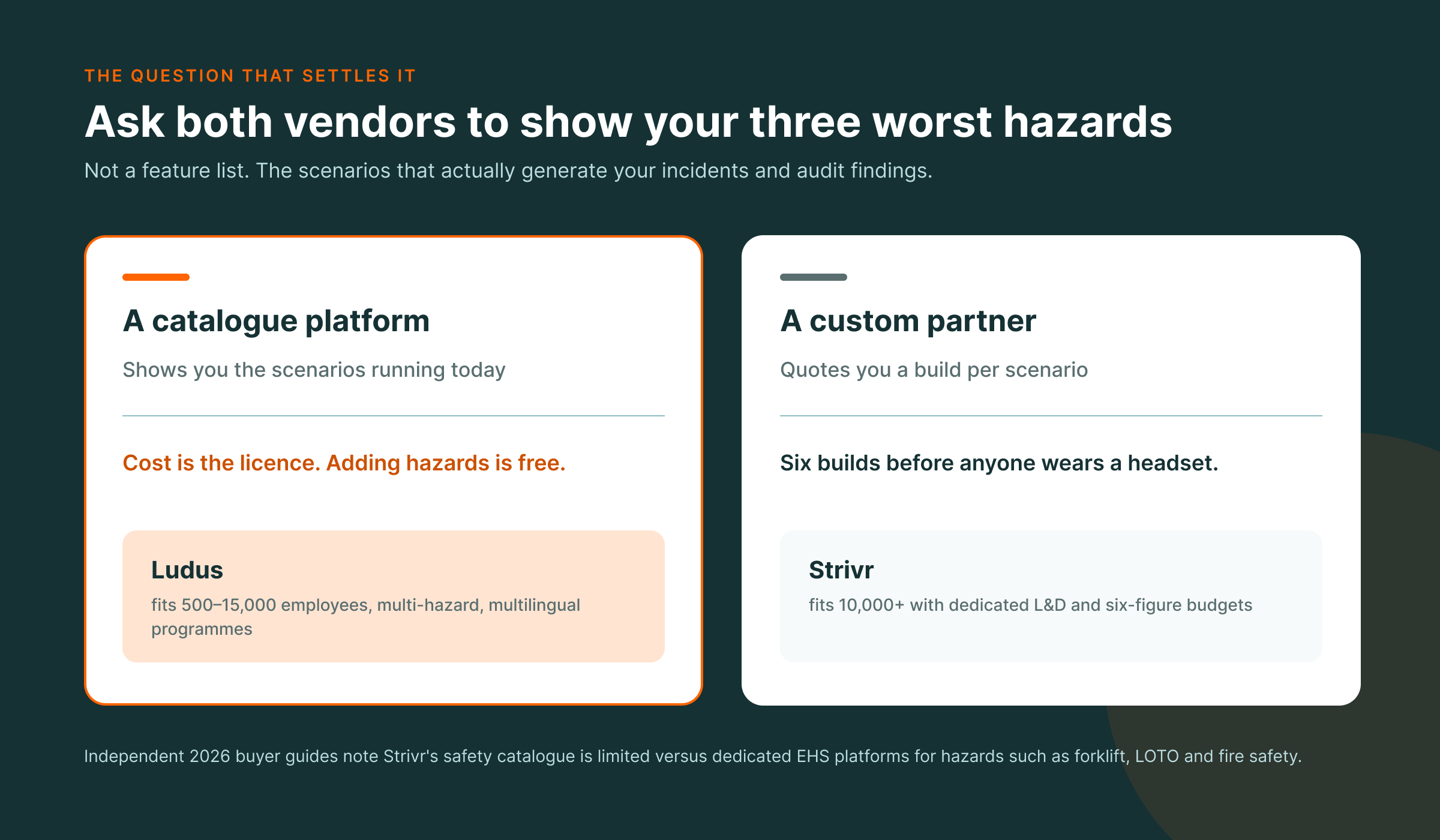
The fastest way to resolve it is not a feature list. Take your three worst hazards — the ones generating incidents or audit findings — and ask each vendor to show you those exact scenarios running today. A catalogue platform can show you immediately. A custom partner will quote you a build. That single question usually settles the decision within a week.
See your own scenario in the Ludus simulator →
Frequently Asked Questions
What is the main difference between Ludus and Strivr?
Strivr builds custom immersive experiences at Fortune 500 scale with deep behavioural analytics. Ludus ships a ready-built industrial HSE catalogue of 23 products and 700+ exercises in 17 languages under one unlimited licence.
Is Strivr good for OSHA safety training?
Its emergency-response work is strong, particularly the active-shooter module. Independent 2026 buyer guides note the wider safety catalogue is limited compared with dedicated EHS platforms for hazards such as forklift, LOTO and fire safety.
How do the two compare on price?
Strivr does not publish list pricing and third-party figures conflict: enterprise licences from around $50,000/yr for 100 users, $200–$500 per employee annually, and custom modules from $40,000–$250,000. Ludus licences unlimited catalogue access, removing per-module build cost.
Which supports more languages?
Ludus ships 17 natively. Strivr does not publish a comparable figure; localisation under a custom model is typically scoped per project.
Which has stronger analytics?
Different orientations. Strivr measures in-session behaviour including gaze and movement. Ludus logs every exercise into a predictive statistics panel built to surface workforce-level error patterns for prevention managers.
Which deploys faster?
Sources cite 4–8 weeks for a Strivr enterprise rollout and 3–6 months for full implementation in another source. Ludus runs standalone with no site-level IT setup, demonstrated in an offshore drillship deployment requiring zero setup from the vessel team.
Can they be used together?
Yes, and some large organisations do exactly that: a catalogue platform for standard HSE hazards, a custom partner for the handful of scenarios unique to the business.
Which is better for a 2,000-person manufacturer?
A ready-built catalogue almost always, because commissioning six custom scenario builds is difficult to justify at that headcount.
Methodology
On sourcing Strivr. Figures come from Strivr's own Walmart and Verizon customer pages and from independent 2026 buyer guides. Strivr does not publish list pricing, so pricing figures are third-party estimates presented as ranges.
On conflicting figures. Custom content pricing is cited at $40,000–$50,000 per experience in one source and $75,000–$250,000 per module in another. Deployment timelines are cited at 4–8 weeks in one source and 3–6 months in another. Session counts appear as 1.5 million on Strivr's 2024 blog and 2 million+ in later third-party summaries. These are shown as ranges rather than resolved, because resolving them in our own favour would not be honest.
On the Walmart figures. The 2.2 million number is the size of the associate workforce the programme was built to serve, not the number of sessions delivered. The 70% figure refers to the share of employees who performed better on evaluation exams, not a 70% increase in scores.
On excluded figures. The NTL Learning Pyramid retention claim (75% vs 5%) is excluded for lack of a traceable source.
Sources
- Strivr. Walmart customer story.
- Strivr. Verizon customer story.
- Strivr. Enterprise platform blog post, 2024.
- Independent 2026 enterprise VR training buyer guides and platform comparisons.
- U.S. Bureau of Labor Statistics. National Census of Fatal Occupational Injuries in 2024. USDL-26-0230.
- OSHA. 2026 annual adjustments to civil penalties. Effective 15 January 2026.
- Ludus Global. Platform pages, Deepsea Networks and Europreven case studies. ludusglobal.com/en
Related Reading
- Best safety training software 2026: 11 platforms compared
- Ludus vs PIXO VR
- Ludus vs Pixaera
- Ludus vs Immersive Factory
- VR training ROI: how to build the number your CFO will accept
- VR training simulator: how to choose the hardware in 2026
- All Ludus training simulations
Written by Álex Gutiérrez, Content Marketing Specialist at Ludus. Methodology and full source list above. Last reviewed 28 July 2026.
---------------------------------------------------------------------------